Welcome to LookChem.com Sign In|Join Free
  • or

Encyclopedia

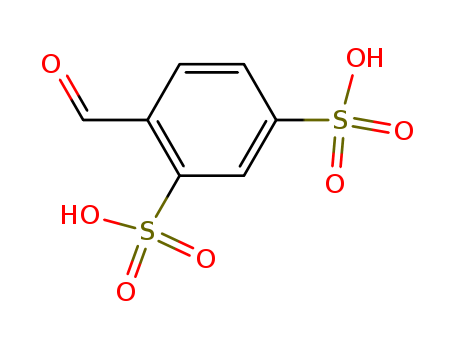
1,3-Benzenedisulfonic acid, 4-formyl-

Base Information
  • Chemical Name:1,3-Benzenedisulfonic acid, 4-formyl-
  • CAS No.:88-39-1
  • Molecular Formula:C7H6 O7 S2
  • Molecular Weight:266.252
  • Hs Code.:2913000090
  • European Community (EC) Number:201-826-6
  • DSSTox Substance ID:DTXSID7058965
  • Nikkaji Number:J168.595C
  • Wikidata:Q72444987
  • Mol file:88-39-1.mol
1,3-Benzenedisulfonic acid, 4-formyl-

Synonyms:2,4-disulfonic acid benzaldehyde;2,4-disulfonic acid benzaldehyde di-sodium salt;2,4-DSAD;benzaldehyde-2,4-disulfonic acid

Suppliers and Price of 1,3-Benzenedisulfonic acid, 4-formyl-
Supply Marketing:
Business phase:
The product has achieved commercial mass production*data from LookChem market partment
Manufacturers and distributors:
  • Manufacture/Brand
  • Chemicals and raw materials
  • Packaging
  • price
  • Crysdot
  • 4-Formylbenzene-1,3-disulfonicacid 95+%
  • 5g
  • $ 198.00
  • Crysdot
  • 4-Formylbenzene-1,3-disulfonicacid 95+%
  • 10g
  • $ 330.00
  • Chemenu
  • 4-Formylbenzene-1,3-disulfonicacid 95%
  • 10g
  • $ 405.00
  • BLDpharm
  • 4-Formylbenzene-1,3-disulfonicacid 95+%
  • 5g
  • $ 255.00
  • Biosynth Carbosynth
  • Benzaldehyde-2,4-disulfonicacid
  • 1 g
  • $ 400.00
  • Biosynth Carbosynth
  • Benzaldehyde-2,4-disulfonicacid
  • 2 g
  • $ 600.00
  • Biosynth Carbosynth
  • Benzaldehyde-2,4-disulfonicacid
  • 500 mg
  • $ 250.00
  • Biosynth Carbosynth
  • Benzaldehyde-2,4-disulfonicacid
  • 250 mg
  • $ 160.00
  • Biosynth Carbosynth
  • Benzaldehyde-2,4-disulfonicacid
  • 100 mg
  • $ 75.00
  • Arctom
  • 4-Formylbenzene-1,3-disulfonicacid 95%
  • 1g
  • $ 69.00
Total 36 raw suppliers
Chemical Property of 1,3-Benzenedisulfonic acid, 4-formyl-
Chemical Property:
  • Appearance/Colour:White crystal powder 
  • Melting Point:105-107°C 
  • PKA:-1.55±0.50(Predicted) 
  • PSA:142.57000 
  • Density:1.815 g/cm3 
  • LogP:2.15410 
  • XLogP3:-1.1
  • Hydrogen Bond Donor Count:2
  • Hydrogen Bond Acceptor Count:7
  • Rotatable Bond Count:3
  • Exact Mass:265.95549487
  • Heavy Atom Count:16
  • Complexity:452
Purity/Quality:

97% *data from raw suppliers

4-Formylbenzene-1,3-disulfonicacid 95+% *data from reagent suppliers

Safty Information:
  • Pictogram(s): Xi 
  • Hazard Codes:Xi 
MSDS Files:

SDS file from LookChem

Useful:
  • Canonical SMILES:C1=CC(=C(C=C1S(=O)(=O)O)S(=O)(=O)O)C=O
Technology Process of 1,3-Benzenedisulfonic acid, 4-formyl-

There total 4 articles about 1,3-Benzenedisulfonic acid, 4-formyl- which guide to synthetic route it. The literature collected by LookChem mainly comes from the sharing of users and the free literature resources found by Internet computing technology. We keep the original model of the professional version of literature to make it easier and faster for users to retrieve and use. At the same time, we analyze and calculate the most feasible synthesis route with the highest yield for your reference as below:

synthetic route:
Guidance literature:
With manganese(IV) oxide; sulfuric acid; at 30 - 120 ℃; Darst.;
Guidance literature:
With sodium sulfite;
Guidance literature:
in geschlossenem Gefaess;
Refernces

Polarography of some 2,1,3 benzothiadiazoles, benzofurazans, 2,1,3 benzoselenadiazoles, and 3,4 disubstituted and fused 1,2,5 thiadiazoles

10.1002/jhet.5570110519

The research aimed to investigate the redox behavior of various heterocyclic compounds, specifically 2,1,3-benzothiadiazoles, benzofurazans, 2,1,3-benzoselenadiazoles, and 3,4-disubstituted and fused 1,2,5-thiadiazoles, in acetonitrile solutions using mercury and platinum electrodes. The study focused on derivatives containing alkyl, phenyl, bromo, chloro, cyano, nitro, methylsulfonyl, and trifluoromethylsulfonyl groups. The findings indicated that all ring systems and their derivatives were reversibly reduced initially in a one-electron step to their respective radical anions, with the exception of nitro and bromo derivatives, which were reduced preferentially at the substituent group. The research concluded that the potential at which the production of the radical anion occurred became more anodic as the electron-withdrawing ability of the substituent and the number of substituents increased, providing insights into the redox behavior of these compounds and their potential applications in artificial media as electron-transfer agents for ATP synthesis.


Post a RFQ

Enter 15 to 2000 letters.Word count: 0 letters

Attach files(File Format: Jpeg, Jpg, Gif, Png, PDF, PPT, Zip, Rar,Word or Excel Maximum File Size: 3MB)

1 Customer Service

What can I do for you?
Get Best Price

Get Best Price for 88-39-1