10.1021/ja00204a015
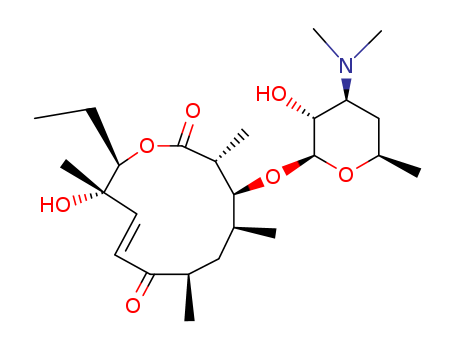
The research focuses on the total synthesis of d,l-methynolide, the aglycon of the macrolide antibiotic methymycin, utilizing sulfur-mediated ring expansion technology. The purpose of this study was to develop a synthetic approach that relies on sequential 2,3-sigmatropic rearrangements of stabilized sulfonium ylides to build cyclic sulfides of varying ring sizes and to achieve remote stereocontrol through the predictable conformational properties of medium-sized ring intermediates and the stereoelectronic effect of sulfur α to ketone carbonyl. The successful route involved the ring expansion of sulfonium ylide to an eight-membered sulfide, followed by conversion to alcohol and reduction of the double bond to form the saturated analogue. Key chemicals used in the process included sulfonium ylides, sulfides, alcohols, and various reagents for protection, oxidation, and reduction steps, such as lithium ethyl boranolate (LiEt3BH), methyltriphenylphosphonium bromide, potassium tert-butoxide, and p-toluenesulfonylhydrazide, among others. The conclusions of the research detailed the successful synthesis of d,l-methynolide and a similar route to ClO-epi-methynolide, demonstrating the efficacy of the sulfur-based strategy for remote stereocontrol in complex macrocycle synthesis.
10.1248/cpb.35.2196
Yuji Oikawa, Tatsuyoshi Tanaka, Tatsuo Hamada, and Osamu Yonemitsu detail a highly stereoselective synthesis of the seco-acid (3) of the aglycone methoxylactone (1) of the 12-membered macrolide antibiotic methicillin. The synthesis started from D-glucose and involved the Wittig-Horner coupling of two fragments (i and ii). Fragment i (4) was synthesized by kinetic acetalization with p-methoxybenzylide (MP) acetal protection, while fragment ii (5) was obtained from the Prelog-Djerassi lactone-type intermediate (2) through a series of reactions including protection, hydrolysis, reduction, and oxidation. Diethyl methylphosphonate, a widely used organic synthesis reagent, was used to synthesize fragment ii (5) to introduce the phosphonate group. The coupling of these fragments formed the ring-opened acid (3), which was confirmed by nuclear magnetic resonance (NMR) and mass spectrometry. This work represents a major advance in the synthesis of complex macrolide antibiotics, demonstrating the utility of noncyclic stereocontrolled approaches and the importance of careful choice of protecting groups to achieve high stereoselectivity.