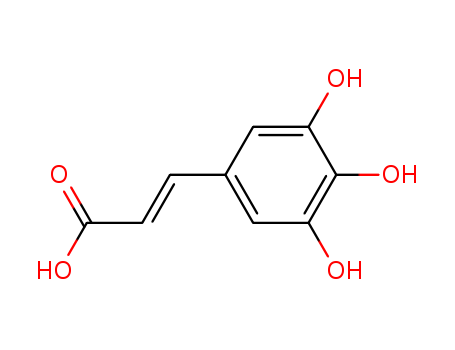
Chemical Property of 3,4,5-Trihydroxycinnamic acid
Chemical Property:
- Vapor Pressure:7.07E-11mmHg at 25°C
- Melting Point:207-208 °C (decomp)
- Boiling Point:501.5°Cat760mmHg
- PKA:4.53±0.10(Predicted)
- Flash Point:271.2°C
- PSA:97.99000
- Density:1.63g/cm3
- LogP:0.90120
- XLogP3:0.8
- Hydrogen Bond Donor Count:4
- Hydrogen Bond Acceptor Count:5
- Rotatable Bond Count:2
- Exact Mass:196.03717335
- Heavy Atom Count:14
- Complexity:225
- Purity/Quality:
-
95% *data from raw suppliers
3,4,5-TrihydroxycinnamicAcid *data from reagent suppliers
Safty Information:
- Pictogram(s):
- Hazard Codes:
- MSDS Files:
-
Useful:
- Canonical SMILES:C1=C(C=C(C(=C1O)O)O)C=CC(=O)O
- Isomeric SMILES:C1=C(C=C(C(=C1O)O)O)/C=C/C(=O)O
-
General Description
(E)-3-(3,4,5-Trihydroxyphenyl)acrylic acid, also known as 3,4,5-trihydroxycinnamic acid, is a trihydroxylated derivative of cinnamic acid structurally related to caffeic acid. It has been studied for its conformational properties using Raman spectroscopy and computational methods, highlighting its potential relevance in phenolic research. Additionally, trihydroxycinnamic derivatives, including (E)-3-(3,4,5-trihydroxyphenyl)acrylic acid, have demonstrated antioxidant and cytotoxic activities, with ester derivatives showing enhanced radical-scavenging effects in liposomal systems. Furthermore, hydroxycinnamic acid derivatives, such as those based on caffeic acid, have been explored for their neuroprotective potential, particularly in crossing the blood-brain barrier and exerting antioxidant effects within the central nervous system. These findings suggest that (E)-3-(3,4,5-trihydroxyphenyl)acrylic acid may have applications in antioxidant therapy and neuroprotection.