Welcome to LookChem.com Sign In|Join Free
  • or

Encyclopedia

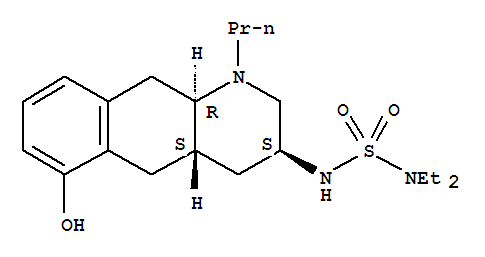
Quinagolide

Base Information
  • Chemical Name:Quinagolide
  • CAS No.:87056-78-8
  • Molecular Formula:C20H33 N3 O3 S
  • Molecular Weight:395.62
  • Hs Code.:
  • Nikkaji Number:J402.834A
  • Wikipedia:Quinagolide
  • Wikidata:Q4860568
  • NCI Thesaurus Code:C73310
  • Metabolomics Workbench ID:152151
  • ChEMBL ID:CHEMBL290962
  • Mol file:87056-78-8.mol
Quinagolide

Synonyms:CV 205-502;CV-205-502;CV205-502;N,N-diethyl-N'-(1,2,3,4,4a,5,10,10a-octahydro-6-hydroxy-1-propyl-3-benzo(g)quinolinyl)sulfamide hydrochloride, (3alpha,4aalpha,10abeta)-(+)-isomer;N,N-diethyl-N'-(1,2,3,4,4a,5,10,10a-octahydro-6-hydroxy-1-propyl-3-benzo(g)quinolinyl)sulfamide, (3alpha,4aalpha,10abeta)-(+-)-isomer;Norprolac;quinagolide;quinagolide hydrochloride;quinagolide hydrochloride, (3alpha,4aalpha,10abeta)-(+)-isomer;quinagolide hydrochloride, 3alpha,4aalpha,10abeta-(-)-isomer;quinagolide, (3alpha,4aalpha,10abeta)-(+-)-isomer

Suppliers and Price of Quinagolide
Supply Marketing:
Business phase:
The product has achieved commercial mass production*data from LookChem market partment
Manufacturers and distributors:
  • Manufacture/Brand
  • Chemicals and raw materials
  • Packaging
  • price
  • American Custom Chemicals Corporation
  • QUINAGOLIDE 95.00%
  • 5MG
  • $ 498.04
Total 22 raw suppliers
Chemical Property of Quinagolide
Chemical Property:
  • Vapor Pressure:3.11E-12mmHg at 25°C 
  • Melting Point:122.5-124° 
  • Boiling Point:539.1°Cat760mmHg 
  • Flash Point:279.8°C 
  • PSA:81.26000 
  • Density:1.23g/cm3 
  • LogP:3.54570 
  • XLogP3:3.1
  • Hydrogen Bond Donor Count:2
  • Hydrogen Bond Acceptor Count:6
  • Rotatable Bond Count:7
  • Exact Mass:395.22426310
  • Heavy Atom Count:27
  • Complexity:576
Purity/Quality:

99% *data from raw suppliers

QUINAGOLIDE 95.00% *data from reagent suppliers

Safty Information:
  • Pictogram(s): Human systemic effects reported. A reproductive hazard. 
  • Hazard Codes:Human systemic effects reported. A reproductive hazard. 
MSDS Files:

SDS file from LookChem

Useful:
  • Canonical SMILES:CCCN1CC(CC2C1CC3=C(C2)C(=CC=C3)O)NS(=O)(=O)N(CC)CC
  • Isomeric SMILES:CCCN1C[C@H](C[C@H]2[C@H]1CC3=C(C2)C(=CC=C3)O)NS(=O)(=O)N(CC)CC
  • Recent ClinicalTrials:Study Assessing the Effect of 3-week Treatment With One of Three Oral Doses of Quinagolide
  • Recent EU Clinical Trials:A randomised, double-blind, placebo-controlled, proof-of-mechanism phase 2 trial investigating the effect of quinagolide extended-release vaginal ring on reduction of lesions assessed by high-resolution magnetic resonance imaging in women with endometrioma, deep infiltrating endometriosis, and/or adenomyosis
  • Clinical Use Hyperprolactinaemia
  • Drug interactions Potentially hazardous interactions with other drugs None known
Refernces

Synthesis of 3-Azidopiperidine Skeleton Employing Ceric Ammonium Nitrate (CAN)-Mediated Regioselective Azidoalkoxylation of Enol Ether: Total Synthesis of D2 Receptor Agonist (±)-Quinagolide

10.1021/acs.orglett.8b02900

The research describes the total synthesis of (±)-quinagolide, a D2 receptor agonist used for treating elevated prolactin levels. The synthesis was achieved through a ceric ammonium nitrate (CAN)-mediated regioselective azidoalkoxylation of enol ether route, which allowed for the rapid construction of the piperidine ring and the nitrogen-containing side chain of quinagolide. Key steps in the process included the PPTS-catalyzed one-pot acetal deprotection followed by a diastereoselective Henry reaction, which enabled the construction of the required trans ring junction. The study also highlighted the first-of-its-kind synthesis of the 3-azidopiperidine skeleton using CAN-mediated regioselective azidoalkoxylation of enol ether. Chemicals used in the process included meta-hydroxybenzaldehyde, allyl bromide, K2CO3, dimethyl sulfate, 2,2-dimethyl-1,3-propanediol, OsO4-NMO, NaIO4, Wittig reagents, DBU, nitromethane, PPTS, FeCl3, PTSA, pyridine, DIBAL-H, MOM Wittig salt, potassium t-butoxide, NaN3, and various other reagents and solvents necessary for the reactions and purification steps. The synthesis concluded with the demethylation of compound 20 to afford quinagolide 4, with the analytical and spectral data obtained for quinagolide 4 being in complete agreement with the reported data.

Post a RFQ

Enter 15 to 2000 letters.Word count: 0 letters

Attach files(File Format: Jpeg, Jpg, Gif, Png, PDF, PPT, Zip, Rar,Word or Excel Maximum File Size: 3MB)

1 Customer Service

What can I do for you?
Get Best Price

Get Best Price for 87056-78-8