Welcome to LookChem.com Sign In|Join Free
  • or

Encyclopedia

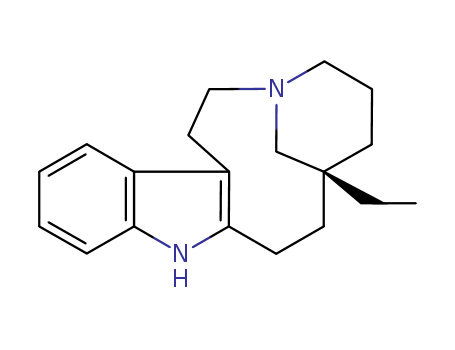
Quebrachamine

Base Information
  • Chemical Name:Quebrachamine
  • CAS No.:4850-21-9
  • Molecular Formula:C12H12N4
  • Molecular Weight:282.429
  • Hs Code.:
  • European Community (EC) Number:225-440-2
  • UNII:7M37I29KEU
  • DSSTox Substance ID:DTXSID50878438
  • Nikkaji Number:J16.330I
  • Wikidata:Q27105240
  • Metabolomics Workbench ID:68014
  • ChEMBL ID:CHEMBL552709
  • Mol file:4850-21-9.mol
Quebrachamine

Synonyms:quebrachamine

Suppliers and Price of Quebrachamine
Supply Marketing:
Business phase:
The product has achieved commercial mass production*data from LookChem market partment
Manufacturers and distributors:
  • Manufacture/Brand
  • Chemicals and raw materials
  • Packaging
  • price
Total 6 raw suppliers
Chemical Property of Quebrachamine
Chemical Property:
  • Vapor Pressure:1.04E-07mmHg at 25°C 
  • Boiling Point:433.3°Cat760mmHg 
  • Flash Point:215.8°C 
  • Density:1.11g/cm3 
  • XLogP3:4.3
  • Hydrogen Bond Donor Count:1
  • Hydrogen Bond Acceptor Count:1
  • Rotatable Bond Count:1
  • Exact Mass:282.209598838
  • Heavy Atom Count:21
  • Complexity:369
Purity/Quality:

98%Min *data from raw suppliers

Safty Information:
  • Pictogram(s):  
  • Hazard Codes: 
MSDS Files:

SDS file from LookChem

Useful:
  • Canonical SMILES:CCC12CCCN(C1)CCC3=C(CC2)NC4=CC=CC=C34
  • Isomeric SMILES:CC[C@]12CCCN(C1)CCC3=C(CC2)NC4=CC=CC=C34
Technology Process of Quebrachamine

There total 18 articles about Quebrachamine which guide to synthetic route it. The literature collected by LookChem mainly comes from the sharing of users and the free literature resources found by Internet computing technology. We keep the original model of the professional version of literature to make it easier and faster for users to retrieve and use. At the same time, we analyze and calculate the most feasible synthesis route with the highest yield for your reference as below:

synthetic route:
Guidance literature:
With hydrogen; acetic acid; Adam’s catalyst; at 20 ℃; for 2h; atmospheric pressure;
DOI:10.1021/ja017863s
Guidance literature:
With lithium aluminium tetrahydride; In various solvent(s); for 7h; Heating;
DOI:10.1021/jo070397q
Guidance literature:
With potassium borohydride; potassium hydroxide; In methanol; for 13h; Reflux;
DOI:10.1021/acs.orglett.7b01292
Refernces

Nickel-Catalyzed Isomerization/Allylic Cyanation of Alkenyl Alcohols

10.1021/acs.orglett.1c02143

The research presents a novel synthetic pathway for allylic substitution reactions. The study focuses on a nickel-catalyzed tandem reaction that involves the isomerization of alkenyl alcohols followed by allylic cyanation. Key chemicals involved in this research include acetone cyanohydrin as the cyanation agent, nickel complexes such as Ni(cod)2 and Ni(4?tBustb)3 as catalysts, and a specific diphosphite ligand (L3) that plays a crucial role in the reaction's success. Methanol is used as the solvent, which is essential for achieving high yields of the desired products. The methodology demonstrated high potential through a gram-scale regioconvergent experiment and the formal synthesis of quebrachamine. The catalytic system tolerates a variety of functional groups and is efficient even when olefins migrate across up to eight carbons. Deuterium labeling experiments provided insights into the reaction mechanism, supporting a sequential alkene isomerization (chain-walking) followed by allylic cyanation.

Post a RFQ

Enter 15 to 2000 letters.Word count: 0 letters

Attach files(File Format: Jpeg, Jpg, Gif, Png, PDF, PPT, Zip, Rar,Word or Excel Maximum File Size: 3MB)

1 Customer Service

What can I do for you?
Get Best Price

Get Best Price for 4850-21-9
