Welcome to LookChem.com Sign In|Join Free
  • or

Encyclopedia

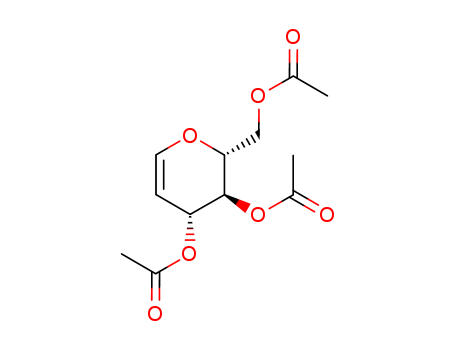
Tri-O-acetyl-D-glucal

Base Information
  • Chemical Name:Tri-O-acetyl-D-glucal
  • CAS No.:2873-29-2
  • Molecular Formula:C12H16O7
  • Molecular Weight:272.255
  • Hs Code.:29329995
  • European Community (EC) Number:220-709-0
  • Nikkaji Number:J47.317K,J109.600A
  • Mol file:2873-29-2.mol
Tri-O-acetyl-D-glucal

Synonyms:3,4,6-tri-O-acetyl-1,5-anhydro-2-deoxy-D-arabino-hex-1-enitol;3,4,6-tri-O-acetyl-D-glucal;3,4,6-tri-O-acetylglucal

Suppliers and Price of Tri-O-acetyl-D-glucal
Supply Marketing:
Business phase:
The product has achieved commercial mass production*data from LookChem market partment
Manufacturers and distributors:
  • Manufacture/Brand
  • Chemicals and raw materials
  • Packaging
  • price
  • Usbiological
  • Tri-O-acetyl-D-glucal
  • 5g
  • $ 403.00
  • TRC
  • Tri-O-acetyl-D-glucal
  • 100g
  • $ 225.00
  • TCI Chemical
  • Tri-O-acetyl-D-glucal >96.0%(GC)
  • 5g
  • $ 42.00
  • TCI Chemical
  • Tri-O-acetyl-D-glucal >96.0%(GC)
  • 25g
  • $ 121.00
  • Sigma-Aldrich
  • Tri-O-acetyl-D-glucal 98%
  • 100g
  • $ 139.00
  • Sigma-Aldrich
  • Tri-O-acetyl-D-glucal 98%
  • 25g
  • $ 113.00
  • Sigma-Aldrich
  • Tri-O-acetyl-D-glucal 98%
  • 5g
  • $ 46.60
  • Matrix Scientific
  • (2R,3S,4R)-2-(Acetoxymethyl)-3,4-dihydro-2H-pyran-3,4-diyl diacetate 95+%
  • 25g
  • $ 33.00
  • Matrix Scientific
  • (2R,3S,4R)-2-(Acetoxymethyl)-3,4-dihydro-2H-pyran-3,4-diyl diacetate 95+%
  • 100g
  • $ 110.00
  • Matrix Scientific
  • (2R,3S,4R)-2-(Acetoxymethyl)-3,4-dihydro-2H-pyran-3,4-diyl diacetate 95+%
  • 500g
  • $ 438.00
Total 149 raw suppliers
Chemical Property of Tri-O-acetyl-D-glucal
Chemical Property:
  • Appearance/Colour:white to off-white crystalline powder 
  • Vapor Pressure:0mmHg at 25°C 
  • Melting Point:53-55 °C(lit.) 
  • Refractive Index:1.484 
  • Boiling Point:343.1 °C at 760 mmHg 
  • Flash Point:149.2 °C 
  • PSA:88.13000 
  • Density:1.24 g/cm3 
  • LogP:0.32540 
  • Storage Temp.:-20°C Freezer 
  • Solubility.:Chloroform (Slightly), Ethanol (Slightly), Methanol (Slightly) 
  • Water Solubility.:Soluble in chloroform and ethanol. Insoluble in water. 
  • XLogP3:0.2
  • Hydrogen Bond Donor Count:0
  • Hydrogen Bond Acceptor Count:7
  • Rotatable Bond Count:7
  • Exact Mass:272.08960285
  • Heavy Atom Count:19
  • Complexity:388
Purity/Quality:

≥98%,≥99%, *data from raw suppliers

Tri-O-acetyl-D-glucal *data from reagent suppliers

Safty Information:
  • Pictogram(s):  
  • Hazard Codes: 
  • Safety Statements: 24/25 
MSDS Files:

SDS file from LookChem

Total 1 MSDS from other Authors

Useful:
  • Chemical Classes:Biological Agents -> Monosaccharides and Derivatives
  • Canonical SMILES:CC(=O)OCC1C(C(C=CO1)OC(=O)C)OC(=O)C
  • Isomeric SMILES:CC(=O)OC[C@@H]1[C@H]([C@@H](C=CO1)OC(=O)C)OC(=O)C
  • General Description Tri-O-acetyl-D-glucal is a per-O-acetylated glycal derivative that serves as a key substrate in AuCl3-catalyzed Ferrier reactions, enabling the synthesis of 2,3-unsaturated glycosides under mild conditions. Its activation by AuCl3 facilitates reactions with diverse nucleophiles, including alcohols and thiols, while also offering potential for influencing β-anomer selectivity, which is typically difficult to achieve due to the anomeric effect. Tri-O-acetyl-D-glucal's reactivity highlights its utility in glycosylation chemistry.
Technology Process of Tri-O-acetyl-D-glucal

There total 122 articles about Tri-O-acetyl-D-glucal which guide to synthetic route it. The literature collected by LookChem mainly comes from the sharing of users and the free literature resources found by Internet computing technology. We keep the original model of the professional version of literature to make it easier and faster for users to retrieve and use. At the same time, we analyze and calculate the most feasible synthesis route with the highest yield for your reference as below:

synthetic route:
Guidance literature:
D-Glucose; acetic anhydride; With hydrogen bromide; acetic anhydride; at 20 ℃;
With sodium acetate; copper(II) sulfate; acetic acid; zinc; In water; for 3.5h; Further stages.;
DOI:10.1021/ja069342g
Guidance literature:
With dicyclohexylammonium salt of O,O-diethylphosphoroselenoic acid; In benzene; at 80 ℃; for 2h;
DOI:10.1016/S0040-4020(01)98912-4
Guidance literature:
With indium(III) chloride; indium; tetrakis(triphenylphosphine) palladium(0); In tetrahydrofuran; water; at 20 ℃; for 8h;
DOI:10.1021/jo0262964
Refernces

Scope of AuCl3 in the activation of per-O-acetylglycals

10.1016/j.tet.2009.07.087

The research investigates the application of AuCl3 as a catalyst in the activation of per-O-acetylglycals and its subsequent use in the Ferrier reaction to produce 2,3-unsaturated glycosides. The study demonstrates that AuCl3 efficiently activates 3,4,6-tri-O-acetyl-D-glucal, 3,4,6-tri-O-acetyl-D-galactal, and 3,4-di-O-acetyl-L-rhamnal, enabling the Ferrier reaction with various nucleophiles at ambient conditions. The research also explores the potential of AuCl3 to influence the selectivity towards the formation of β-anomers, which are typically challenging to synthesize due to the anomeric effect. Key chemicals involved in the study include AuCl3 as the catalyst, per-O-acetylglycals such as 3,4,6-tri-O-acetyl-D-glucal, 3,4,6-tri-O-acetyl-D-galactal, and 3,4-di-O-acetyl-L-rhamnal as the substrates, and a range of nucleophiles like primary, secondary, allylic, benzylic, and propargylic alcohols, as well as thiol and C-nucleophiles. The study also examines the use of additives like AgSbF6, AgOTf, and LiClO4 in attempts to enhance the β-selectivity of the reactions.


Post a RFQ

Enter 15 to 2000 letters.Word count: 0 letters

Attach files(File Format: Jpeg, Jpg, Gif, Png, PDF, PPT, Zip, Rar,Word or Excel Maximum File Size: 3MB)

1 Customer Service

What can I do for you?
Get Best Price

Get Best Price for 2873-29-2