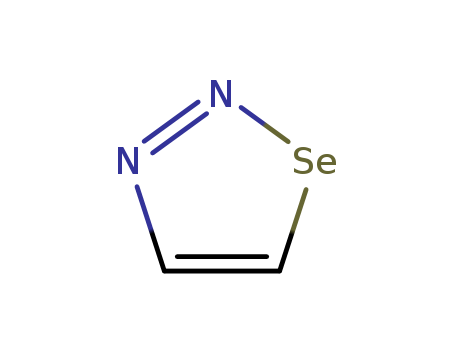
Base Information
- Chemical Name:1,2,3-selenadiazole
- CAS No.:26223-16-5
- Molecular Formula:C2H2N2Se
- Molecular Weight:133.011
- Hs Code.:
Synonyms:
Synonyms:
98% *data from raw suppliers
There total 2 articles about 1,2,3-selenadiazole which guide to synthetic route it. The literature collected by LookChem mainly comes from the sharing of users and the free literature resources found by Internet computing technology. We keep the original model of the professional version of literature to make it easier and faster for users to retrieve and use. At the same time, we analyze and calculate the most feasible synthesis route with the highest yield for your reference as below:
Reference yield: 10.0%
Reference yield:
Reference yield: 50.0%
The research focuses on the development of a convenient synthesis method for 1,2,3-thiadiazoles and 1,2,3-selenadiazoles, which are important heterocyclic compounds with broad pharmacological properties, including anticancer, antibacterial, and antifungal activities. The study utilizes an ionic liquid as a novel soluble support, offering a simple and efficient approach to synthesize these compounds. The methodology involves the synthesis of ionic liquid-supported sulfonyl hydrazine, which is then reacted with various ketones and 1,2-diketones to form ionic liquid-supported hydrazones. These hydrazones are subsequently converted to 1,2,3-thiadiazoles in the presence of thionyl chloride, while 1,2,3-selenadiazoles are obtained by reacting the hydrazones with selenium dioxide in acetonitrile. The research concludes that this approach offers several advantages, such as ease of workup, simple reaction conditions, and high purity of the products. The chemicals used in the process include 1-methylimidazole, 1,4-butane sultone, trifluoromethane sulfonic acid (TfOH), thionyl chloride, hydrazine hydrate, and various ketones and 1,2-diketones, as well as selenium dioxide for the synthesis of selenadiazoles.
This study aims to develop a convenient method for preparing 3,5-disubstituted 1,2,4-selenadiazoles from primary selenoamides using N-bromosuccinimide (NBS) as the oxidizing agent. The study investigates various conditions and reagents to optimize the yield and stability of the synthesized selenadiazoles. Key chemicals involved include primary selenoamides as starting materials, which are treated with NBS in solvents like CHCl3. The research concludes that NBS is effective for synthesizing 1,2,4-selenadiazoles with aromatic substituents, yielding good to moderate results. However, aliphatic and heteroatom analogues are obtained in lower yields due to the decomposition of selenoamides to nitriles. The synthesized selenadiazoles are expected to promote further chemical conversions, and the study highlights the potential for introducing various functionalities to the 3- and 5-positions of the nucleus, paving the way for the development of novel heterocyclic ring systems.

What can I do for you?
Get Best Price

Total 8 Pictures about this product