Welcome to LookChem.com Sign In|Join Free
  • or

Encyclopedia

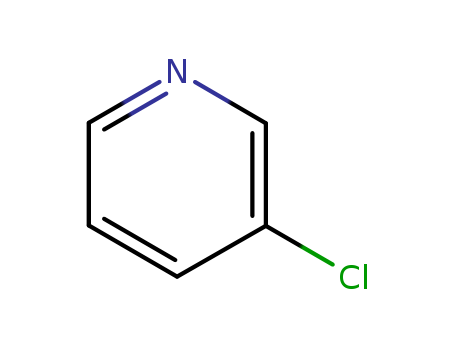
3-Chloropyridine

Base Information
  • Chemical Name:3-Chloropyridine
  • CAS No.:626-60-8
  • Molecular Formula:C5H4ClN
  • Molecular Weight:113.546
  • Hs Code.:29333999
  • European Community (EC) Number:210-955-7
  • NSC Number:60200
  • UNII:1M13HUC1P4
  • DSSTox Substance ID:DTXSID3052309
  • Nikkaji Number:J32.649F
  • Wikipedia:3-Chloropyridine
  • Wikidata:Q223069
  • Mol file:626-60-8.mol
3-Chloropyridine

Synonyms:m-Chloropyridine;Pyridine, 3-chloro-;5-20-05-00406 (Beilstein Handbook Reference);3-Pyridinyl chloride;

Suppliers and Price of 3-Chloropyridine
Supply Marketing:
Business phase:
The product has achieved commercial mass production*data from LookChem market partment
Manufacturers and distributors:
  • Manufacture/Brand
  • Chemicals and raw materials
  • Packaging
  • price
  • TRC
  • 3-Chloropyridine
  • 100g
  • $ 470.00
  • TCI Chemical
  • 3-Chloropyridine >95.0%(GC)
  • 500g
  • $ 280.00
  • TCI Chemical
  • 3-Chloropyridine >95.0%(GC)
  • 100g
  • $ 92.00
  • TCI Chemical
  • 3-Chloropyridine >95.0%(GC)
  • 25g
  • $ 35.00
  • SynQuest Laboratories
  • 3-Chloropyridine
  • 25 g
  • $ 28.00
  • SynQuest Laboratories
  • 3-Chloropyridine
  • 100 g
  • $ 68.00
  • Sigma-Aldrich
  • 3-Chloropyridine ReagentPlus , 99%
  • 25g
  • $ 49.70
  • Sigma-Aldrich
  • 3-Chloropyridine ReagentPlus , 99%
  • 50g
  • $ 85.40
  • Oakwood
  • 3-Chloropyridine 99%
  • 25g
  • $ 14.00
  • Matrix Scientific
  • 3-Chloropyridine 95%
  • 25g
  • $ 82.00
Total 130 raw suppliers
Chemical Property of 3-Chloropyridine
Chemical Property:
  • Appearance/Colour:clear colorless to yellow liquid 
  • Vapor Pressure:6.8mmHg at 25°C 
  • Melting Point:-0.5oC 
  • Refractive Index:n20/D 1.533(lit.)  
  • Boiling Point:143.1 °C at 760 mmHg 
  • PKA:2.84(at 25℃) 
  • Flash Point:49.7 °C 
  • PSA:12.89000 
  • Density:1.2 g/cm3 
  • LogP:1.73500 
  • Storage Temp.:Flammables area 
  • Solubility.:10g/l 
  • Water Solubility.:Soluble in water 10 g/L. 
  • XLogP3:1.3
  • Hydrogen Bond Donor Count:0
  • Hydrogen Bond Acceptor Count:1
  • Rotatable Bond Count:0
  • Exact Mass:113.0032268
  • Heavy Atom Count:7
  • Complexity:56
Purity/Quality:

99% *data from raw suppliers

3-Chloropyridine *data from reagent suppliers

Safty Information:
  • Pictogram(s): HarmfulXn,IrritantXi 
  • Hazard Codes:Xn,Xi 
  • Statements: 20/21/22-36/37/38 
  • Safety Statements: 36/37-36/37/39-26-36 
MSDS Files:

SDS file from LookChem

Total 1 MSDS from other Authors

Useful:
  • Chemical Classes:Nitrogen Compounds -> Pyridines
  • Canonical SMILES:C1=CC(=CN=C1)Cl
  • General Description 3-Chloropyridine is a heteroaromatic compound used as a reagent in the synthesis of palladium N-heterocyclic carbene (Pd-NHC) complexes, demonstrating utility in catalytic applications such as direct arylation reactions. Its role in these reactions highlights its importance as a ligand and solvent in facilitating the formation of aryl-aryl bonds in organic synthesis.
Technology Process of 3-Chloropyridine

There total 92 articles about 3-Chloropyridine which guide to synthetic route it. The literature collected by LookChem mainly comes from the sharing of users and the free literature resources found by Internet computing technology. We keep the original model of the professional version of literature to make it easier and faster for users to retrieve and use. At the same time, we analyze and calculate the most feasible synthesis route with the highest yield for your reference as below:

synthetic route:
Guidance literature:
With tert-Butyl thionitrate; copper dichloride; In acetonitrile; at 25 ℃; for 6h;
Guidance literature:
With hydrogen; triethyl phosphite; In isopropyl alcohol; at 100 ℃; for 12h; under 4500.45 Torr; chemoselective reaction; Glovebox;
DOI:10.1039/d0cy01695k
Guidance literature:
With trans-bis(glycinato)copper(II) monohydrate; tetramethlyammonium chloride; In ethanol; at 100 ℃; for 20h; Schlenk technique; Inert atmosphere;
DOI:10.1016/j.apcata.2013.12.022
Refernces

Dichlorido(3-chloropyridine-N)[1,3-dialkylbenzimidazol-2-ylidene]palladium(II) complexes: Synthesis, characterization and catalytic activity in the arylation reaction

10.1016/j.ica.2015.01.019

This research details the synthesis, characterization, and evaluation of six novel Pyridine Enhanced Precatalyst Preparation, Stabilization, and Initiation (PEPPSI) themed palladium N-heterocyclic carbene (Pd-NHC) complexes (2a-f) for their catalytic activity in direct arylation reactions. The purpose of the study was to create and test new Pd-NHC complexes for their efficiency in catalyzing the arylation of heteroaromatic compounds with aryl bromides. The researchers synthesized the complexes using 1,3-dialkylbenzimidazolium salts, PdCl2, and K2CO3 in 3-chloropyridine, and characterized them using elemental analysis and spectroscopic methods including FT-IR, 1H and 13C NMR. The conclusions of the study indicated that these complexes, when used as catalysts in the direct arylation of 2-n-propylthiazole, 2-n-butylthiophene, and 2-n-butylfuran with different aryl bromides at 130°C for 1 hour, exhibited high catalytic activities, suggesting their potential use in organic chemistry for the formation of aryl-aryl bonds.

Post a RFQ

Enter 15 to 2000 letters.Word count: 0 letters

Attach files(File Format: Jpeg, Jpg, Gif, Png, PDF, PPT, Zip, Rar,Word or Excel Maximum File Size: 3MB)

1 Customer Service

What can I do for you?
Get Best Price

Get Best Price for 626-60-8
