Welcome to LookChem.com Sign In|Join Free
  • or

Encyclopedia

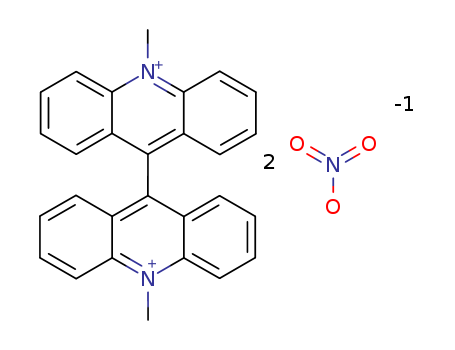
Dihydroxy(oxo)azanium;10-methyl-9-(10-methylacridin-10-ium-9-yl)acridin-10-ium

Base Information
  • Chemical Name:Dihydroxy(oxo)azanium;10-methyl-9-(10-methylacridin-10-ium-9-yl)acridin-10-ium
  • CAS No.:2315-97-1
  • Molecular Formula:C28H22N4O6
  • Molecular Weight:510.506
  • Hs Code.:29339900
  • NSC Number:151912
  • Mol file:2315-97-1.mol
Dihydroxy(oxo)azanium;10-methyl-9-(10-methylacridin-10-ium-9-yl)acridin-10-ium

Synonyms:dihydroxy(oxo)azanium;10-methyl-9-(10-methylacridin-10-ium-9-yl)acridin-10-ium;NSC-151912;NSC151912

Suppliers and Price of Dihydroxy(oxo)azanium;10-methyl-9-(10-methylacridin-10-ium-9-yl)acridin-10-ium
Supply Marketing:
Business phase:
The product has achieved commercial mass production*data from LookChem market partment
Manufacturers and distributors:
  • Manufacture/Brand
  • Chemicals and raw materials
  • Packaging
  • price
  • Usbiological
  • Lucigenine
  • 1g
  • $ 460.00
  • TRC
  • Lucigenine
  • 10g
  • $ 1320.00
  • TCI Chemical
  • 10,10'-Dimethyl-9,9'-biacridinium Dinitrate [for Chemiluminescence Research] >97.0%(HPLC)
  • 5g
  • $ 415.00
  • TCI Chemical
  • 10,10'-Dimethyl-9,9'-biacridinium Dinitrate [for Chemiluminescence Research] >97.0%(HPLC)
  • 1g
  • $ 139.00
  • Sigma-Aldrich
  • N,N′-Dimethyl-9,9′-biacridinium dinitrate used as chemiluminescent reagent
  • 1g
  • $ 323.00
  • Sigma-Aldrich
  • N,N′-Dimethyl-9,9′-biacridinium dinitrate used as chemiluminescent reagent
  • 500mg
  • $ 173.00
  • Sigma-Aldrich
  • N,N′-Dimethyl-9,9′-biacridinium dinitrate used as chemiluminescent reagent
  • 5g
  • $ 1050.00
  • Medical Isotopes, Inc.
  • Lucigenine
  • 10 g
  • $ 2200.00
  • Frontier Specialty Chemicals
  • N,N'-Dimethyl-9,9'-bisacridiniumnitrate 95%
  • 5g
  • $ 410.00
  • Frontier Specialty Chemicals
  • N,N'-Dimethyl-9,9'-bisacridiniumnitrate 95%
  • 1g
  • $ 120.00
Total 41 raw suppliers
Chemical Property of Dihydroxy(oxo)azanium;10-methyl-9-(10-methylacridin-10-ium-9-yl)acridin-10-ium
Chemical Property:
  • Melting Point:250°C 
  • PSA:145.52000 
  • LogP:6.18360 
  • Solubility.:acetic acid: soluble10mg/mL 
  • Hydrogen Bond Donor Count:2
  • Hydrogen Bond Acceptor Count:3
  • Rotatable Bond Count:1
  • Exact Mass:450.18176664
  • Heavy Atom Count:34
  • Complexity:530
Purity/Quality:

≥98% *data from raw suppliers

Lucigenine *data from reagent suppliers

Safty Information:
  • Pictogram(s):  
  • Hazard Codes: 
  • Safety Statements: 24/25 
MSDS Files:

SDS file from LookChem

Total 1 MSDS from other Authors

Useful:
  • Canonical SMILES:C[N+]1=C2C=CC=CC2=C(C3=CC=CC=C31)C4=C5C=CC=CC5=[N+](C6=CC=CC=C64)C.[N+](=O)(O)O
  • Description Lucigenin is a chemiluminescent probe used to detect superoxide production and the presence of chloride. It can be used to detect superoxide production by enzymatic and cellular sources. It is a sensitive method that has been applied to the monitoring of superoxide production from xanthine oxidase, microsomal NADPH cytochrome reductase, and NADPH oxidases of phagocytes, endothelial cells, fibroblasts, and smooth muscle cells of blood vessel walls. However, it produces similar chemiluminescence signals in isolated aortic and cardiac tissues from wild-type and Nox1-Nox2-Nox4 triple knockout mice, suggesting that it is not selective for NADPH-based ROS production. It also reacts with hydrogen peroxide without generating free radical intermediates and has been used to detect lipid hydroperoxide in oils. Lucigenin is also used as a fluorescent chloride-sensitive indicator, with its fluorescence being quenched by chloride (ex/em = 455/505 nm, respectively). Lucigenin fluorescence is insensitive to phosphate, sulfate, and nitrate.
  • Uses Lucigenine, is used as chemiluminescence. It exhibits a bluish-green fluorescence. Dyes and metabolites. Chemiluminescent probe for the detection of peroxides in biological systems.
Technology Process of Dihydroxy(oxo)azanium;10-methyl-9-(10-methylacridin-10-ium-9-yl)acridin-10-ium

There total 2 articles about Dihydroxy(oxo)azanium;10-methyl-9-(10-methylacridin-10-ium-9-yl)acridin-10-ium which guide to synthetic route it. The literature collected by LookChem mainly comes from the sharing of users and the free literature resources found by Internet computing technology. We keep the original model of the professional version of literature to make it easier and faster for users to retrieve and use. At the same time, we analyze and calculate the most feasible synthesis route with the highest yield for your reference as below:

synthetic route:

Reference yield:

Guidance literature:
With nitric acid;

Reference yield:

Guidance literature:
With acetic acid; zinc; Behandeln des erhaltenen Niederschlags mit verd. Salpetersaeure;
Refernces

Imidazolinium-based Multiblock Amphiphile as Transmembrane Anion Transporter

10.1002/asia.202001106

This study reports the development of imidazoline-based multiblock amphiphiles (IMAs) as transmembrane anion transporters. IMAs consist of a hydrophilic octaethylene glycol chain and a hydrophobic aromatic unit, with the imidazoline ring acting as an anion recognition site. The C2 proton of the imidazoline ring recognizes anions. Ion transport assays using halide-sensitive lucigenin and pH-sensitive 8-hydroxypyrene-1,3,6-trisulfonate (HPTS) showed that IMAs transported the anion, nitrate, with high selectivity. Temperature-dependent ion transport assays using 1,2-dipalmitoyl-sn-glycero-3-phosphocholine (DPPC) showed that IMAs function as mobile carriers. 1H NMR titration experiments and all-atom molecular dynamics simulations further elucidated the dynamic features of IMAs within the membrane during ion transport.

Post a RFQ

Enter 15 to 2000 letters.Word count: 0 letters

Attach files(File Format: Jpeg, Jpg, Gif, Png, PDF, PPT, Zip, Rar,Word or Excel Maximum File Size: 3MB)

1 Customer Service

What can I do for you?
Get Best Price

Get Best Price for 2315-97-1
