Welcome to LookChem.com Sign In|Join Free
  • or

Encyclopedia

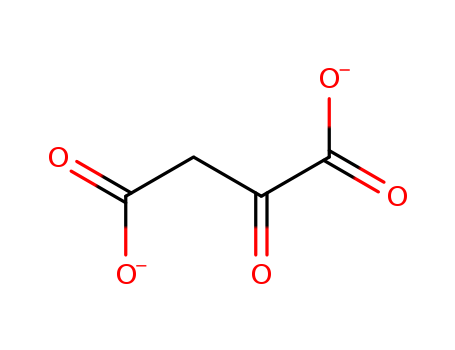
Oxaloacetate

Base Information
  • Chemical Name:Oxaloacetate
  • CAS No.:149-63-3
  • Molecular Formula:C4H2 O5
  • Molecular Weight:130.057
  • Hs Code.:
  • Nikkaji Number:J1.263.971F
  • Wikidata:Q27101912
  • Mol file:149-63-3.mol
Oxaloacetate

Synonyms:oxalacetate;Oxobutanedioate;2-oxobutanedioate;oxaloacetate(2-);oxosuccinate;149-63-3;keto-oxaloacetate;Butanedioic acid, oxo-, ion(2-);C4H2O5.Mg;C4-H2-O5.Mg;C4H2O5;C4-H2-O5;oxaloacetate dianion;3p4q;oxobutanedioic acid, ion(2-);CHEBI:16452;Q27101912

Suppliers and Price of Oxaloacetate
Supply Marketing:
Business phase:
The product has achieved commercial mass production*data from LookChem market partment
Manufacturers and distributors:
  • Manufacture/Brand
  • Chemicals and raw materials
  • Packaging
  • price
Total 7 raw suppliers
Chemical Property of Oxaloacetate
Chemical Property:
  • PSA:97.33000 
  • LogP:-3.55460 
  • XLogP3:0.7
  • Hydrogen Bond Donor Count:0
  • Hydrogen Bond Acceptor Count:5
  • Rotatable Bond Count:1
  • Exact Mass:129.99022316
  • Heavy Atom Count:9
  • Complexity:147
Purity/Quality:

98%min *data from raw suppliers

Safty Information:
  • Pictogram(s):  
  • Hazard Codes: 
MSDS Files:

SDS file from LookChem

Useful:
  • Canonical SMILES:C(C(=O)C(=O)[O-])C(=O)[O-]
  • Recent ClinicalTrials:Oxaloacetate in Myasthenia Gravis
Technology Process of Oxaloacetate

There total 13 articles about Oxaloacetate which guide to synthetic route it. The literature collected by LookChem mainly comes from the sharing of users and the free literature resources found by Internet computing technology. We keep the original model of the professional version of literature to make it easier and faster for users to retrieve and use. At the same time, we analyze and calculate the most feasible synthesis route with the highest yield for your reference as below:

synthetic route:
Guidance literature:
With dithiothreitol; Chlorobium limicola ATP-citrate lyase; ATP; magnesium chloride; In aq. buffer; pH=8.4; Concentration; Reagent/catalyst; Kinetics; Enzymatic reaction;
DOI:10.1002/pro.3708
Guidance literature:
With aspartate aminotransferase wild-type from porcine heart muscle; NADPH; malate dehydrogenase; In aq. phosphate buffer; at 25 ℃; pH=7.4; Reagent/catalyst; Kinetics; Enzymatic reaction;
DOI:10.1074/jbc.M116.774588
Guidance literature:
With potassium chloride; 3-quinuclidinol; In water; at 25 ℃; Rate constant; other catalysts (OH-, Et3N, tetrameen, H(tetrameen)+, H2(tetrameen)2+); observed relaxation rate constants from some pH; mechanistic propositions;
DOI:10.1021/ja00393a022
Refernces

Effect of K and Mg Aspartate on Cellular Metabolism

10.1007/BF02142154

The study investigates the effects of K and Mg aspartate on cellular metabolism, specifically focusing on oxygen consumption and respiratory CO? production in isolated rat nephrons. The chemicals involved include aspartate, which is proposed to stimulate cellular metabolic processes by potentially acting as an anaerobic generator of CO? or stimulating the tricarboxylic acid cycle after deamination. The study found that the addition of aspartate significantly increased oxygen consumption and CO? production without altering the respiratory quotient, suggesting that aspartate enhances cellular metabolism through its role in producing oxalacetate, a key component of the Krebs cycle. This effect is more complex than simply acting as a cation carrier for K and Mg, and may also involve a vascular action due to the vasodilating effect of oxalacetate on small vessels.

Post a RFQ

Enter 15 to 2000 letters.Word count: 0 letters

Attach files(File Format: Jpeg, Jpg, Gif, Png, PDF, PPT, Zip, Rar,Word or Excel Maximum File Size: 3MB)

1 Customer Service

What can I do for you?
Get Best Price

Get Best Price for 149-63-3