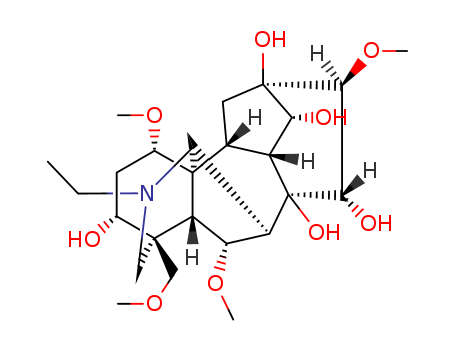
Chemical Property of Jesaconine
Chemical Property:
- Vapor Pressure:2.67E-18mmHg at 25°C
- Melting Point:129-131ºC
- Refractive Index:1.6000 (estimate)
- Boiling Point:626.1°Cat760mmHg
- PKA:9.52(at 25℃)
- Flash Point:332.4°C
- PSA:141.31000
- Density:1.42g/cm3
- LogP:-1.84950
- Storage Temp.:-20°C Freezer
- Solubility.:Chloroform (Slightly), DMSO (Slightly)
- XLogP3:-2.5
- Hydrogen Bond Donor Count:5
- Hydrogen Bond Acceptor Count:10
- Rotatable Bond Count:6
- Exact Mass:499.27813189
- Heavy Atom Count:35
- Complexity:878
- Purity/Quality:
-
99%, *data from raw suppliers
Aconine *data from reagent suppliers
Safty Information:
- Pictogram(s):
- Hazard Codes:
- MSDS Files:
-
SDS file from LookChem
Useful:
- Canonical SMILES:CCN1CC2(C(CC(C34C2C(C(C31)C5(C6C4CC(C6O)(C(C5O)OC)O)O)OC)OC)O)COC
- Isomeric SMILES:CCN1C[C@@]2([C@@H](C[C@@H]([C@@]34[C@@H]2[C@H]([C@@H]([C@H]31)[C@@]5([C@@H]6[C@H]4C[C@@]([C@@H]6O)([C@H]([C@@H]5O)OC)O)O)OC)OC)O)COC
-
Description
Aconine is an alkaloid originally isolated from Aconitum species and active metabolite of aconitine. It inhibits osteoclast differentiation of RANKL-stimulated RAW 264.7 cells and bone resorption in a pit formation assay in a concentration-dependent manner. Aconine also inhibits RANKL-induced activation of NF-κB and NFATc1 in RAW 264.7 cells. Aconine is an alkaloid originally isolated from Aconitum species and active metabolite of aconitine. It inhibits osteoclast differentiation of RANKL-stimulated RAW 264.7 cells and bone resorption in a pit formation assay in a concentration-dependent manner. Aconine also inhibits RANKL-induced activation of NF-κB and NFATc1 in RAW 264.7 cells. In vivo, aconine is toxic to mice when administered intravenously at a dose of 120 mg/kg. It induces flaccid paralysis and toxicity in rats with toxic dose (TD50) and LD50 values of 1.5 and 1.7 μmol per animal, respectively.
-
Uses
Aconine is a derivative of Aconitine (A189875), a neurotoxin which activates tetrodotoxin-sensitive Na+ channels, inducing presynaptic depolarization, thus blocking the nerve action potential which, in turn, blocks the release of neurotransmitters and decreases the end plate potential at the neuromuscular junction.