Welcome to LookChem.com Sign In|Join Free
  • or

Encyclopedia

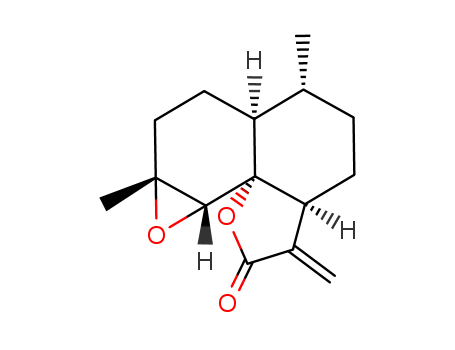
Arteannuin B

Base Information
  • Chemical Name:Arteannuin B
  • CAS No.:50906-56-4
  • Molecular Formula:C15H20 O3
  • Molecular Weight:248.322
  • Hs Code.:
  • European Community (EC) Number:683-223-1
  • Nikkaji Number:J34.140A
  • Wikidata:Q104253369
  • Metabolomics Workbench ID:141334
  • ChEMBL ID:CHEMBL515516
Arteannuin B

Synonyms:arteannuin B

Suppliers and Price of Arteannuin B
Supply Marketing:
Business phase:
The product has achieved commercial mass production*data from LookChem market partment
Manufacturers and distributors:
  • Manufacture/Brand
  • Chemicals and raw materials
  • Packaging
  • price
  • Usbiological
  • Arteannuin B
  • 10mg
  • $ 490.00
  • JR MediChem
  • ArteannuinB(NewProduct) 98%
  • 20mg
  • $ 298.00
  • DC Chemicals
  • Arteannuin >98%,StandardReferencesGrade
  • 20 mg
  • $ 280.00
  • ChemScene
  • ArteannuinB 99.27%
  • 10mg
  • $ 571.00
  • ChemScene
  • ArteannuinB 99.27%
  • 5mg
  • $ 336.00
  • Biosynth Carbosynth
  • Arteannuin B
  • 5 mg
  • $ 175.00
  • Biosynth Carbosynth
  • Arteannuin B
  • 2 mg
  • $ 90.00
  • Biosynth Carbosynth
  • Arteannuin B
  • 1 mg
  • $ 60.00
  • Biosynth Carbosynth
  • Arteannuin B
  • 10 mg
  • $ 270.00
  • Biosynth Carbosynth
  • Arteannuin B
  • 25 mg
  • $ 500.00
Total 67 raw suppliers
Chemical Property of Arteannuin B
Chemical Property:
  • Vapor Pressure:1.44E-06mmHg at 25°C 
  • Melting Point:149-151 °C(Solv: ethyl ether (60-29-7)) 
  • Boiling Point:398.7°Cat760mmHg 
  • Flash Point:168.5°C 
  • PSA:38.83000 
  • Density:1.18g/cm3 
  • LogP:2.45180 
  • Storage Temp.:2-8°C(protect from light) 
  • XLogP3:2.6
  • Hydrogen Bond Donor Count:0
  • Hydrogen Bond Acceptor Count:3
  • Rotatable Bond Count:0
  • Exact Mass:248.14124450
  • Heavy Atom Count:18
  • Complexity:457
Purity/Quality:

≥98% *data from raw suppliers

Arteannuin B *data from reagent suppliers

Safty Information:
  • Pictogram(s):  
  • Hazard Codes: 
MSDS Files:

SDS file from LookChem

Useful:
  • Canonical SMILES:CC1CCC2C(=C)C(=O)OC23C1CCC4(C3O4)C
  • Isomeric SMILES:C[C@@H]1CC[C@H]2C(=C)C(=O)O[C@]23[C@H]1CC[C@@]4([C@H]3O4)C
  • Uses Arteannuin B has been used in the treatment of coronavirus infection.
Technology Process of Arteannuin B

There total 35 articles about Arteannuin B which guide to synthetic route it. The literature collected by LookChem mainly comes from the sharing of users and the free literature resources found by Internet computing technology. We keep the original model of the professional version of literature to make it easier and faster for users to retrieve and use. At the same time, we analyze and calculate the most feasible synthesis route with the highest yield for your reference as below:

synthetic route:
Guidance literature:
In water; at 30 ℃; for 2h; Title compound not separated from byproducts; cell-free extract from Artemisia annua L. (Asteraceae), EDTA, HEPES with DDT buffer, pH 7.15;
Refernces

Synthesis of (+)-Artemisinin and (+)-Deoxoartemisinin from arteannuin B and arteannuic acid

10.1016/S0040-4020(97)10286-1

The research details the first-time synthesis of (+)-Artemisinin and (+)-Deoxoartemisinin from Arteannuin B and Arteannuic Acid. The purpose of this study was to develop a short and efficient synthetic route leveraging prior art for the final photo-oxygenation/cyclization reaction, addressing the urgency in discovering novel antimalarial agents due to the emergence of chloroquine-resistant strains of Plasmodium falciparum. The researchers successfully established a synthetic link between Arteannuin B and Artemisinin, as well as a new route from readily available Arteannuic Acid, utilizing a novel oxidative lactonization reaction and a regioselective protection method. The study concluded that the yields for the photo-oxygenation reaction leading to Artemisinin were comparable to previous syntheses, with no observed "ene" products, likely due to the absence of axial allylic protons in their substrates. The yield for the photo-oxygenation to form Deoxoartemisinin was exceptionally high at 65%, attributed to the enhanced rate of cyclization and the absence of competing ene reactions. Key chemicals used in the process included Arteannuin B, Arteannuic Acid, singlet oxygen, Rose Bengal as a sensitizer, and various reagents for protection and deprotection steps, such as 1,2-bis(trimethylsilyloxy)ethane (BTSE), trimethylsilyltriflate (TMSOTf), and lithium aluminum hydride.

Stereoselective reduction of arteannuin B and its chemical transformations

10.1016/S0040-4020(03)00330-2

The research focuses on the stereoselective reduction of arteannuin B and its chemical transformations, with the aim of establishing the absolute stereochemistry of dihydroarteannuin B, a derivative of arteannuin B. The study utilized various chemicals and reagents, including Ni2B, NaBH4, CdCl2–Mg–MeOH–H2O, BF3·Et2O–Ac2O, HBr, Ac2O, pyridine, Pd–C, KOH–MeOH, and diglyme, to perform a series of chemical reactions and transformations. The absolute stereochemistry of dihydroarteannuin B was confirmed through 2D NMR and single crystal X-ray diffraction studies. The research concluded that reduction of arteannuin B with Ni2B, NaBH4, or CdCl2–Mg–MeOH–H2O yields dihydroarteannuin B, in which the relative stereochemistry of the C-13 methyl group has been established. The study also discussed experiments aimed at synthesizing dihydrodeoxyarteannuin B, an isomer of dihydroarteannuin B, and its potential transformation to artemisinin, a biologically active component used in antimalarial treatments.


Post a RFQ

Enter 15 to 2000 letters.Word count: 0 letters

Attach files(File Format: Jpeg, Jpg, Gif, Png, PDF, PPT, Zip, Rar,Word or Excel Maximum File Size: 3MB)

1 Customer Service

What can I do for you?
Get Best Price

Get Best Price for 50906-56-4