Welcome to LookChem.com Sign In|Join Free
  • or

Encyclopedia

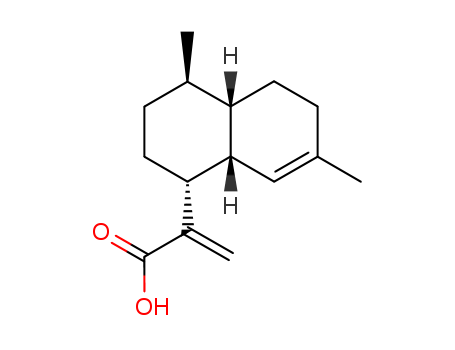
2-(4,7-Dimethyl-1,2,3,4,4a,5,6,8a-octahydronaphthalen-1-yl)prop-2-enoic acid

Base Information
  • Chemical Name:2-(4,7-Dimethyl-1,2,3,4,4a,5,6,8a-octahydronaphthalen-1-yl)prop-2-enoic acid
  • CAS No.:80286-58-4
  • Molecular Formula:C15H22O2
  • Molecular Weight:234.338
  • Hs Code.:
  • DSSTox Substance ID:DTXSID301001147
  • Wikidata:Q105211146
  • Mol file:80286-58-4.mol
2-(4,7-Dimethyl-1,2,3,4,4a,5,6,8a-octahydronaphthalen-1-yl)prop-2-enoic acid

Synonyms:DTXSID301001147;2-(4,7-dimethyl-1,2,3,4,4a,5,6,8a-octahydronaphthalen-1-yl)prop-2-enoic acid

Suppliers and Price of 2-(4,7-Dimethyl-1,2,3,4,4a,5,6,8a-octahydronaphthalen-1-yl)prop-2-enoic acid
Supply Marketing:
Business phase:
The product has achieved commercial mass production*data from LookChem market partment
Manufacturers and distributors:
  • Manufacture/Brand
  • Chemicals and raw materials
  • Packaging
  • price
  • Usbiological
  • Artemisic acid
  • 10mg
  • $ 490.00
  • TRC
  • ArtemisicAcid
  • 100mg
  • $ 225.00
  • TRC
  • ArtemisicAcid
  • 50mg
  • $ 150.00
  • DC Chemicals
  • Artemisinicacid >98%,StandardReferencesGrade
  • 20 mg
  • $ 280.00
  • ChemScene
  • Artemisicacid 99.88%
  • 10mg
  • $ 90.00
  • ChemScene
  • Artemisicacid 99.88%
  • 5mg
  • $ 50.00
  • ChemScene
  • Artemisicacid 99.88%
  • 20mg
  • $ 150.00
  • Cayman Chemical
  • Artemisinic Acid ≥98%
  • 100mg
  • $ 221.00
  • Cayman Chemical
  • Artemisinic Acid ≥98%
  • 50mg
  • $ 145.00
  • Cayman Chemical
  • Artemisinic Acid ≥98%
  • 10mg
  • $ 34.00
Total 98 raw suppliers
Chemical Property of 2-(4,7-Dimethyl-1,2,3,4,4a,5,6,8a-octahydronaphthalen-1-yl)prop-2-enoic acid
Chemical Property:
  • Vapor Pressure:1.31E-06mmHg at 25°C 
  • Melting Point:129-131 °C 
  • Refractive Index:1.504 
  • Boiling Point:373.563 °C at 760 mmHg 
  • PKA:4.32±0.11(Predicted) 
  • Flash Point:273.336 °C 
  • PSA:37.30000 
  • Density:1.019 g/cm3 
  • LogP:3.64580 
  • Storage Temp.:-20°C Freezer, Under inert atmosphere 
  • Solubility.:Chloroform (Slightly), Methanol (Slightly) 
  • XLogP3:3.8
  • Hydrogen Bond Donor Count:1
  • Hydrogen Bond Acceptor Count:2
  • Rotatable Bond Count:2
  • Exact Mass:234.161979940
  • Heavy Atom Count:17
  • Complexity:367
Purity/Quality:

≥98% *data from raw suppliers

Artemisic acid *data from reagent suppliers

Safty Information:
  • Pictogram(s):  
  • Hazard Codes: 
MSDS Files:

SDS file from LookChem

Useful:
  • Canonical SMILES:CC1CCC(C2C1CCC(=C2)C)C(=C)C(=O)O
  • Isomeric SMILES:C[C@@H]1CCC(C2C1CCC(=C2)C)C(=C)C(=O)O
  • General Description Artemisic acid, also known as arteannuic acid, artemisininic acid, or qing hao acid, is a key intermediate in the synthesis of antimalarial compounds such as (+)-artemisinin and (+)-deoxoartemisinin. It serves as a readily available starting material for efficient synthetic routes, enabling novel oxidative lactonization and regioselective protection methods to achieve high-yield production of these critical antimalarial agents. The absence of competing side reactions, such as ene products, further enhances its utility in streamlined synthetic processes.
Technology Process of 2-(4,7-Dimethyl-1,2,3,4,4a,5,6,8a-octahydronaphthalen-1-yl)prop-2-enoic acid

There total 7 articles about 2-(4,7-Dimethyl-1,2,3,4,4a,5,6,8a-octahydronaphthalen-1-yl)prop-2-enoic acid which guide to synthetic route it. The literature collected by LookChem mainly comes from the sharing of users and the free literature resources found by Internet computing technology. We keep the original model of the professional version of literature to make it easier and faster for users to retrieve and use. At the same time, we analyze and calculate the most feasible synthesis route with the highest yield for your reference as below:

synthetic route:
Guidance literature:
With Jones reagent; In acetone; at 20 ℃;

Reference yield: 88.0%

Guidance literature:
With sodium citrate; In water; iso-butanol; for 0.5h; pH=3.0 - 6.0; Purification / work up;
Guidance literature:
With Tetradecanoic acid 1-methylethyl ester; artemisinic acid producing yeast strain; In water; for 123.4h; Product distribution / selectivity; Enzymatic reaction;
Refernces

Synthesis of (+)-Artemisinin and (+)-Deoxoartemisinin from arteannuin B and arteannuic acid

10.1016/S0040-4020(97)10286-1

The research details the first-time synthesis of (+)-Artemisinin and (+)-Deoxoartemisinin from Arteannuin B and Arteannuic Acid. The purpose of this study was to develop a short and efficient synthetic route leveraging prior art for the final photo-oxygenation/cyclization reaction, addressing the urgency in discovering novel antimalarial agents due to the emergence of chloroquine-resistant strains of Plasmodium falciparum. The researchers successfully established a synthetic link between Arteannuin B and Artemisinin, as well as a new route from readily available Arteannuic Acid, utilizing a novel oxidative lactonization reaction and a regioselective protection method. The study concluded that the yields for the photo-oxygenation reaction leading to Artemisinin were comparable to previous syntheses, with no observed "ene" products, likely due to the absence of axial allylic protons in their substrates. The yield for the photo-oxygenation to form Deoxoartemisinin was exceptionally high at 65%, attributed to the enhanced rate of cyclization and the absence of competing ene reactions. Key chemicals used in the process included Arteannuin B, Arteannuic Acid, singlet oxygen, Rose Bengal as a sensitizer, and various reagents for protection and deprotection steps, such as 1,2-bis(trimethylsilyloxy)ethane (BTSE), trimethylsilyltriflate (TMSOTf), and lithium aluminum hydride.

Post a RFQ

Enter 15 to 2000 letters.Word count: 0 letters

Attach files(File Format: Jpeg, Jpg, Gif, Png, PDF, PPT, Zip, Rar,Word or Excel Maximum File Size: 3MB)

1 Customer Service

What can I do for you?
Get Best Price

Get Best Price for 80286-58-4