Welcome to LookChem.com Sign In|Join Free
  • or

Encyclopedia

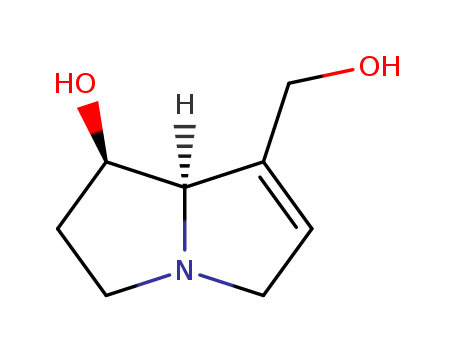
Retronecine

Base Information
  • Chemical Name:Retronecine
  • CAS No.:480-85-3
  • Molecular Formula:C8H13 N O2
  • Molecular Weight:155.197
  • Hs Code.:
  • UNII:2P5723M6II
  • DSSTox Substance ID:DTXSID401020156
  • Nikkaji Number:J12.338B
  • Wikipedia:Retronecine
  • Wikidata:Q3933789
  • Metabolomics Workbench ID:67588
  • Mol file:480-85-3.mol
Retronecine

Synonyms:heliotridine;retronecine;retronecine, (1S-cis)-isomer;retronecine, monohydrochloride, (1S-cis)-isomer;retronecine, monohydrochloride, (1S-trans)-isomer

Suppliers and Price of Retronecine
Supply Marketing:
Business phase:
The product has achieved commercial mass production*data from LookChem market partment
Manufacturers and distributors:
  • Manufacture/Brand
  • Chemicals and raw materials
  • Packaging
  • price
  • TRC
  • (+)-Retronecine
  • 5mg
  • $ 180.00
  • TRC
  • (+)-Retronecine
  • 50mg
  • $ 1390.00
  • Sigma-Aldrich
  • Retronecine analytical standard
  • 10mg
  • $ 775.00
  • Medical Isotopes, Inc.
  • (+)-Retronecine
  • 50 mg
  • $ 2200.00
  • Medical Isotopes, Inc.
  • (+)-Retronecine
  • 5 mg
  • $ 650.00
  • American Custom Chemicals Corporation
  • RETRONECINE 95.00%
  • 5MG
  • $ 497.46
Total 10 raw suppliers
Chemical Property of Retronecine
Chemical Property:
  • Vapor Pressure:0.000211mmHg at 25°C 
  • Melting Point:119-120° 
  • Boiling Point:291.3°Cat760mmHg 
  • PKA:14.48±0.40(Predicted) 
  • Flash Point:161.4°C 
  • PSA:43.70000 
  • Density:1.29g/cm3 
  • LogP:-0.70820 
  • Storage Temp.:2-8°C 
  • Solubility.:Ethanol (Slightly), Methanol (Slightly) 
  • XLogP3:-1.3
  • Hydrogen Bond Donor Count:2
  • Hydrogen Bond Acceptor Count:3
  • Rotatable Bond Count:1
  • Exact Mass:155.094628657
  • Heavy Atom Count:11
  • Complexity:191
Purity/Quality:

99%, *data from raw suppliers

(+)-Retronecine *data from reagent suppliers

Safty Information:
  • Pictogram(s):  
  • Hazard Codes: 
MSDS Files:

SDS file from LookChem

Useful:
  • Canonical SMILES:C1CN2CC=C(C2C1O)CO
  • Isomeric SMILES:C1CN2CC=C([C@@H]2[C@@H]1O)CO
  • General Description Retronecine is a pyrrolizidine alkaloid precursor known for its role in the biosynthesis of hepatotoxic and bioactive compounds like monocrotaline. It is characterized by a 1H-pyrrolizine core structure with hydroxyl and hydroxymethyl substituents, often utilized in the synthesis of macrocyclic dilactones due to its reactive functional groups. retronecine's derivatives are key intermediates in constructing complex alkaloids, demonstrating its significance in both natural product chemistry and pharmacological research.
Technology Process of Retronecine

There total 21 articles about Retronecine which guide to synthetic route it. The literature collected by LookChem mainly comes from the sharing of users and the free literature resources found by Internet computing technology. We keep the original model of the professional version of literature to make it easier and faster for users to retrieve and use. At the same time, we analyze and calculate the most feasible synthesis route with the highest yield for your reference as below:

synthetic route:
Guidance literature:
With barium dihydroxide;
Guidance literature:
With barium hydroxide octahydrate; In water; for 2h; Product distribution;
Refernces

Synthesis of monocrotaline by nucleophilic macrolactonization

10.1021/jo00226a045

The research focuses on the synthesis of monocrotaline, a macrocyclic dilactone pyrrolizidine alkaloid, which is notable for its potent hepatotoxic and antitumor activity, as well as its role as a defensive agent and pheromone precursor in Danaid butterflies. The study addresses the challenges in synthesizing the 11-membered derivative monocrotaline, particularly its tendency for y-lactone formation, which complicates synthetic strategies. The researchers developed a sequence involving the coupling of compounds 10 and 6, followed by nucleophilic ring closure, which includes the displacement of mesylate by a carboxylate ion generated in situ through the desilylation of a β-(trimethylsilyl)ethyl ester 3. Key chemicals used in the process include retronecine derivatives, glutaric anhydride derivative 5, 2-(trimethylsilyl)ethanol, and various reagents for cyclization and deprotection steps. The conclusions of the research confirm the generality of the nucleophilic cyclization method for the synthesis of retronecine-derived dilactones and provide a complete synthesis of monocrotaline, highlighting the effectiveness of the method in the case of pyrrolizidine alkaloids.


Post a RFQ

Enter 15 to 2000 letters.Word count: 0 letters

Attach files(File Format: Jpeg, Jpg, Gif, Png, PDF, PPT, Zip, Rar,Word or Excel Maximum File Size: 3MB)

1 Customer Service

What can I do for you?
Get Best Price

Get Best Price for 480-85-3