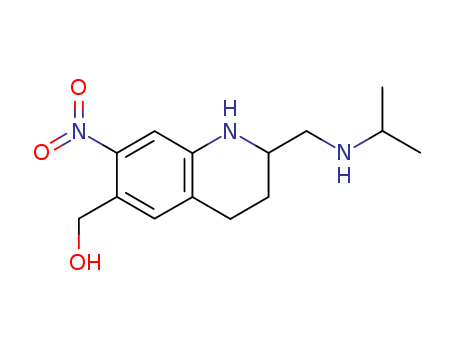
Chemical Property of Oxamniquine
Chemical Property:
- Vapor Pressure:1.19E-08mmHg at 25°C
- Melting Point:147-149°
- Refractive Index:1.5700 (estimate)
- Boiling Point:443.6°Cat760mmHg
- PKA:pKa 3.28 ± 0.07;9.53(H2O,t =25) (Uncertain)
- Flash Point:222.1°C
- PSA:90.11000
- Density:1.174g/cm3
- LogP:2.86390
- XLogP3:2.2
- Hydrogen Bond Donor Count:3
- Hydrogen Bond Acceptor Count:5
- Rotatable Bond Count:4
- Exact Mass:279.15829154
- Heavy Atom Count:20
- Complexity:332
- Purity/Quality:
-
99%, *data from raw suppliers
Oxamniquine *data from reagent suppliers
Safty Information:
- Pictogram(s):
- Hazard Codes:
- MSDS Files:
-
SDS file from LookChem
Useful:
- Canonical SMILES:CC(C)NCC1CCC2=CC(=C(C=C2N1)[N+](=O)[O-])CO
-
Indications
Oxamniquine is used against S. mansoni infections, including advanced cases with hepatomegaly, ascites or with colonic polyposis. Oxamniquine (Vansil) is a tetrahydroquinoline that
stimulates parasite muscular activity at low concentrations
but causes paralysis at higher concentrations. The
drug may act by esterification and binding of DNA,
leading to the death of the schistosome by interruption
of its nucleic acid and protein synthesis. The fluke may
esterify oxamniquine to produce a reactive metabolite
that alkylates parasite DNA. Resistance results from
absent or defective esterifying activity of the drug.
Oxamniquine has a restricted range of efficacy, being
active only against S. mansoni infections.
Oxamniquine is given orally and is readily absorbed
from the intestinal tract. Peak concentrations in plasma
are obtained in about 3 hours. The drug is excreted in
urine mostly as a 6-carboxyl derivative.
Side effects include CNS toxicity with unsteadiness
and occasionally seizures, especially in patients with a
history of seizures. It is contraindicated in pregnancy.
-
Description
Oxamniquine was originally investigated in the 1960s and was found to have limited antiprotozoal
activity, with activity against Schi stosoma mansoni but no activity against the other two
schistosomal organisms. In addition, the drug is stage specific, with activity against cercariae and
very young schistosomula and adult worms. For reasons that remain unknown, the drug is more
effective against adult male worms than against female worms. The drug has structural similarity to
hycanthone, which is no longer used because of severe toxicity and teratogenic effects.
-
Uses
Antischistosomal.
-
Clinical Use
1,2,3,4-Tetrahydro-2-[(isopropylamino)methyl]-7-nitro-6-quinolinemethanol (Vansil) is an antischistosomal agent thatis indicated for the treatment of Schistosoma mansoni (intestinalschistosomiasis) infection. It has been shown to inhibitDNA, RNA, and protein synthesis in schistosomes. The6-hydroxymethyl group is critical for activity; metabolic activationof precursor 6-methyl derivatives is critical. Theoral bioavailability of oxamniquine is good; effectiveplasma levels are achieved in 1 to 1.5 hours. The plasmahalf-life is 1 to 2.5 hours. The drug is extensively metabolizedto inactive metabolites, of which the principal one isthe 6-carboxy derivative.The free base occurs as a yellow crystalline solid thatis slightly soluble in water but soluble in dilute aqueousmineral acids and soluble in most organic solvents. Itis available in capsules containing 250 mg of the drug.Oxamniquine is generally well tolerated. Dizziness anddrowsiness are common, but transitory, side effects. Seriousreactions, such as epileptiform convulsions, are rare. Infection with S. mansoni