Welcome to LookChem.com Sign In|Join Free
  • or

Encyclopedia

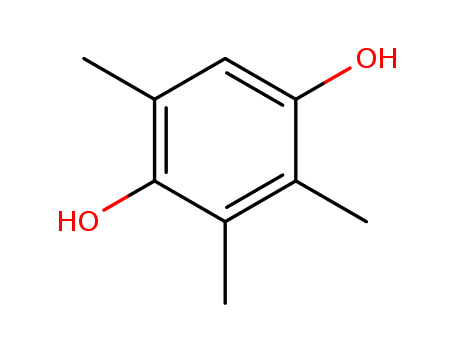
Trimethylhydroquinone

Base Information
  • Chemical Name:Trimethylhydroquinone
  • CAS No.:700-13-0
  • Molecular Formula:C9H12O2
  • Molecular Weight:152.193
  • Hs Code.: Oral rat LD50: 3200 mg/kg
  • European Community (EC) Number:211-838-3
  • NSC Number:401617
  • UNII:GSY6340N4A
  • DSSTox Substance ID:DTXSID7052446
  • Nikkaji Number:J12.289K
  • Wikidata:Q27279264
  • Metabolomics Workbench ID:130602
  • ChEMBL ID:CHEMBL3182864
  • Mol file:700-13-0.mol
Trimethylhydroquinone

Synonyms:Hydroquinone,trimethyl- (6CI,7CI,8CI);1,4-Dihydroxy-2,3,5-trimethylbenzene;2,3,5-Trimethyl-1,4-benzenediol;2,3,5-Trimethyl-1,4-hydroquinone;2,3,5-Trimethyl-p-hydroquinone;2,3,5-Trimethylhydroquinone;NSC 401617;Pseudocumohydroquinone;Trimethyl-p-hydroquinone;Trimethylhydroquinone;y-Cumohydroquinone;

Suppliers and Price of Trimethylhydroquinone
Supply Marketing:
Business phase:
The product has achieved commercial mass production*data from LookChem market partment
Manufacturers and distributors:
  • Manufacture/Brand
  • Chemicals and raw materials
  • Packaging
  • price
  • TRC
  • Trimethylhydroquinone
  • 1g
  • $ 55.00
  • TCI Chemical
  • Trimethylhydroquinone >98.0%(GC)(T)
  • 100g
  • $ 81.00
  • TCI Chemical
  • Trimethylhydroquinone >98.0%(GC)(T)
  • 500g
  • $ 246.00
  • TCI Chemical
  • Trimethylhydroquinone >98.0%(GC)(T)
  • 25g
  • $ 29.00
  • Sigma-Aldrich
  • Trimethylhydroquinone 97%
  • 100g
  • $ 50.00
  • Sigma-Aldrich
  • Trimethylhydroquinone 97%
  • 500g
  • $ 195.00
  • Medical Isotopes, Inc.
  • Trimethylhydroquinone
  • 50 g
  • $ 690.00
  • Medical Isotopes, Inc.
  • Trimethylhydroquinone
  • 10 g
  • $ 610.00
  • Frontier Specialty Chemicals
  • Trimethylhydroquinone 97%
  • 500g
  • $ 205.00
  • Frontier Specialty Chemicals
  • Trimethylhydroquinone 97%
  • 100g
  • $ 56.00
Total 149 raw suppliers
Chemical Property of Trimethylhydroquinone
Chemical Property:
  • Appearance/Colour:off-white, tan or orange powder 
  • Vapor Pressure:0.000723mmHg at 25°C 
  • Melting Point:169-174 °C 
  • Refractive Index:1.572 
  • Boiling Point:298.3 °C at 760 mmHg 
  • PKA:11.28±0.28(Predicted) 
  • Flash Point:146.3 °C 
  • PSA:40.46000 
  • Density:1.126 g/cm3 
  • LogP:2.02300 
  • Storage Temp.:Inert atmosphere,Room Temperature 
  • Solubility.:methanol: 0.1 g/mL, clear 
  • Water Solubility.:2 g/L (20 ºC) 
  • XLogP3:1.7
  • Hydrogen Bond Donor Count:2
  • Hydrogen Bond Acceptor Count:2
  • Rotatable Bond Count:0
  • Exact Mass:152.083729621
  • Heavy Atom Count:11
  • Complexity:136
Purity/Quality:

98%min *data from raw suppliers

Trimethylhydroquinone *data from reagent suppliers

Safty Information:
  • Pictogram(s): HarmfulXn; Dangerous
  • Hazard Codes:Xn,N 
  • Statements: 20-37/38-41-43-50/53 
  • Safety Statements: 24-26-37/39-60-61 
MSDS Files:

SDS file from LookChem

Total 1 MSDS from other Authors

Useful:
  • Chemical Classes:Other Classes -> Phenols
  • Canonical SMILES:CC1=CC(=C(C(=C1O)C)C)O
  • General Description Trimethylhydroquinone is a key intermediate in the synthesis of (All-rac)-α-tocopherol acetate, a vitamin E derivative, where it undergoes condensation with linalool catalyzed by camphorsulfonic acid to form chromanols and tricyclic compounds, which are further processed to yield the final product. Its role highlights its importance in the efficient and cost-effective production of this industrially relevant antioxidant.
Technology Process of Trimethylhydroquinone

There total 42 articles about Trimethylhydroquinone which guide to synthetic route it. The literature collected by LookChem mainly comes from the sharing of users and the free literature resources found by Internet computing technology. We keep the original model of the professional version of literature to make it easier and faster for users to retrieve and use. At the same time, we analyze and calculate the most feasible synthesis route with the highest yield for your reference as below:

synthetic route:
Guidance literature:
With sodium dithionite; In diethyl ether; water;
Guidance literature:
With hydrogen; sodium carbonate; at 80 ℃;
Guidance literature:
2,6,6-trimethyl-1,4-cyclohexanedione; acetic anhydride; With sulfuric acid; acetic acid; at 50 ℃; for 2h;
With water; for 3h; Heating / reflux;
Refernces

A Convenient access to (All-rac)-α-tocopherol acetate from linalool and dihydromyrcene

10.1246/bcsj.82.829

The study explores a novel synthetic route to produce (All-rac)-α-tocopherol acetate, a form of vitamin E, using linalool and dihydromyrcene as starting materials. The researchers employed trimethylhydroquinone (2) as a key reactant and utilized camphorsulfonic acid as a catalyst to condense it with linalool (3b) in a solvent mixture of dodecane and dichloromethane. The resulting crude product, a mixture of chromanols and tricyclic compounds, was sequentially treated with acetic anhydride (Ac2O) and m-chloroperoxybenzoic acid (m-CPBA) to form a mixture of epoxides. This mixture was then converted to the desired (All-rac)-α-tocopherol acetate through a series of reactions involving aluminum isopropoxide, copper(I) iodide-catalyzed Wurtz coupling with citronellylmagnesium chloride, and hydrogenation. The study aimed to develop a more efficient and cost-effective method for synthesizing this important vitamin E derivative, which is widely used in the feed industry due to its antioxidant properties and health benefits.

Post a RFQ

Enter 15 to 2000 letters.Word count: 0 letters

Attach files(File Format: Jpeg, Jpg, Gif, Png, PDF, PPT, Zip, Rar,Word or Excel Maximum File Size: 3MB)

1 Customer Service

What can I do for you?
Get Best Price

Get Best Price for 700-13-0