Welcome to LookChem.com Sign In|Join Free
  • or

Encyclopedia

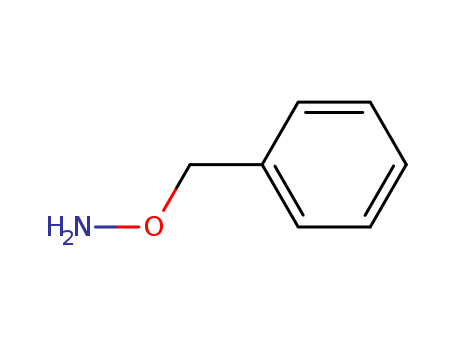
O-Benzylhydroxylamine

Base Information
  • Chemical Name:O-Benzylhydroxylamine
  • CAS No.:622-33-3
  • Molecular Formula:C7H9NO
  • Molecular Weight:123.155
  • Hs Code.:2928 00 90
  • European Community (EC) Number:612-969-2
  • DSSTox Substance ID:DTXSID8073213
  • Nikkaji Number:J45.679I
  • Wikidata:Q27464086
  • Pharos Ligand ID:N5GRKL5TFHYD
  • ChEMBL ID:CHEMBL443652
  • Mol file:622-33-3.mol
O-Benzylhydroxylamine

Synonyms:benzyloxyamine;benzyloxyamine hydrochloride;O-benzylhydroxylamine

Suppliers and Price of O-Benzylhydroxylamine
Supply Marketing:
Business phase:
The product has achieved commercial mass production*data from LookChem market partment
Manufacturers and distributors:
  • Manufacture/Brand
  • Chemicals and raw materials
  • Packaging
  • price
  • TRC
  • O-Benzylhydroxylamine
  • 100mg
  • $ 60.00
  • SynQuest Laboratories
  • O-Benzylhydroxylamine 97%
  • 100 g
  • $ 178.00
  • Sigma-Aldrich
  • O-Benzylhydroxylamine for synthesis. CAS 622-33-3, pH 8 (47 g/l, H O)., for synthesis
  • 8206170010
  • $ 98.80
  • Sigma-Aldrich
  • O-Benzylhydroxylamine for synthesis
  • 10 mL
  • $ 94.35
  • Matrix Scientific
  • O-Benzylhydroxylamine 96%
  • 25g
  • $ 124.00
  • Matrix Scientific
  • O-Benzylhydroxylamine 96%
  • 5g
  • $ 32.00
  • Crysdot
  • O-Benzylhydroxylamine 97%
  • 25g
  • $ 81.00
  • Biosynth Carbosynth
  • O-Benzylhydroxylamine
  • 5 g
  • $ 90.00
  • Biosynth Carbosynth
  • O-Benzylhydroxylamine
  • 2 g
  • $ 46.80
  • Biosynth Carbosynth
  • O-Benzylhydroxylamine
  • 50 g
  • $ 650.00
Total 62 raw suppliers
Chemical Property of O-Benzylhydroxylamine
Chemical Property:
  • Appearance/Colour:Clear colorless liquid 
  • Vapor Pressure:2.09 hPa (58 °C) 
  • Melting Point:238 °C (subl.)(lit.) 
  • Refractive Index:1.5410 
  • Boiling Point:237.5 °C at 760 mmHg 
  • PKA:4.70±0.70(Predicted) 
  • Flash Point:113.1 °C 
  • PSA:35.25000 
  • Density:1.063 g/cm3 
  • LogP:1.77720 
  • Storage Temp.:Store below +30°C. 
  • Solubility.:Soluble in dimethylsulfoxide and methanol. 
  • XLogP3:1.2
  • Hydrogen Bond Donor Count:1
  • Hydrogen Bond Acceptor Count:2
  • Rotatable Bond Count:2
  • Exact Mass:123.068413911
  • Heavy Atom Count:9
  • Complexity:69.3
Purity/Quality:

97% *data from raw suppliers

O-Benzylhydroxylamine *data from reagent suppliers

Safty Information:
  • Pictogram(s): IrritantXi 
  • Hazard Codes:Xi,T 
  • Statements: 36/37/38-25 
  • Safety Statements: 22-24/25-45-26 
MSDS Files:

SDS file from LookChem

Total 1 MSDS from other Authors

Useful:
  • Chemical Classes:Nitrogen Compounds -> Hydroxylamines
  • Canonical SMILES:C1=CC=C(C=C1)CON
  • Uses O-benzylhydroxylamine used in the synthesis of alfa- hydroxybenzylamines from alfa-hydroxyketones. It is also involved in the preparation of hydroxylamines and hydroxyamates.
Technology Process of O-Benzylhydroxylamine

There total 43 articles about O-Benzylhydroxylamine which guide to synthetic route it. The literature collected by LookChem mainly comes from the sharing of users and the free literature resources found by Internet computing technology. We keep the original model of the professional version of literature to make it easier and faster for users to retrieve and use. At the same time, we analyze and calculate the most feasible synthesis route with the highest yield for your reference as below:

synthetic route:
Guidance literature:
With hydrazine; In ethanol; for 4h; Heating;
DOI:10.1021/jo00248a017
Guidance literature:
benzyl alcohol; With N-hydroxyphthalimide; di-isopropyl azodicarboxylate; triphenylphosphine; In tetrahydrofuran; at 20 ℃; for 4h;
With hydrazine hydrate; In tetrahydrofuran; at 20 ℃; for 0.5h;
DOI:10.1021/jo0509399
Refernces

2-Hydroxyisoquinoline-1,3(2H,4H)-diones as inhibitors of HIV-1 integrase and reverse transcriptase RNase H domain: Influence of the alkylation of position 4

10.1016/j.ejmech.2010.11.033

This research presents the synthesis and evaluation of a series of 2-hydroxyisoquinoline-1,3(2H,4H)-dione derivatives as potential inhibitors of HIV-1 integrase and reverse transcriptase RNase H domain. The purpose of the study was to develop new anti-HIV agents that could overcome the limitations of existing therapies, such as high costs, side effects, and drug resistance. The researchers introduced alkyl and arylalkyl groups at position 4 of the 2-hydroxyisoquinoline-1,3(2H,4H)-dione scaffold to investigate the influence of these substitutions on enzymatic inhibitory and antiviral activities. The chemicals used in the process included various alkyl and arylalkyl halides for alkylation, O-benzylhydroxylamine for cyclization, and boron tribromide or trichloride for deprotection. The study concluded that while all compounds showed poor inhibitory properties against HIV-1 reverse transcriptase RNase H, four compounds demonstrated low micromolar level inhibition of HIV-1 integrase. However, high cellular cytotoxicity limited their potential as antiviral agents. Despite this, the identified integrase inhibitors provided a good basis for the development of new antiviral hits. The study also included docking studies using crystallographic data to explain the improved integrase inhibitory activities of certain compounds.


Post a RFQ

Enter 15 to 2000 letters.Word count: 0 letters

Attach files(File Format: Jpeg, Jpg, Gif, Png, PDF, PPT, Zip, Rar,Word or Excel Maximum File Size: 3MB)

1 Customer Service

What can I do for you?
Get Best Price

Get Best Price for 622-33-3