Welcome to LookChem.com Sign In|Join Free
  • or

Encyclopedia

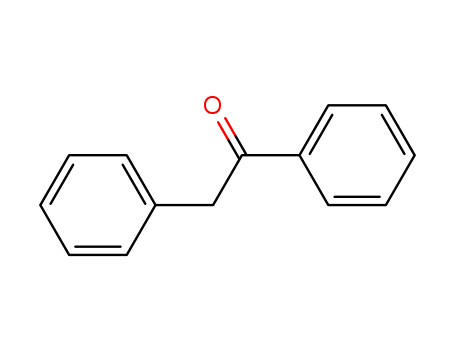
Deoxybenzoin

Base Information
  • Chemical Name:Deoxybenzoin
  • CAS No.:451-40-1
  • Molecular Formula:C14H12O
  • Molecular Weight:196.249
  • Hs Code.:2914.39 DERIVATION
  • European Community (EC) Number:207-193-2
  • NSC Number:249236,131456,6097
  • UNII:F17V6C9PZX
  • DSSTox Substance ID:DTXSID6044430
  • Nikkaji Number:J5.751G
  • Wikidata:Q27277503
  • ChEMBL ID:CHEMBL3182695
  • Mol file:451-40-1.mol
Deoxybenzoin

Synonyms:deoxybenzoin

Suppliers and Price of Deoxybenzoin
Supply Marketing:
Business phase:
The product has achieved commercial mass production*data from LookChem market partment
Manufacturers and distributors:
  • Manufacture/Brand
  • Chemicals and raw materials
  • Packaging
  • price
  • TRC
  • 2-Phenylacetophenone
  • 500g
  • $ 895.00
  • TCI Chemical
  • Benzyl Phenyl Ketone >98.0%(GC)
  • 250g
  • $ 137.00
  • TCI Chemical
  • Benzyl Phenyl Ketone >98.0%(GC)
  • 25g
  • $ 27.00
  • Sigma-Aldrich
  • 2-Phenylacetophenone 97%
  • 25g
  • $ 45.20
  • Rieke Metals
  • 2-Phenylacetophenone 97%
  • 1g
  • $ 215.00
  • Rieke Metals
  • 2-Phenylacetophenone 97%
  • 2g
  • $ 366.00
  • Rieke Metals
  • 2-Phenylacetophenone 97%
  • 5g
  • $ 631.00
  • Medical Isotopes, Inc.
  • 2-Phenylacetophenone
  • 5 g
  • $ 620.00
  • Matrix Scientific
  • 2-Phenylacetophenone
  • 5g
  • $ 588.00
  • Matrix Scientific
  • 2-Phenylacetophenone
  • 2g
  • $ 364.00
Total 117 raw suppliers
Chemical Property of Deoxybenzoin
Chemical Property:
  • Appearance/Colour:White to off-white crystalline powder 
  • Vapor Pressure:0.000313mmHg at 25°C 
  • Melting Point:54-55 °C 
  • Refractive Index:1.583 
  • Boiling Point:320.7 °C at 760 mmHg 
  • Flash Point:137 °C 
  • Density:1.08 g/cm3 
  • Storage Temp.:2-8°C 
  • Solubility.:methanol: 0.1 g/mL, clear 
  • Water Solubility.:Soluble in water (partly), methanol, alcohols, and ketones. 
  • XLogP3:3.2
  • Hydrogen Bond Donor Count:0
  • Hydrogen Bond Acceptor Count:1
  • Rotatable Bond Count:3
  • Exact Mass:196.088815002
  • Heavy Atom Count:15
  • Complexity:197
Purity/Quality:

99% *data from raw suppliers

2-Phenylacetophenone *data from reagent suppliers

Safty Information:
  • Pictogram(s):  
  • Hazard Codes: 
  • Safety Statements: 22-24/25 
MSDS Files:

SDS file from LookChem

Total 1 MSDS from other Authors

Useful:
  • Chemical Classes:Other Classes -> Aromatic Ketones
  • Canonical SMILES:C1=CC=C(C=C1)CC(=O)C2=CC=CC=C2
  • Uses 2-Phenylacetophenone is a benzoin derivative used as a photoinitiator in vinyl polymerization. Deoxybenzoin, is used as a benzoin derivative and as a photoinitiator in vinyl polymerization.
Technology Process of Deoxybenzoin

There total 1128 articles about Deoxybenzoin which guide to synthetic route it. The literature collected by LookChem mainly comes from the sharing of users and the free literature resources found by Internet computing technology. We keep the original model of the professional version of literature to make it easier and faster for users to retrieve and use. At the same time, we analyze and calculate the most feasible synthesis route with the highest yield for your reference as below:

synthetic route:
Refernces

The Relative Reactivity of Methylmagnesium Chloride and Dimethylmagnesium

10.1021/ja01874a043

The study investigates the relative reactivities of methylmagnesium chloride and dimethylmagnesium, focusing on their interactions with various carbonyl compounds in different solvents. Methylmagnesium chloride and dimethylmagnesium are the primary reagents used, with dioxane and isoamyl ether serving as solvents. The researchers found that dimethylmagnesium exhibits a preference for reacting with hydroxyl groups over carbonyl groups, forming ene-diol magnesium salts and resulting in less reactivity toward carbonyl functions compared to methylmagnesium chloride. This was demonstrated through reactions with benzoin, acetophenone, desoxybenzoin, and diphenylacetophenone, where dimethylmagnesium showed lower yields and incomplete reactions. The study also highlights the influence of solvents on reaction outcomes and suggests that the presence of dioxane does not alter the reaction course significantly.

Synthesis of 3,5,6-trisubstituted α-pyrones from Baylis-Hillman adducts

10.1016/j.tetlet.2006.11.180

The research aims to develop an efficient and convenient method for synthesizing 3,5,6-trisubstituted a-pyrones, which are important synthetic intermediates and components of various biologically active natural products. The study starts from Baylis–Hillman adducts and involves sequential steps including the introduction of a ketone at the primary position, lactonization, and oxidation with PCC. Key chemicals used include Baylis–Hillman acetates, various ketone derivatives such as deoxybenzoin and acetophenone, t-BuOK for the initial reaction, NaOH for hydrolysis, TFAA for lactonization, and PCC for oxidation. The results show that the desired a-pyrones can be obtained in moderate yields (51–64%) from the lactone intermediates (4a–h), with the overall process being effective for a range of substrates. The study concludes that this method provides a facile route for the synthesis of these valuable compounds, expanding the utility of Baylis–Hillman adducts in heterocyclic chemistry.


Post a RFQ

Enter 15 to 2000 letters.Word count: 0 letters

Attach files(File Format: Jpeg, Jpg, Gif, Png, PDF, PPT, Zip, Rar,Word or Excel Maximum File Size: 3MB)

1 Customer Service

What can I do for you?
Get Best Price

Get Best Price for 451-40-1