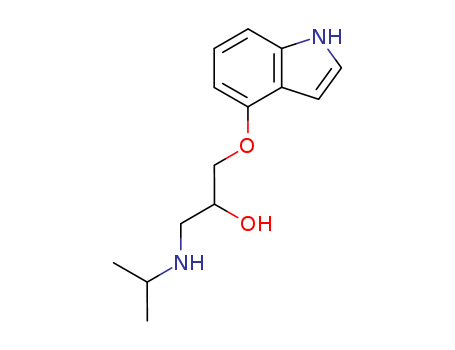
Chemical Property of Pindolol
Chemical Property:
- Appearance/Colour:white to off-white crystalline powder
- Vapor Pressure:3.77E-09mmHg at 25°C
- Melting Point:167-171 °C(lit.)
- Refractive Index:1.5110 (estimate)
- Boiling Point:457.132 °C at 760 mmHg
- PKA:pKa 9.26 (Uncertain)
- Flash Point:230.265 °C
- PSA:57.28000
- Density:1.152 g/cm3
- LogP:2.29650
- Storage Temp.:2-8°C
- Solubility.:0.1 M NaOH: 0.2 mg/mL
- Water Solubility.:33mg/L(22.5 oC)
- XLogP3:1.8
- Hydrogen Bond Donor Count:3
- Hydrogen Bond Acceptor Count:3
- Rotatable Bond Count:6
- Exact Mass:248.152477885
- Heavy Atom Count:18
- Complexity:248
- Purity/Quality:
-
97% *data from raw suppliers
Pindolol
*data from reagent suppliers
Safty Information:
- Pictogram(s):
 Xn
Xn
- Hazard Codes:Xn
- Statements:
22-36/37/38
- Safety Statements:
26-36
- MSDS Files:
-
SDS file from LookChem
Total 1 MSDS from other Authors
Useful:
- Drug Classes:Beta-Adrenergic Receptor Antagonists
- Canonical SMILES:CC(C)NCC(COC1=CC=CC2=C1C=CN2)O
- Recent ClinicalTrials:Study of Human Non-Shivering Thermogenesis and Basal Metabolic Rate
- Recent EU Clinical Trials:Intensiv ikke-sympatikus aktiverende vasodilaterende behandling hos patienter med mikrovaskul?r angina pectoris
-
Uses
Mixed β-adrenergic blocker and serotonin 5HT1A-receptor antagonist. Antihypertensive; antianginal; antiarrhythmic; antiglaucoma. Pindolol, like nadolol, is a nonselective β-adrenoblocker. It possesses antianginal, antihy�potensive, and antiarrythmic action. It is used for arterial hypertension, angina stress (pre�venting attacks), supraventricular tachycardia, tachsystolic form of atrial fibrillation, and
superventricular extrasystole.
-
Therapeutic Function
Beta-adrenergic blocker
-
Clinical Use
Beta-blocker:
Hypertension
Angina
-
Drug interactions
Potentially hazardous interactions with other drugs
Anaesthetics: enhanced hypotensive effect.
Analgesics: NSAIDs antagonise hypotensive effect.
Anti-arrhythmics: increased risk of myocardial
depression and bradycardia; increased risk of
bradycardia, myocardial depression and AV block
with amiodarone; increased risk of myocardial
depression and bradycardia with flecainide.
Antidepressants: enhanced hypotensive effect with
MAOIs.
Antihypertensives; enhanced hypotensive effect;
increased risk of withdrawal hypertension with
clonidine; increased risk of first dose hypotensive
effect with post-synaptic alpha-blockers such as
prazosin.
Antimalarials: increased risk of bradycardia with
mefloquine.
Antipsychotics: enhanced hypotensive effect with
phenothiazines.
Calcium-channel blockers: increased risk of
bradycardia and AV block with diltiazem;
hypotension and heart failure possible with
nifedipine and nisoldipine; asystole, severe
hypotension and heart failure with verapamil.
Cytotoxics: possible increased risk of bradycardia
with crizotinib.
Diuretics: enhanced hypotensive effect.
Fingolimod: possibly increased risk of bradycardia.
Moxisylyte: possible severe postural hypotension.
Sympathomimetics: severe hypertension with
adrenaline and noradrenaline and possibly with
dobutamine.