Welcome to LookChem.com Sign In|Join Free
  • or

Encyclopedia

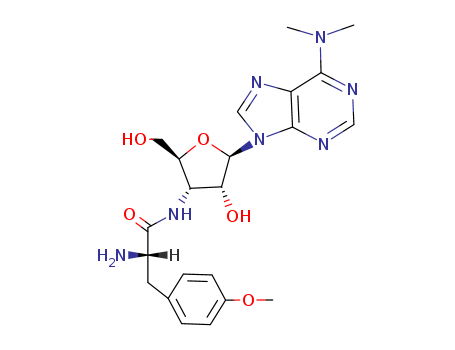
Puromycin

Base Information
  • Chemical Name:Puromycin
  • CAS No.:53-79-2
  • Molecular Formula:C22H29 N7 O5
  • Molecular Weight:471.516
  • Hs Code.:
  • European Community (EC) Number:200-387-8
  • UNII:4A6ZS6Q2CL
  • DSSTox Substance ID:DTXSID8036788
  • Nikkaji Number:J2.310H
  • Wikipedia:Puromycin
  • Wikidata:Q424696,Q27167243
  • NCI Thesaurus Code:C787
  • Metabolomics Workbench ID:51097
  • ChEMBL ID:CHEMBL469912
  • Mol file:53-79-2.mol
Puromycin

Synonyms:CL 13900;CL-13900;CL13900;P 638;P-638;P638;Puromycin;Puromycin Dihydrochloride;Puromycin Hydrochloride;Stylomycin

Suppliers and Price of Puromycin
Supply Marketing:
Business phase:
The product has achieved commercial mass production*data from LookChem market partment
Manufacturers and distributors:
  • Manufacture/Brand
  • Chemicals and raw materials
  • Packaging
  • price
  • TRC
  • Puromycin
  • 100mg
  • $ 715.00
  • DC Chemicals
  • Puromycin >98%
  • 100 mg
  • $ 300.00
  • DC Chemicals
  • Puromycin >98%
  • 250 mg
  • $ 600.00
  • DC Chemicals
  • Puromycin >98%
  • 1 g
  • $ 1200.00
  • American Custom Chemicals Corporation
  • PUROMYCIN 95.00%
  • 100MG
  • $ 758.70
  • American Custom Chemicals Corporation
  • PUROMYCIN 95.00%
  • 25MG
  • $ 608.32
  • American Custom Chemicals Corporation
  • PUROMYCIN 95.00%
  • 10MG
  • $ 575.21
  • Alfa Aesar
  • Puromycin, 10 mg/ml in distilled water, sterile-filtered
  • 5x1ml
  • $ 204.00
  • Alfa Aesar
  • Puromycin, 10 mg/ml in distilled water, sterile-filtered
  • 1ml
  • $ 61.90
  • AHH
  • Puromycin 98%
  • 1g
  • $ 880.00
Total 30 raw suppliers
Chemical Property of Puromycin
Chemical Property:
  • Vapor Pressure:8.44E-30mmHg at 25°C 
  • Melting Point:175.5-177° 
  • Refractive Index:1.7010 (estimate) 
  • Boiling Point:°Cat760mmHg 
  • PKA:6.8, 7.2(at 25℃) 
  • Flash Point:°C 
  • PSA:160.88000 
  • Density:1.51 g/cm3 
  • LogP:0.29750 
  • Water Solubility.:Soluble in water (50 mg/ml at 20°C). 
  • XLogP3:0
  • Hydrogen Bond Donor Count:4
  • Hydrogen Bond Acceptor Count:10
  • Rotatable Bond Count:8
  • Exact Mass:471.22301705
  • Heavy Atom Count:34
  • Complexity:680
Purity/Quality:

99%, *data from raw suppliers

Puromycin *data from reagent suppliers

Safty Information:
  • Pictogram(s): Toxic to living cells of all kinds. 
  • Hazard Codes:Toxic to living cells of all kinds. 
MSDS Files:

SDS file from LookChem

Useful:
  • Canonical SMILES:CN(C)C1=NC=NC2=C1N=CN2C3C(C(C(O3)CO)NC(=O)C(CC4=CC=C(C=C4)OC)N)O
  • Isomeric SMILES:CN(C)C1=NC=NC2=C1N=CN2[C@H]3[C@@H]([C@@H]([C@H](O3)CO)NC(=O)[C@H](CC4=CC=C(C=C4)OC)N)O
  • Description Puromycin is an aminonucleoside antibiotic produced by Streptomyces alboniger. It is a very common antibiotic routinely used by scientists in biomedical research to select cells modified by genetic engineering. It specifically inhibits peptidyl transfer on both prokaryotic and eukaryotic ribosomes. The antibiotic inhibits the growth of Gram-positive bacteria and various animal and insect cells. Fungi and Gram-negative bacteria are resistant due to the low permeability of the antibiotic. For more than 30 years, puromycin has been widely used as a basic tool for studying protein synthesis. Now, puromycin hydrochloride is particularly useful for the selection of cell types harboring plasmids carrying puromycin resistance genes. Puromycinresistant cells express pac gene, which encodes an N-acetyl puromycin transferase. The pac gene can be mobilized on a plasmid and used to transfect a host cell in an attempt to provide resistance; therefore, puromycin can be used in gene selections for mammalian host cells. This aminonucleoside antibiotic causes premature chain termination during translation in the ribosomes. Part of the molecule resembles the 30 end of the aminoacylated tRNA. It enters the A site and transfers to the growing chain, causing premature chain release. The exact mechanism of action is unknown, but the 30 position contains an amide linkage instead of the normal ester linkage of tRNA; the amide bond makes the molecule much more resistant to hydrolysis and thus causes the ribosome to become stopped. It is not selective for either prokaryotes or eukaryotes. Also of note, puromycin is critical in mRNA display as it allows the growing peptide chain to be covalently bonded to its own mRNA template. Additionally, puromycin is a reversible inhibitor of dipeptidyl-peptidase II (serine peptidase) and cytosol alanyl aminopeptidase (metallopeptidase). The mechanism of inhibition is not well understood; however, puromycin can be used to distinguish between aminopeptidase M (active) and cytosol alanyl aminopeptidase (inhibited by puromycin) and therefore extremely useful in biochemistry and nephrology research.
  • Uses Puromycin has been widely used as a basic tool in research for studying protein synthesis. It is an antibiotic used by scientists in bioresearch to select cells modified by genetic engineering. It inhibits protein synthesis by binding to RNA. It is also an antineoplastic and antitrypanosomal agent. Puromycin is a nucleoside antibiotic isolated from Streptomyces alboniger in the 1950s as an anti-trypansomal agent with antibiotic activity. Puromycin is non-selective, inhibiting RNA by blocking ribosomal translation. Puromycin is used in cell biology to select mammalian cell lines that have been transformed by vectors that express puromycin-N-acetyl-transferase. Puromycin is an aminonuclease antibiotic produced by the soil actinomycete?Streptomyces alboniger; which induces apoptosis.
Technology Process of Puromycin

There total 28 articles about Puromycin which guide to synthetic route it. The literature collected by LookChem mainly comes from the sharing of users and the free literature resources found by Internet computing technology. We keep the original model of the professional version of literature to make it easier and faster for users to retrieve and use. At the same time, we analyze and calculate the most feasible synthesis route with the highest yield for your reference as below:

synthetic route:
Guidance literature:
Multi-step reaction with 6 steps
1: 92 percent / NH4HCO2 / Pd(OH)2-C / H2O; methanol / 1.5 h / Heating
2: pyridine / 48 h / 5 °C
3: 59.4 mg / TMSCl / pyridine
4: 25.8 mg / pyridine; H2O / 19 h / 20 °C
5: 62 percent / DCC; N-hydroxysuccinimide / dimethylformamide / 0 - 20 °C
6: 36 percent / TFA / 0.13 h / 20 °C
With 1-hydroxy-pyrrolidine-2,5-dione; chloro-trimethyl-silane; ammonium formate; dicyclohexyl-carbodiimide; trifluoroacetic acid; palladium hydroxide - carbon; In pyridine; methanol; water; N,N-dimethyl-formamide;
DOI:10.1021/jo010935d
Refernces

A STEREOSELECTIVE SYNTHESIS OF THE C-15 TO C-20 SEGMENT OF RIFAMYCIN-S

10.1016/S0040-4039(00)84780-2

The research focuses on the stereoselective synthesis of the C-15 to C-20 segment of rifamycin-S, specifically targeting the construction of 5-substituted 2-methyl-2Z,4E-pentadienoic acid. The purpose of this study was to develop a new and stereoselective method for the synthesis of this key compound, which is part of the ansa chain of rifamycin-S. The researchers achieved this by using a series of chemical reactions starting with the alkylation of ethyl 2-selenophenyl propionate with substituted allylic chloride in the presence of LDA, followed by hydrolysis, iodolactonization, oxidative elimination of the selenophenyl group, and finally, treatment with zinc in refluxing ethanol to yield the desired dienoic acid. The study concluded that the methodology was successful in constructing the target molecule with the correct stereochemistry and could be valuable for a variety of synthetic approaches, including the construction of the ansa chain 2 of rifamycin-S.

Inhibition of ribosomal peptidyltransferase with 2'(3')-O-acetyl-2 inches(3 inches)-O-glycyl-1,2-di(adenosin-N6-yl)ethane and -1,4-di(adenosin-N6-yl)butane. Effect of alkyl chain length.

10.1021/jm00181a015

The study investigates the synthesis and biological activity of two compounds, XIIIa and XIIIb, designed to inhibit ribosomal peptidyltransferase, an enzyme crucial for peptide bond formation during protein synthesis. The researchers used a series of chemical reactions involving starting materials like p-(2-amino-ethyl)adenosine (Ia) and methyl orthoacetate (II) to synthesize the target compounds. The synthesis process included steps such as cyclization, hydrolysis, and coupling reactions to form intermediates like III, VI, and XIa/b, ultimately leading to XIIIa and XIIIb. These compounds were tested for their ability to inhibit the puromycin reaction catalyzed by ribosomes. The study found that XIIIb, with a longer alkyl chain, was a more effective inhibitor than XIIIa, suggesting that the length of the alkyl chain significantly impacts the inhibitory activity. The results indicate that these compounds simulate the 3’ terminal of aminoacyl-tRNA rather than being transition state analogues of the enzyme-catalyzed reaction, providing insights into the mechanism of action of peptidyltransferase.

Post a RFQ

Enter 15 to 2000 letters.Word count: 0 letters

Attach files(File Format: Jpeg, Jpg, Gif, Png, PDF, PPT, Zip, Rar,Word or Excel Maximum File Size: 3MB)

1 Customer Service

What can I do for you?
Get Best Price

Get Best Price for 53-79-2
