Welcome to LookChem.com Sign In|Join Free
  • or

Encyclopedia

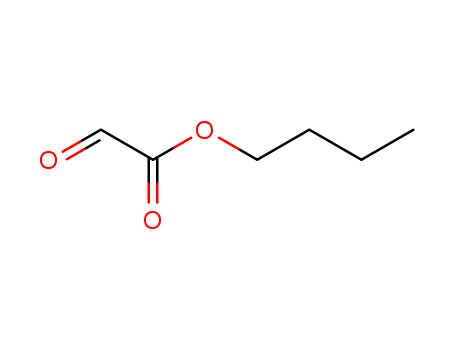
Butyl glyoxylate

Base Information
  • Chemical Name:Butyl glyoxylate
  • CAS No.:6295-06-3
  • Molecular Formula:C6H10O3
  • Molecular Weight:130.144
  • Hs Code.:2918300090
  • European Community (EC) Number:228-561-9
  • NSC Number:11793
  • UNII:AH46A7531R
  • DSSTox Substance ID:DTXSID0064208
  • Nikkaji Number:J206.862A
  • Wikidata:Q65225259
  • Mol file:6295-06-3.mol
Butyl glyoxylate

Synonyms:Butyl glyoxylate;butyl 2-oxoacetate;6295-06-3;Butyl oxoacetate;Butyl glyoxalate;N-Butyl glyoxylate;Acetic acid, oxo-, butyl ester;Glyoxylic acid, butyl ester;AH46A7531R;Acetic acid, 2-oxo-, butyl ester;NSC-11793;n-butyl glyoxalate;1-butyl glyoxylate;glyoxylic acid butyl ester;Glyoxalic acid butyl ester;SCHEMBL195396;UNII-AH46A7531R;DTXSID0064208;NSC11793;EINECS 228-561-9;MFCD00043908;NSC 11793;AKOS006273499;AI3-19936;FT-0655482

Suppliers and Price of Butyl glyoxylate
Supply Marketing:
Business phase:
The product has achieved commercial mass production*data from LookChem market partment
Manufacturers and distributors:
  • Manufacture/Brand
  • Chemicals and raw materials
  • Packaging
  • price
  • Crysdot
  • Butyl2-oxoacetate 95+%
  • 5g
  • $ 743.00
  • American Custom Chemicals Corporation
  • BUTYL GLYOXYLATE 95.00%
  • 5G
  • $ 909.56
Total 29 raw suppliers
Chemical Property of Butyl glyoxylate
Chemical Property:
  • Vapor Pressure:1.37mmHg at 25°C 
  • Refractive Index:1.41 
  • Boiling Point:171.9 °C at 760 mmHg 
  • Flash Point:62.8 °C 
  • PSA:43.37000 
  • Density:1.013 g/cm3 
  • LogP:0.52860 
  • XLogP3:1.3
  • Hydrogen Bond Donor Count:0
  • Hydrogen Bond Acceptor Count:3
  • Rotatable Bond Count:5
  • Exact Mass:130.062994177
  • Heavy Atom Count:9
  • Complexity:98.5
Purity/Quality:

99.9% *data from raw suppliers

Butyl2-oxoacetate 95+% *data from reagent suppliers

Safty Information:
  • Pictogram(s):  
  • Hazard Codes: 
MSDS Files:

SDS file from LookChem

Useful:
  • Chemical Classes:Other Classes -> Other Organic Compounds
  • Canonical SMILES:CCCCOC(=O)C=O
Technology Process of Butyl glyoxylate

There total 15 articles about Butyl glyoxylate which guide to synthetic route it. The literature collected by LookChem mainly comes from the sharing of users and the free literature resources found by Internet computing technology. We keep the original model of the professional version of literature to make it easier and faster for users to retrieve and use. At the same time, we analyze and calculate the most feasible synthesis route with the highest yield for your reference as below:

synthetic route:
Guidance literature:
With (NH4)4[CuMo6O18(OH)6]·5H2O; oxygen; sodium sulfite; In water; acetonitrile; at 60 ℃; for 12h; under 760.051 Torr;
DOI:10.1039/c9gc01248f
Guidance literature:
With periodic acid; In diethyl ether; at 0 ℃;
DOI:10.1021/ol900196w
Guidance literature:
dibutyl fumarate; With oxygen; ozone; In dichloromethane; at -78 ℃;
With dimethylsulfide; In dichloromethane; at -78 ℃; for 5h;
DOI:10.1021/ja504727u
Refernces

TOTAL SYNTHESIS OF HIGHER-CARBON SUGARS: SYNTHESIS OF METHYL 3,4,5-TRI-O-ACETYL-1,7-DI-O-BENZYL-α-DL-gluco-HEPT-2-ULOPYRANOSIDE

10.1016/S0008-6215(00)90756-0

The research aimed to achieve the total synthesis of higher-carbon sugars, specifically focusing on the synthesis of methyl 3,4,5-tri-O-acetyl-1,7-di-O-benzyl-α-DL-gulo-hept-2-ulopyranoside. The purpose of this study was to expand upon the methods of synthesizing monosaccharides from furan compounds, particularly targeting the preparation of hex-2-uloses, which are a common type of ketose sugar. The researchers successfully synthesized a racemic α-DL-hept-2-ulopyranoside derivative from a non-sugar precursor, marking a significant advancement in the field of carbohydrate chemistry. The process involved a series of chemical reactions, including reduction, benzylation, hydrolysis, and acetylation, utilizing chemicals such as butyl glyoxylate, lithium aluminium hydride, toluene-p-sulphonic acid, and various benzyl-protected compounds. The conclusions of the study detailed the successful synthesis of the target compound through a series of stereoselective reactions, which not only demonstrated the viability of the approach but also opened up new avenues for the synthesis of complex carbohydrate structures.

Catalytic asymmetric allylation of aldehydes using the chiral (salen)chromium(III) complexes

10.1016/j.tet.2006.03.032

The research focuses on the enantioselective allylation of aldehydes using chiral (salen)chromium(III) complexes as catalysts. The purpose of the study was to develop a novel and efficient method for the asymmetric allylation of aldehydes, a significant process in organic synthesis. The researchers investigated the reaction of allylstannanes with glyoxylates, glyoxals, and simple aromatic and aliphatic aldehydes, catalyzed by chiral (salen)Cr(III) complexes. They found that the reaction proceeded smoothly for reactive 2-oxoaldehydes and allyltributyltin in the presence of small amounts of (salen)Cr(III)BF4 under mild conditions. However, for other simple aldehydes, high-pressure conditions were required to obtain good yields. The classic chromium catalyst, easily prepared from commercially available chloride complex, afforded homoallylic alcohols usually in good yield and with enantiomeric purity of 50–79% ee. The study concluded that the developed method is reproducible, not very sensitive to external factors such as oxygen or moisture, and requires only 1–2 mol % of the catalyst. The chemicals used in the process included various metallosalen complexes, allyltributyltin, and different aldehydes such as n-butyl glyoxylate, iso-propyl glyoxylate, and tert-butyl glyoxylate, among others.


Post a RFQ

Enter 15 to 2000 letters.Word count: 0 letters

Attach files(File Format: Jpeg, Jpg, Gif, Png, PDF, PPT, Zip, Rar,Word or Excel Maximum File Size: 3MB)

1 Customer Service

What can I do for you?
Get Best Price

Get Best Price for 6295-06-3