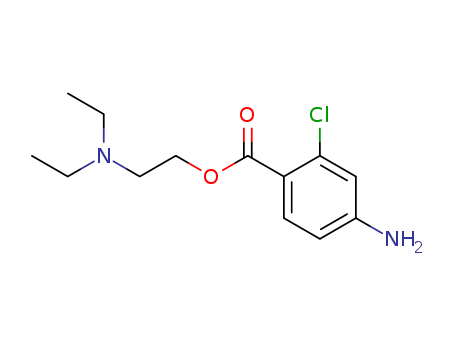
Chemical Property of Chloroprocaine
Chemical Property:
- Vapor Pressure:1.08E-06mmHg at 25°C
- Melting Point:42°C
- Refractive Index:1.553
- Boiling Point:402.632 °C at 760 mmHg
- PKA:9.14±0.25(Predicted)
- Flash Point:197.305 °C
- PSA:55.56000
- Density:1.17 g/cm3
- LogP:3.80400
- XLogP3:2.9
- Hydrogen Bond Donor Count:1
- Hydrogen Bond Acceptor Count:4
- Rotatable Bond Count:7
- Exact Mass:270.1135055
- Heavy Atom Count:18
- Complexity:259
- Purity/Quality:
-
99% *data from raw suppliers
Chloroprocaine *data from reagent suppliers
Safty Information:
- Pictogram(s):
- Hazard Codes:
- MSDS Files:
-
SDS file from LookChem
Useful:
- Canonical SMILES:CCN(CC)CCOC(=O)C1=C(C=C(C=C1)N)Cl
- Recent ClinicalTrials:1% Chloroprocaine(PF) vs. Bupivacaine Spinals
- Recent EU Clinical Trials:Comparative study of cloroprocaine versus prilocaine intrathecal anestesia in major ambulatory surgery
-
Description
Chloroprocaine (N,N′-diethylaminoethyl 4-amino-2-chlorobenzoate) is a very short-acting, amino
ester-type local anesthetic used to provide regional anesthesia by infiltration as well as by
peripheral and central nerve block, including lumbar and caudal epidural blocks. The presence of
a chlorine atom ortho to the carbonyl of the ester function increases its rate of hydrolysis by
plasma cholinesterase at least threefold compared to procaine and benzocaine. Thus,
chloroprocaine may be used in maternal and neonatal patients with minimal placental passage of
chloroprocaine. The lower plasma cholinesterase activity in the maternal epidural space must still
have sufficient activity for degrading chloroprocaine and, thus, not allowing it to cross the
placenta barrier. Like PABA, the hydrolysis product of chloroprocaine, 4-amino-2-chlorobenzoic acid, also inhibits
the action of sulfonamides. Therefore, its use with sulfonamides should be avoided.
-
Uses
Chloroprocaine is an ester that is metabolised rapidly by ester hydrolysis,
so its duration of action is short and potential for cardiac toxicity relatively
low. It can be used as a preservative-free solution for spinal anaesthesia for
surgical procedures up to 40 min in duration. Anesthetic (local).
-
Biological Functions
Chloroprocaine hydrochloride (Nesacaine) is obtained
from addition of a chlorine atom to procaine, which results
in a compound of greater potency and less toxicity
than procaine itself. This local anesthetic is hydrolyzed
very rapidly by cholinesterase and therefore has a short
plasma half-life. Because it is broken down rapidly,
chloroprocaine is commonly used in obstetrics. It is believed
that the small amount that might get to the fetus
continues to be rapidly hydrolyzed, so there may be no
residual effects on the neonate.
-
Clinical Use
Chloroprocaine is used for cutaneous or mucous membraneinfiltration for surgical procedures, epidural anesthesia(without preservatives) and for peripheral conduction block.