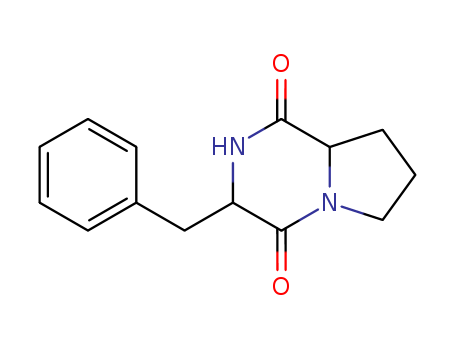
Chemical Property of Cyclo(L-Phe-L-Pro)
Chemical Property:
- Vapor Pressure:1.68E-10mmHg at 25°C
- Melting Point:146-148 °C
- Boiling Point:509.5°Cat760mmHg
- PKA:13.21±0.40(Predicted)
- Flash Point:262°C
- PSA:49.41000
- Density:1.26g/cm3
- LogP:0.98520
- Storage Temp.:-15°C
- Solubility.:Chloroform (Slightly), Ethanol (Slightly, Sonicated)
- XLogP3:1.4
- Hydrogen Bond Donor Count:1
- Hydrogen Bond Acceptor Count:2
- Rotatable Bond Count:2
- Exact Mass:244.121177757
- Heavy Atom Count:18
- Complexity:350
- Purity/Quality:
-
99% *data from raw suppliers
Cyclo(L-prolyl-L-phenylalanyl) *data from reagent suppliers
Safty Information:
- Pictogram(s):
- Hazard Codes:
- MSDS Files:
-
SDS file from LookChem
Useful:
- Canonical SMILES:C1CC2C(=O)NC(C(=O)N2C1)CC3=CC=CC=C3
- Isomeric SMILES:C1C[C@H]2C(=O)N[C@H](C(=O)N2C1)CC3=CC=CC=C3
-
Uses
Cyclo(L-prolyl-L-phenylalanyl) is a diketopiperazine derivative isolated from Bacillus thuringiensis and Bacillus endophyticus. Cyclo(L-Phe-L-Pro) is a diketopiperazine formed by the fusion of phenylalanine and proline, reported as a secondary metabolite of fungi and bacteria. In Pseudomonas aeruginosa, cyclo(L-Phe-L-Pro) is capable of activating N-acylhomoserine lactones (AHLs). Cyclo(L-Phe-L-Pro) is also capable of activating or antagonizing other LuxR-based quorum-sensing systems. While the mode of action of cyclo(L-Phe-L-Pro) is not known, its activity suggests the existence of cross talk among bacterial signalling systems.