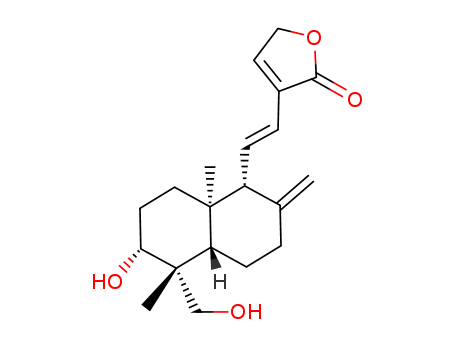
Chemical Property of 14-Deoxy-11,12-didehydroandrographolide
Chemical Property:
- Vapor Pressure:5.71E-13mmHg at 25°C
- Melting Point:204-205oC
- Boiling Point:519.6oC at 760 mmHg
- PKA:14.80±0.70(Predicted)
- Flash Point:182.4oC
- PSA:66.76000
- Density:1.17g/cm3
- LogP:2.76780
- XLogP3:3.2
- Hydrogen Bond Donor Count:2
- Hydrogen Bond Acceptor Count:4
- Rotatable Bond Count:3
- Exact Mass:332.19875937
- Heavy Atom Count:24
- Complexity:605
- Purity/Quality:
-
99%, *data from raw suppliers
14-Deoxy-11,12-didehydroandrographolide analytical standard *data from reagent suppliers
Safty Information:
- Pictogram(s):
- Hazard Codes:
- MSDS Files:
-
SDS file from LookChem
Useful:
- Canonical SMILES:CC12CCC(C(C1CCC(=C)C2C=CC3=CCOC3=O)(C)CO)O
- Isomeric SMILES:C[C@@]12CC[C@H]([C@@]([C@H]1CCC(=C)[C@H]2/C=C/C3=CCOC3=O)(C)CO)O
-
Description
14-deoxy-11,12-didehydro Andrographolide is an analog of the natural diterpenoid andrographolide that can be isolated from A. paniculata. It retains the anti-inflammatory, antiallergenic, immuno-stimulatory, antiviral, antioxidant, hepatoprotective, and cardiovascular activities of andrographolide without producing cytotoxicity in KB cells (ED50 >20 μg/ml) that can occur with andrographolide 6.5 μg/ml.
-
Uses
14-Deoxy-11,12-didehydroandrographolide is the derivative of Andrographolide(A637475) is a labdane diterpenoid (2). Andrographolide is the main bioactive component isolated from the medicinal plant Andrographis paniculata (2). Andrographolide showed significant antihepatotoxic action in P. berghei K173-induced hepatic damage in M. natalensis(1). Andrographolide inhibits tumor necrosis factor-α (TNF-α)-induced intercellular adhesion mol.-1 (ICAM-1) expression and adhesion of HL-60 cells onto human umbilical vein endothelial cells (HUVEC), which are associated with inflammatory diseases (2). These findings suggest that Andrographolide may have potential as a cardiovascular-protective agent.