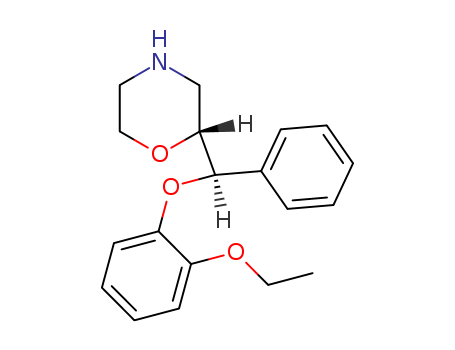
Chemical Property of Reboxetine
Chemical Property:
- Vapor Pressure:4.54E-08mmHg at 25°C
- Melting Point:170-171°
- Boiling Point:443.7°C at 760 mmHg
- Flash Point:188.2°C
- PSA:39.72000
- LogP:3.52260
- XLogP3:3
- Hydrogen Bond Donor Count:1
- Hydrogen Bond Acceptor Count:4
- Rotatable Bond Count:6
- Exact Mass:313.16779360
- Heavy Atom Count:23
- Complexity:333
- Purity/Quality:
-
99%, *data from raw suppliers
REBOXETINE 95.00% *data from reagent suppliers
Safty Information:
- Pictogram(s):
- Hazard Codes:
- MSDS Files:
-
SDS file from LookChem
Useful:
- Canonical SMILES:CCOC1=CC=CC=C1OC(C2CNCCO2)C3=CC=CC=C3
- Isomeric SMILES:CCOC1=CC=CC=C1O[C@@H]([C@H]2CNCCO2)C3=CC=CC=C3
- Recent ClinicalTrials:Efficacy of Reboxetine and Methylphenidate Treatment on Attentional, Sensory and Emotional Dysregulation in Adults With PTSD
- Recent EU Clinical Trials:The effect of various medications on emotioal processing, attention, experiences and sensory information processing
-
Description
Reboxetine is a pure noradrenaline reuptake inhibitor that is licensed as an antidepressant in the United Kingdom. Reboxetine has established efficacy based on placebo-controlled studies both in the short and the long term. Previous noradrenaline reuptake inhibitors, such as desipramine, nortriptyline, and maprotiline, have been relatively selective for noradrenaline compared with serotonin but have not avoided affinities with α1, muscarinic, and histaminergic receptors. The lack of selectivity of these drugs has the consequence that the levels of cardiotoxicity are those expected with TCAs. Reboxetine is the first pure noradrenaline reuptake inhibitor, and therefore it may also provide a more appropriate agent to consider for the investigation of possible adjunctive treatments with SSRIs.
-
Clinical Use
Reboxetine is a nontricyclic SNRI in which the propylamine side chain of the TCAs is constrained into a
morpholine ring. It is a potent and selective ligand for the NET, with a mechanism of action is
similar to that of desipramine. Reboxetine is used for the treatment of major depressive disorders. It is a
chiral compound that is marketed as a racemic mixture of R,R- and S,S-reboxetine. The antidepressant
activity for reboxetine appears to reside with the S,S-(+)-enantiomer, which has approximately twofold the
inhibition potency of the R,R-enantiomer. It is well tolerated, with different adverse-event profiles, and it
appears to be at least as effective as the SSRIs in the treatment of depressive illness. Currently, it is
available only in Europe and is under U.S. FDA review. It preferentially inhibits the reuptake of NE (5-HT :NE
ratio, 8). Reboxetine is not metabolized by the polymorphic isoforms, CYP2D6 or CYP2C19, and may offer a
valuable alternative to the secondary amine TCAs in the treatment of major depression. Reboxetine is likely
to become a promising alternative for patients who have failed treatment with or do not tolerate serotonergic
antidepressants.
-
Drug interactions
Reboxetine seems to be an antidepressant that has negligible interference with the pharmacokinetics of other
drugs; thus, fewer drug–drug interactions are expected. It also may be possible to use reboxetine in
combination with MAOIs, because it has no inhibitory effect on this enzyme, which would avoid tyramine�induced hypertensive reactions.