Welcome to LookChem.com Sign In|Join Free
  • or

Encyclopedia

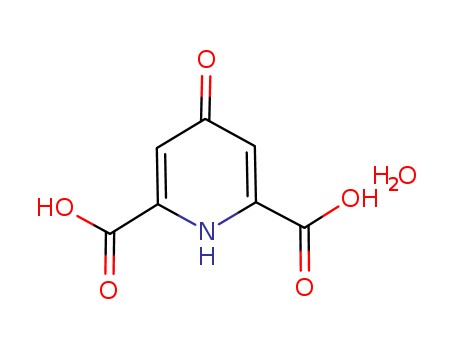
4-Oxo-1,4-dihydropyridine-2,6-dicarboxylic acid hydrate

Base Information
  • Chemical Name:4-Oxo-1,4-dihydropyridine-2,6-dicarboxylic acid hydrate
  • CAS No.:199926-39-1
  • Molecular Formula:C7H5NO5*H2O
  • Molecular Weight:201.136
  • Hs Code.:2933399090
  • DSSTox Substance ID:DTXSID60486644
  • Mol file:199926-39-1.mol
4-Oxo-1,4-dihydropyridine-2,6-dicarboxylic acid hydrate

Synonyms:199926-39-1;4-Oxo-1,4-dihydropyridine-2,6-dicarboxylic acid hydrate;chelidamic acid monohydrate;4-Oxo-1H-pyridine-2,6-dicarboxylic acid;hydrate;Chelidamic acid hydrate;4-HYDROXYPYRIDINE-2,6-DICARBOXYLIC ACID HYDRATE;2,6-Pyridinedicarboxylic acid, 1,4-dihydro-4-oxo-, hydrate (1:1);1961195-81-2;SCHEMBL113302;Chelidamic acid monohydrate,98;DTXSID60486644;MFCD00150943;MFCD03818117;AKOS015998637;CHELIDAMIC ACID MONOHYDRATE, 98;AS-50193;Chelidamic acid hydrate, >=95%, powder;SY233437;CS-0062895;EN300-207708;O11277;A879902;4-hydroxypyridine-2,6-dicarboxylic acid monohydrate;4-Oxo-1,4-dihydropyridine-2,6-dicarboxylic acid monohydrate;Chelidamic acid hydrate, >=97.0% (dried material, T), ~1 mol/mol water

Suppliers and Price of 4-Oxo-1,4-dihydropyridine-2,6-dicarboxylic acid hydrate
Supply Marketing:
Business phase:
The product has achieved commercial mass production*data from LookChem market partment
Manufacturers and distributors:
  • Manufacture/Brand
  • Chemicals and raw materials
  • Packaging
  • price
  • TRC
  • 4-Oxo-1,4-dihydropyridine-2,6-dicarboxylicAcidHydrate
  • 100mg
  • $ 60.00
  • TCI Chemical
  • Chelidamic Acid Monohydrate >95.0%(T)
  • 5g
  • $ 75.00
  • TCI Chemical
  • Chelidamic Acid Monohydrate >95.0%(T)
  • 25g
  • $ 216.00
  • Matrix Scientific
  • 4-Oxo-1,4-dihydropyridine-2,6-dicarboxylicacidmonohydrate >95%
  • 25g
  • $ 112.00
  • Matrix Scientific
  • 4-Oxo-1,4-dihydropyridine-2,6-dicarboxylicacidmonohydrate >95%
  • 5g
  • $ 44.00
  • Matrix Scientific
  • 4-Oxo-1,4-dihydropyridine-2,6-dicarboxylicacidmonohydrate >95%
  • 100g
  • $ 285.00
  • Crysdot
  • 4-Oxo-1,4-dihydropyridine-2,6-dicarboxylicacidhydrate 95+%
  • 100g
  • $ 257.00
  • Chem-Impex
  • Chelidamicacidmonohydrate,95%(Assayonanhydrousbasis) 95%(Assayonanhydrousbasis)
  • 5G
  • $ 68.32
  • Chem-Impex
  • Chelidamicacidmonohydrate,≥95%(Assayonanhydrousbasis) ≥95%(Assayonanhydrousbasis)
  • 25G
  • $ 238.78
  • Chemenu
  • 4-Oxo-1,4-dihydropyridine-2,6-dicarboxylicacidhydrate 95%
  • 10g
  • $ 799.00
Total 28 raw suppliers
Chemical Property of 4-Oxo-1,4-dihydropyridine-2,6-dicarboxylic acid hydrate
Chemical Property:
  • Melting Point:263°C 
  • PSA:116.69000 
  • LogP:-0.29300 
  • Storage Temp.:Sealed in dry,Room Temperature 
  • Hydrogen Bond Donor Count:4
  • Hydrogen Bond Acceptor Count:7
  • Rotatable Bond Count:2
  • Exact Mass:201.02733694
  • Heavy Atom Count:14
  • Complexity:320
Purity/Quality:

97% *data from raw suppliers

4-Oxo-1,4-dihydropyridine-2,6-dicarboxylicAcidHydrate *data from reagent suppliers

Safty Information:
  • Pictogram(s):  
  • Hazard Codes: 
MSDS Files:

SDS file from LookChem

Useful:
  • Canonical SMILES:C1=C(NC(=CC1=O)C(=O)O)C(=O)O.O
Refernces

Synthesis and Hydrolysis of 4-Chloro-PyMTA and 4-Iodo-PyMTA Esters and Their Oxidative Degradation with Cu(I/II) and Oxygen

10.1055/s-0035-1561660

The research aims to develop efficient synthetic routes for 4-chloro-PyMTA and 4-iodo-PyMTA esters from commercially available chelidamic acid monohydrate, and to investigate their hydrolysis and oxidative degradation. Chelidamic acid monohydrate is a commercially available compound which serves as the foundation for the synthesis of various pyridine-based ligands, including PyMTA (2,2',2'',2'''-[(Pyridine-2,6-diyl)bis(methylenenitrilo)]tetrakis(acetic acid)), which is known for its attractive optical and magnetic properties when complexed with Ln(III) ions. The study successfully synthesized ethyl and tert-butyl esters of 4-chloro-PyMTA and 4-iodo-PyMTA with overall yields of 39–67% and 60–67%, respectively. Key chemicals used include chelidamic acid monohydrate as the starting material, thionyl chloride for chlorination, and NaBH4 for reduction steps. The researchers also explored the hydrolysis of these esters using NaOH and trifluoroacetic acid (TFA), achieving ligand contents of 90–94 wt% for ethyl esters and around 94 wt% for tert-butyl esters. Notably, the study discovered that PyMTA esters are incompatible with Cu(I/II) salts in the presence of oxygen, leading to oxidative degradation where one of the aminomethyl groups is converted into a formyl group. This finding highlights the need for caution when using Cu(I/II)-catalyzed reactions and suggests the use of metal ion scavengers to prevent oxidation. The research concludes with procedures for ester hydrolysis and quantification of ligand content, providing valuable insights for the synthesis and application of PyMTA derivatives.

Post a RFQ

Enter 15 to 2000 letters.Word count: 0 letters

Attach files(File Format: Jpeg, Jpg, Gif, Png, PDF, PPT, Zip, Rar,Word or Excel Maximum File Size: 3MB)

1 Customer Service

What can I do for you?
Get Best Price

Get Best Price for 199926-39-1