Welcome to LookChem.com Sign In|Join Free
  • or

Encyclopedia

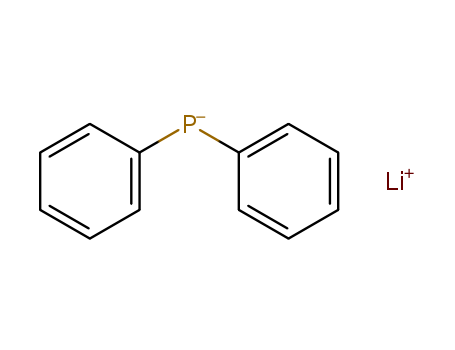
Lithium Diphenylphosphanide

Base Information
  • Chemical Name:Lithium Diphenylphosphanide
  • CAS No.:65567-06-8
  • Molecular Formula:C12H10LiP
  • Molecular Weight:192.126
  • Hs Code.:29310099
  • European Community (EC) Number:628-933-4
  • DSSTox Substance ID:DTXSID80392839
  • Nikkaji Number:J554.134D
  • Wikipedia:Lithium_diphenylphosphide
  • Mol file:65567-06-8.mol
Lithium Diphenylphosphanide

Synonyms:lithium diphenylphosphide

Suppliers and Price of Lithium Diphenylphosphanide
Supply Marketing:
Business phase:
The product has achieved commercial mass production*data from LookChem market partment
Manufacturers and distributors:
  • Manufacture/Brand
  • Chemicals and raw materials
  • Packaging
  • price
  • Sigma-Aldrich
  • Lithium diphenylphosphide solution 0.5 M in THF
  • 100ml
  • $ 217.00
  • American Custom Chemicals Corporation
  • LITHIUM DIPHENYLPHOSPHIDE IN THF 95.00%
  • 5MG
  • $ 500.95
Total 11 raw suppliers
Chemical Property of Lithium Diphenylphosphanide
Chemical Property:
  • Boiling Point:65-67 °C 
  • Flash Point:-20 °C 
  • PSA:13.59000 
  • Density:0.925 g/mL at 25 °C 
  • LogP:2.31590 
  • Hydrogen Bond Donor Count:0
  • Hydrogen Bond Acceptor Count:1
  • Rotatable Bond Count:2
  • Exact Mass:192.06801575
  • Heavy Atom Count:14
  • Complexity:121
Purity/Quality:

98%,99%, *data from raw suppliers

Lithium diphenylphosphide solution 0.5 M in THF *data from reagent suppliers

Safty Information:
  • Pictogram(s):  
  • Hazard Codes:F,C,N 
  • Statements: 11-19-20/21/22-34-50/53-40-37 
  • Safety Statements: 16-26-27-36/37/39-45-61 
MSDS Files:

SDS file from LookChem

Useful:
  • Canonical SMILES:[Li+].C1=CC=C(C=C1)[P-]C2=CC=CC=C2
  • General Description Lithium diphenylphosphide (Ph2PLi) is a reactive organophosphorus compound commonly used as a nucleophilic reagent in synthetic chemistry. It is typically generated in situ from triphenylphosphine and metallic lithium in THF and serves as a key intermediate in the preparation of phosphine ligands, such as diphenyl(pyrazin-2-yl)phosphine, which are valuable for forming transition metal complexes with applications in catalysis, luminescence, and materials science. Its role in facilitating efficient one-pot syntheses highlights its utility in organometallic and coordination chemistry.
Technology Process of Lithium Diphenylphosphanide

There total 23 articles about Lithium Diphenylphosphanide which guide to synthetic route it. The literature collected by LookChem mainly comes from the sharing of users and the free literature resources found by Internet computing technology. We keep the original model of the professional version of literature to make it easier and faster for users to retrieve and use. At the same time, we analyze and calculate the most feasible synthesis route with the highest yield for your reference as below:

synthetic route:
Guidance literature:
diphenylphosphane; With n-butyllithium; In hexane; at -20 ℃; Inert atmosphere; Schlenk technique;
In hexane; at 20 ℃; for 5h; Inert atmosphere; Schlenk technique;
DOI:10.1039/c7cy01561e
Guidance literature:
With lithium; In tetrahydrofuran; mineral oil; at 56 ℃; Product distribution / selectivity; Inert atmosphere;
Guidance literature:
With lithium; In tetrahydrofuran; at 20 ℃; for 3h; Inert atmosphere;
DOI:10.1039/b900591a
Refernces

Efficient one-pot synthesis of diphenyl(pyrazin-2-yl)phosphine and its AgI, AuI and PtII complexes

10.1016/j.mencom.2020.05.014

The research focuses on the development of an efficient one-pot synthesis method for diphenyl(pyrazin-2-yl)phosphine, a ligand of interest for its potential use in molecular complexes and coordination polymers due to its catalytic performance, luminescent properties, biological activity, and magnetic features. The synthesis involves the reaction of 2-chloropyrazine with lithium diphenylphosphide (Ph2PLi), which is generated in situ from triphenylphosphine (Ph3P) and metallic lithium in THF. The process also includes the quenching of by-produced PhLi with Me3SiCl. The resulting diphenyl(pyrazin-2-yl)phosphine was then used to form complexes with Ag, Au, and Pt centers, revealing a P-monodentate ligation pattern in the synthesized complexes: [Ag4Cl4(1)4], [Au(1)Cl], and cis-[Pt(1)2Cl2]. The study contributes to the coordination chemistry of P,N-ligands and the synthesis of organophosphorus compounds, providing a new potential pre-catalysts and luminescent materials.


Post a RFQ

Enter 15 to 2000 letters.Word count: 0 letters

Attach files(File Format: Jpeg, Jpg, Gif, Png, PDF, PPT, Zip, Rar,Word or Excel Maximum File Size: 3MB)

1 Customer Service

What can I do for you?
Get Best Price

Get Best Price for 65567-06-8