Welcome to LookChem.com Sign In|Join Free
  • or

Encyclopedia

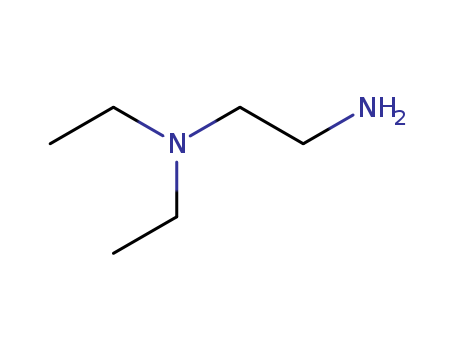
N,N-Diethylethylenediamine

Base Information
  • Chemical Name:N,N-Diethylethylenediamine
  • CAS No.:100-36-7
  • Molecular Formula:C6H16N2
  • Molecular Weight:116.206
  • Hs Code.:29212900
  • European Community (EC) Number:202-844-7
  • NSC Number:19675
  • UN Number:2685
  • UNII:859V6OK12Y
  • DSSTox Substance ID:DTXSID7057606
  • Nikkaji Number:J25.753B
  • Wikidata:Q27269625
  • ChEMBL ID:CHEMBL52701
  • Mol file:100-36-7.mol
N,N-Diethylethylenediamine

Synonyms:N,N-diethylethylenediamine

Suppliers and Price of N,N-Diethylethylenediamine
Supply Marketing:
Business phase:
The product has achieved commercial mass production*data from LookChem market partment
Manufacturers and distributors:
  • Manufacture/Brand
  • Chemicals and raw materials
  • Packaging
  • price
  • TRC
  • N,?N-?Diethylethylenediami?ne(2-Diethylaminoethylamine)
  • 5g
  • $ 55.00
  • TCI Chemical
  • N,N-Diethylethylenediamine >98.0%(GC)(T)
  • 25mL
  • $ 23.00
  • TCI Chemical
  • N,N-Diethylethylenediamine >98.0%(GC)(T)
  • 500mL
  • $ 106.00
  • SynQuest Laboratories
  • N,N-Diethylethylenediamine 97%
  • 1 kg
  • $ 240.00
  • SynQuest Laboratories
  • N,N-Diethylethylenediamine 97%
  • 500 g
  • $ 160.00
  • Sigma-Aldrich
  • N,N-Diethylethylenediamine for synthesis. CAS 100-36-7, EC Number 202-844-7, chemical formula (C H ) NCH CH NH ., for synthesis
  • 8032150250
  • $ 54.30
  • Sigma-Aldrich
  • N,N-Diethylethylenediamine for synthesis
  • 250 mL
  • $ 51.98
  • Sigma-Aldrich
  • N,N-Diethylethylenediamine ≥99%
  • 100g
  • $ 31.50
  • Sigma-Aldrich
  • N,N-Diethylethylenediamine ≥99%
  • 5g
  • $ 18.30
  • Sigma-Aldrich
  • N,N-Diethylethylenediamine for synthesis. CAS 100-36-7, EC Number 202-844-7, chemical formula (C H ) NCH CH NH ., for synthesis
  • 8032150005
  • $ 15.90
Total 35 raw suppliers
Chemical Property of N,N-Diethylethylenediamine
Chemical Property:
  • Appearance/Colour:clear colorless to light yellow liquid 
  • Vapor Pressure:5.56mmHg at 25°C 
  • Melting Point:<-70 °C 
  • Refractive Index:n20/D 1.436(lit.)  
  • Boiling Point:142.5 °C at 760 mmHg 
  • PKA:pK1:7.70(+2);pK2:10.46(+1) (25°C) 
  • Flash Point:30.6 °C 
  • PSA:29.26000 
  • Density:0.82 g/cm3 
  • LogP:0.98720 
  • Storage Temp.:Flammables area 
  • Sensitive.:Air Sensitive 
  • Water Solubility.:MISCIBLE 
  • XLogP3:0.2
  • Hydrogen Bond Donor Count:1
  • Hydrogen Bond Acceptor Count:2
  • Rotatable Bond Count:4
  • Exact Mass:116.131348519
  • Heavy Atom Count:8
  • Complexity:41.8
Purity/Quality:

99% *data from raw suppliers

N,?N-?Diethylethylenediami?ne(2-Diethylaminoethylamine) *data from reagent suppliers

Safty Information:
  • Pictogram(s): CorrosiveC, IrritantXi 
  • Hazard Codes:C,Xi 
  • Statements: 10-20/21/22-35-21-36/37/38-34 
  • Safety Statements: 26-36/37/39-45-25-16-36-27 
MSDS Files:

SDS file from LookChem

Total 1 MSDS from other Authors

Useful:
  • Chemical Classes:Nitrogen Compounds -> Amines, Aliphatic
  • Canonical SMILES:CCN(CC)CCN
  • Uses N,N-Diethylethylenediamine is used in the syntheses of anti-malarials. In addition, it has been seem to induce apoptosis through a caspase-3 dependent pathway. N,N-Diethylethylenediamine was used in the oxidative amidation of hydrogen phosphonate diesters in the synthesis of oligonucleotides. It is also used to develop melanin targeted PET and single-photon emission computed tomography (SPECT) imaging agents for melanoma.
Technology Process of N,N-Diethylethylenediamine

There total 53 articles about N,N-Diethylethylenediamine which guide to synthetic route it. The literature collected by LookChem mainly comes from the sharing of users and the free literature resources found by Internet computing technology. We keep the original model of the professional version of literature to make it easier and faster for users to retrieve and use. At the same time, we analyze and calculate the most feasible synthesis route with the highest yield for your reference as below:

synthetic route:
Guidance literature:
With hydrazine hydrate; In ethanol; for 24h; Reflux;
DOI:10.1016/j.ejmech.2019.01.052
Guidance literature:
With O-benzyl carbamate; palladium on activated charcoal; sodium hydroxide; at 60 ℃; for 5h; Temperature; Reagent/catalyst; Sealed tube;

Reference yield: 90.45%

Guidance literature:
With ammonia; In methanol; at 25 ℃; for 12h;
Refernces

Dimeric and trimeric molybdenum( II) complexes containing 2-substituted η3-bonded butadienyl bridging ligands

10.1016/s0022-328x(97)00456-7

The study investigates the formation of dimeric and trimeric molybdenum(II) complexes containing 2-substituted 3-bonded butadienyl bridging ligands. The starting material used is [MoCI(CO)2(@-CH2(COCI)C=CH2)phen] (phen = 1,10-phenanthroline) (1). When 1 reacts with 1,2-ethanediol or N,N'-diethylethylenediamine in a 2:1 mole ratio, dimeric complexes [MoCI(CO)2(@-CH/(COACH2)C=CH2)phen]2 are formed, where A represents the substituent group (A = O for ester, A = NEt for amide). Reactions with hydroquinone or 1,4-phenylenediamine yield monomeric complexes [MoCI(CO)2(@-CH2(COA)C=CH2)phen], while dimeric complexes are isolated from reactions involving 4,4'-ethylenedianiline or p-xylylenediamine. Attempts to prepare a novel complex bridged by three linked amide substituted butadienyl groups using diethylenetriamine were unsuccessful. However, reaction of 1 with triethanolamine or tris(2-aminoethyl)amine in a 3:1 mole ratio gives trimeric complexes [MoCI(CO)2(~/a-CH2(COACH2CH2)C=CH2)phen]3 N (A = O, NH) in good yield. The study establishes conditions for the formation of these complexes and examines the boundaries of dimer and trimer formation using various bifunctional and trifunctional reagents.

Post a RFQ

Enter 15 to 2000 letters.Word count: 0 letters

Attach files(File Format: Jpeg, Jpg, Gif, Png, PDF, PPT, Zip, Rar,Word or Excel Maximum File Size: 3MB)

1 Customer Service

What can I do for you?
Get Best Price

Get Best Price for 100-36-7
