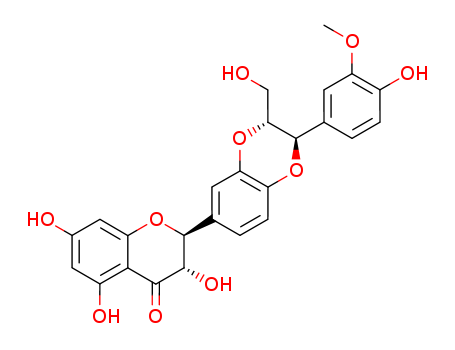
Chemical Property of Isosilybin
Chemical Property:
- Vapor Pressure:0mmHg at 25°C
- Refractive Index:1.684
- Boiling Point:793 °C at 760 mmHg
- PKA:7.39±0.60(Predicted)
- Flash Point:274.4 °C
- PSA:155.14000
- Density:1.527 g/cm3
- LogP:2.36270
- XLogP3:2.4
- Hydrogen Bond Donor Count:5
- Hydrogen Bond Acceptor Count:10
- Rotatable Bond Count:4
- Exact Mass:482.12129689
- Heavy Atom Count:35
- Complexity:750
- Purity/Quality:
-
99%, *data from raw suppliers
Isosilybin *data from reagent suppliers
Safty Information:
- Pictogram(s):
- Hazard Codes:
- MSDS Files:
-
SDS file from LookChem
Useful:
- Canonical SMILES:COC1=C(C=CC(=C1)C2C(OC3=C(O2)C=CC(=C3)C4C(C(=O)C5=C(C=C(C=C5O4)O)O)O)CO)O
-
Description
Isosilybin is a flavanolignan found in the extract of S. marianum fruits with antioxidant and anticancer activities. It inhibits lipid peroxidation in rat liver microsomes (IC50 = 32 μM) and reduces ADP/Fe3+-induced malondialdehyde (MDA) production and lactate dehydrogenase (LDH) release in rat hepatocytes. Isosilybin inhibits the production of reactive oxygen species (ROS), MDA and LDH release, and reduction in total antioxidant capacity induced by amyloid-β (25-35) (Aβ25-35) in HT-22 hippocampal cells. It also increases protein and mRNA expression of heme oxygenase-1 (HO-1), glutathione S-transferase (GST), and the aldo-keto reductases (AKCR) 1C1 and AKCR1C2 in HT-22 cells. In vivo, isosilybin (50 and 100 mg/kg) reduces tumor volume and increases tumor cell apoptosis in a DU145 prostate cancer mouse xenograft model. It also reduces expression of the tumor angiogenesis markers CD31, nestin, VEGF, VEGFR1, VEGFR2, phospho-Akt, and HIF-1α in tumor tissue without reducing blood vessel count in non-cancerous liver, lung, and kidney tissue in DU145 tumor-bearing mice.
-
Uses
Useful in the treatment of liver disease. Isosilybin is useful in the treatment of liver disease