Welcome to LookChem.com Sign In|Join Free
  • or

Encyclopedia

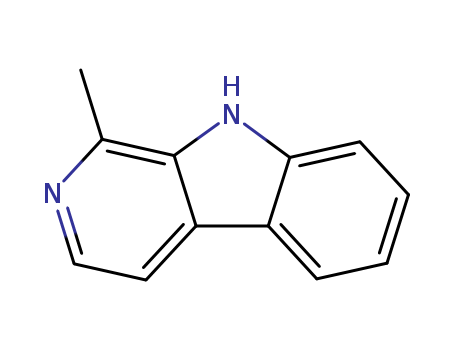
HARMANE

Base Information
  • Chemical Name:HARMANE
  • CAS No.:486-84-0
  • Molecular Formula:C12H10 N2
  • Molecular Weight:182.225
  • Hs Code.:2933990090
  • Mol file:486-84-0.mol
HARMANE

Synonyms:2,9-Pyridindole,1-methyl- (3CI); 1-Methyl-9H-pyrido[3,4-b]indole; 1-Methyl-b-carboline; Aribin; Aribine;Harman; Harmane; Indoter; Locuturin; Locuturine; NSC 54439; Zygofabagine

Suppliers and Price of HARMANE
Supply Marketing:
Business phase:
The product has achieved commercial mass production*data from LookChem market partment
Manufacturers and distributors:
  • Manufacture/Brand
  • Chemicals and raw materials
  • Packaging
  • price
  • Usbiological
  • Harmane 98+%
  • 1g
  • $ 262.00
  • Usbiological
  • Harmane
  • 100mg
  • $ 296.00
  • TRC
  • Harman
  • 50mg
  • $ 70.00
  • Sigma-Aldrich
  • Harmane 98%
  • 1g
  • $ 157.00
  • Medical Isotopes, Inc.
  • Harman
  • 10 mg
  • $ 620.00
  • Matrix Scientific
  • 1-Methyl-9H-beta-carboline
  • 500mg
  • $ 189.00
  • Crysdot
  • 1-Methyl-9H-pyrido[3,4-b]indole 95+%
  • 250mg
  • $ 85.00
  • ChemScene
  • Harmane 99.73%
  • 250mg
  • $ 278.00
  • ChemScene
  • Harmane 99.73%
  • 1g
  • $ 688.00
  • ChemScene
  • Harmane 99.73%
  • 100mg
  • $ 165.00
Total 64 raw suppliers
Chemical Property of HARMANE
Chemical Property:
  • Appearance/Colour:Off-White Solid 
  • Vapor Pressure:7.61E-06mmHg at 25°C 
  • Melting Point:235-238 °C(lit.)
     
  • Refractive Index:1.6266 (estimate) 
  • Boiling Point:386.9°Cat760mmHg 
  • PKA:7.37, 14.6(at 25℃) 
  • Flash Point:176.2°C 
  • PSA:28.68000 
  • Density:1.252g/cm3 
  • LogP:3.02450 
  • Storage Temp.:Store at RT 
  • Solubility.:methanol: soluble50mg/ml 
  • Water Solubility.:1523g/L(20 oC) 
Purity/Quality:

≥98% *data from raw suppliers

Harmane 98+% *data from reagent suppliers

Safty Information:
  • Pictogram(s):  
  • Hazard Codes:Xn,Xi 
  • Statements: 20/21-36/37/38 
  • Safety Statements: 22-24/25-36-26 
MSDS Files:

SDS file from LookChem

Total 1 MSDS from other Authors

Useful:
  • Uses Harmane was used in trace level determination of harmane by planar chromatography coupled with (tandem) mass spectrometry. It was used to study interactions of norharman and harman with DNA.It may be used as matrix for analysis of cyclodextrins and for sulfated oligosaccharides in combination with DHB as co-matrix.
Technology Process of HARMANE

There total 101 articles about HARMANE which guide to synthetic route it. The literature collected by LookChem mainly comes from the sharing of users and the free literature resources found by Internet computing technology. We keep the original model of the professional version of literature to make it easier and faster for users to retrieve and use. At the same time, we analyze and calculate the most feasible synthesis route with the highest yield for your reference as below:

synthetic route:

Reference yield: 93.0%

Guidance literature:
With C21H21ClIrNO2; In tetrahydrofuran; 2,2,2-trifluoroethanol; for 20h; Inert atmosphere;
DOI:10.1002/anie.201300292
Guidance literature:
With 2 mol-% Pd/C; lithium carbonate; In ethanol; at 150 ℃; for 0.166667h; Sealed tube; Microwave irradiation;
DOI:10.1002/ejoc.201301580
Guidance literature:
With potassium permanganate; In acetone; at 20 ℃;
DOI:10.3987/COM-05-10484
Refernces

Synthesis and isolation of bromo-β-carbolines obtained by bromination of β-carboline alkaloids

10.1002/jhet.5570380512

The study focuses on the synthesis and isolation of bromo-β-carbolines, which are derivatives of β-carboline alkaloids. The researchers used N-bromosuccinimide (NBS) as the brominating agent to induce electrophilic aromatic substitution in various β-carbolines, including nor-harmane, harmane, harmine, harmol, and 7-acetylharmol. The purpose of using these chemicals was to explore the behavior of substituted β-carbolines, prepare nitro-β-carbolines and bromo-β-carbolines, and investigate their potential use as matrices (photosensitizers) in matrix-assisted ultraviolet laser desorption/ionization time-of-flight mass spectrometry (uv-maldi-tof ms). The study also aimed to understand the effects of substituents on the acid-base properties and electronic excited states of these molecules. The researchers compared the use of NBS in solution and in solid state, and employed semiempirical AM1 and PM3 calculations to predict reactivity in terms of molecular orbital energies and charge density. The results provided insights into the regioselectivity of bromination and the influence of the β-carboline/NBS molar ratio and reaction time on product selectivity.


Post a RFQ

Enter 15 to 2000 letters.Word count: 0 letters

Attach files(File Format: Jpeg, Jpg, Gif, Png, PDF, PPT, Zip, Rar,Word or Excel Maximum File Size: 3MB)

1 Customer Service

What can I do for you?
Get Best Price

Get Best Price for 486-84-0