Welcome to LookChem.com Sign In|Join Free
  • or

Encyclopedia

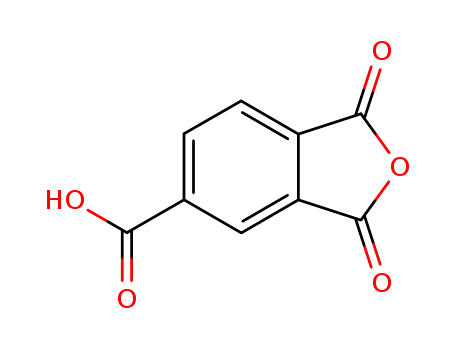
Trimellitic anhydride

Base Information
  • Chemical Name:Trimellitic anhydride
  • CAS No.:552-30-7
  • Deprecated CAS:28605-64-3,68864-89-1,70425-46-6,928770-37-0,2088100-85-8,68864-89-1,70425-46-6,928770-37-0
  • Molecular Formula:C9H4O5
  • Molecular Weight:192.128
  • Hs Code.:29173980
  • European Community (EC) Number:209-008-0
  • ICSC Number:0345
  • NSC Number:60252
  • UNII:80T61EUU7H
  • DSSTox Substance ID:DTXSID7026235
  • Nikkaji Number:J6.720B
  • Wikipedia:Trimellitic_anhydride
  • Wikidata:Q1675143
  • Metabolomics Workbench ID:58518
  • ChEMBL ID:CHEMBL2137687
  • Mol file:552-30-7.mol
Trimellitic anhydride

Synonyms:tri-mellitic anhydride;trimellitic anhydride

Suppliers and Price of Trimellitic anhydride
Supply Marketing:
Business phase:
The product has achieved commercial mass production*data from LookChem market partment
Manufacturers and distributors:
  • Manufacture/Brand
  • Chemicals and raw materials
  • Packaging
  • price
  • Usbiological
  • Trimellitic Anhydride
  • 10g
  • $ 403.00
  • TRC
  • Trimellitic Anhydride
  • 50g
  • $ 155.00
  • TCI Chemical
  • Trimellitic Anhydride >98.0%(T)
  • 500g
  • $ 99.00
  • TCI Chemical
  • Trimellitic Anhydride >97.0%(HPLC)(T)
  • 25g
  • $ 16.00
  • TCI Chemical
  • Trimellitic Anhydride >98.0%(T)
  • 25g
  • $ 21.00
  • TCI Chemical
  • Trimellitic Anhydride >97.0%(HPLC)(T)
  • 500g
  • $ 26.00
  • Sigma-Aldrich
  • 1,2,4-Benzenetricarboxylic anhydride 97%
  • 500g
  • $ 52.00
  • Sigma-Aldrich
  • 1,2,4-Benzenetricarboxylic 1,2-anhydride for synthesis. CAS 552-30-7, pH 2 (21 g/l, H O, 20 °C)., for synthesis
  • 8201380500
  • $ 44.50
  • Sigma-Aldrich
  • 1,2,4-Benzenetricarboxylic 1,2-anhydride for synthesis
  • 500 g
  • $ 42.64
  • Sigma-Aldrich
  • 1,2,4-Benzenetricarboxylic anhydride 97%
  • 1kg
  • $ 80.30
Total 179 raw suppliers
Chemical Property of Trimellitic anhydride
Chemical Property:
  • Appearance/Colour:white crystalline powder 
  • Vapor Pressure:<0.01 mm Hg ( 20 °C) 
  • Melting Point:163-166 °C(lit.) 
  • Refractive Index:1.662 
  • Boiling Point:470.6 °C at 760 mmHg 
  • PKA:3.11±0.20(Predicted) 
  • Flash Point:201.3 °C 
  • PSA:80.67000 
  • Density:1.669 g/cm3 
  • LogP:0.69540 
  • Storage Temp.:Store below +30°C. 
  • Sensitive.:Moisture Sensitive 
  • Solubility.:24.4g/l (decomposition) 
  • Water Solubility.:DECOMPOSES 
  • XLogP3:0.8
  • Hydrogen Bond Donor Count:1
  • Hydrogen Bond Acceptor Count:5
  • Rotatable Bond Count:1
  • Exact Mass:192.00587322
  • Heavy Atom Count:14
  • Complexity:308
Purity/Quality:

99% *data from raw suppliers

Trimellitic Anhydride *data from reagent suppliers

Safty Information:
  • Pictogram(s): HarmfulXn 
  • Hazard Codes:Xn 
  • Statements: 37-41-42/43 
  • Safety Statements: 22-26-36/37/39 
MSDS Files:

SDS file from LookChem

Useful:
  • Chemical Classes:Plastics & Rubber -> Acid Anhydrides, Cyclic
  • Canonical SMILES:C1=CC2=C(C=C1C(=O)O)C(=O)OC2=O
  • Inhalation Risk:A harmful concentration of airborne particles can be reached quickly when dispersed.
  • Effects of Short Term Exposure:The substance is severely irritating to the eyes. The substance is irritating to the skin and respiratory tract. Inhalation of dust may cause asthma-like reactions.
  • Effects of Long Term Exposure:Repeated or prolonged inhalation may cause asthma. The substance may cause allergic reactions with flu-like symptoms and 'pulmonary disease-anaemia syndrome'.
  • Uses Trimellitic Anhydride is mainly used as raw material for polyester resin,polyimide resin,plasticizer TOTM ,and also be used for producing heatproof & insulating,adhesive,surfactant, paint,synthesize dye materials etc. Trimellitic anhydride is used as an embossing agent for vinyl flooring and as a curing agent for epoxy resins. It is also used as an intermediate for the synthesis of surface coatings chemicals, adhesives, polymers, dyes printing inks, pharmaceuticals . Trimellitic anhydride is mainly applied to produce good heat-proof, weather-proof and solvent-proof trimellitate plasticizers, among which the most popular product is tri(2-ethylhexyl)trimellitate. It is also used to synthesize polyester resins.TMA can also be applied to curing agent of epoxy resins.
Technology Process of Trimellitic anhydride

There total 11 articles about Trimellitic anhydride which guide to synthetic route it. The literature collected by LookChem mainly comes from the sharing of users and the free literature resources found by Internet computing technology. We keep the original model of the professional version of literature to make it easier and faster for users to retrieve and use. At the same time, we analyze and calculate the most feasible synthesis route with the highest yield for your reference as below:

synthetic route:
Guidance literature:
Multi-step reaction with 5 steps
2: sulfuric acid
3: aqueous-methanolic KOH-solution
5: 200 °C
With potassium hydroxide; sulfuric acid;
Guidance literature:
Multi-step reaction with 3 steps
1: aqueous-methanolic KOH-solution
3: 200 °C
With potassium hydroxide;
Refernces

Synthesis of structurally diverse 2-azetidinones via staudinger reaction on a solid support

10.1246/bcsj.20100212

The research focuses on the synthesis of structurally diverse 2-azetidinones, which are key structural elements in the family of β-lactam antibiotics and possess significant biological activities. The study aims to develop a new method for the synthesis of β-lactams via ketene-imine cycloaddition using polymer-supported ketene on a solid support, specifically Merrifield resin. The researchers successfully synthesized a variety of β-lactam derivatives with different substituents at positions 1 and 4, which could serve as potential intermediates for the synthesis of active compounds. The process involved the use of trimellitic anhydride, phthaloylglycine, imines, Vilsmeier reagent, triethylamine, trifluoroacetic acid, methylhydrazine, and other reagents. The conclusions of the research highlight the selective cleavage of supported β-lactams by trifluoroacetic acid and methylhydrazine to obtain 4-carboxyphthalimido- and 3-amino-β-lactams, respectively. The method offers simplified purification through filtration, avoiding time-consuming separation techniques, and the ability to regenerate the starting polymer-supported phthaloylglycine, making it a valuable contribution to solid-phase polymer-supported synthesis.

Post a RFQ

Enter 15 to 2000 letters.Word count: 0 letters

Attach files(File Format: Jpeg, Jpg, Gif, Png, PDF, PPT, Zip, Rar,Word or Excel Maximum File Size: 3MB)

1 Customer Service

What can I do for you?
Get Best Price

Get Best Price for 552-30-7