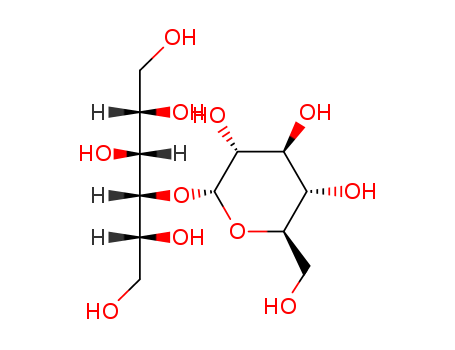
Chemical Property of Maltitol
Chemical Property:
- Appearance/Colour:white crystalline powder
- Vapor Pressure:9.8E-29mmHg at 25°C
- Melting Point:149-152 °C
- Refractive Index:105 ° (C=10, H2O)
- Boiling Point:788.5 °C at 760 mmHg
- PKA:12.84±0.70(Predicted)
- Flash Point:430.7 °C
- PSA:200.53000
- Density:1.69 g/cm3
- LogP:-5.76120
- Storage Temp.:2-8°C
- Solubility.:Very soluble in water, practically insoluble in anhydrous ethanol.
- Water Solubility.:Soluble in water. Slightly soluble in ethanol.
- XLogP3:-5.2
- Hydrogen Bond Donor Count:9
- Hydrogen Bond Acceptor Count:11
- Rotatable Bond Count:8
- Exact Mass:344.13186158
- Heavy Atom Count:23
- Complexity:343
- Purity/Quality:
-
99% ,98%,Electron Grade , *data from raw suppliers
D-Maltitol *data from reagent suppliers
Safty Information:
- Pictogram(s):
- Hazard Codes:
- Safety Statements:
24/25
- MSDS Files:
-
SDS file from LookChem
Useful:
- Canonical SMILES:C(C1C(C(C(C(O1)OC(C(CO)O)C(C(CO)O)O)O)O)O)O
- Isomeric SMILES:C([C@@H]1[C@H]([C@@H]([C@H]([C@H](O1)O[C@H]([C@@H](CO)O)[C@@H]([C@H](CO)O)O)O)O)O)O
- Recent NIPH Clinical Trials:Preventive effect of ramelteon on delirium in ICU
-
Description
Maltitol is a-D-glucopyranosyl-1.4-glucitol. The solubility in water is approximately 1,750 g/L at room temperature. Maltitol is stable under the common processing conditions of foods. In addition to dry maltitol several types of syrups are available.Maltitol is, depending on the concentration, approximately 90 % as sweet as sucrose and noncariogenic.In the European Union, maltitol is approved as E 965 for a large number of food applications. It is GRAS in the United States and also approved in many other countries.
-
Uses
Maltitol is a polyhydric alcohol (polyol) produced by hydrogenation
of maltose. it is approximately 90% as sweet as sucrose, has good
stability, and is nonhygroscopic. uses include chewing gum, dry nut
bakery products, and chocolate. Maltol is a flavor enhancer used as a synthetic flavoring substance, the function of which is related to ethyl . It occurs naturally in chicory, cocoa, coffee, and cereals. It does not contribute a flavor of its own, but modifies the inherent flavors. As compared to ethyl , it is one-half to one-sixth as effective. It is less soluble, having a solubility of 1 g in 82 ml of water at 25°c. It has a melting range of 160–164°c. It is used to enhance the flavor and aroma of fruit, vanilla, and chocolate flavored foods and beverages. It is also used in beverages and desserts with a typical usage range of 10–200 ppm.