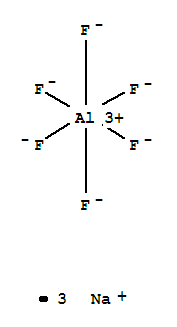
Chemical Property of Cryolite
Chemical Property:
- Appearance/Colour:odorless white solid or powder
- Melting Point:1012 °C
- Refractive Index:1.338
- Boiling Point:decomp
- PSA:0.00000
- Density:2.9 g/mL at 25 °C
- LogP:2.52120
- Storage Temp.:2-8°C
- Hydrogen Bond Donor Count:0
- Hydrogen Bond Acceptor Count:7
- Rotatable Bond Count:0
- Exact Mass:209.9412652
- Heavy Atom Count:10
- Complexity:62.7
- Purity/Quality:
-
99% *data from raw suppliers
Sodium hexafluoroaluminate
*data from reagent suppliers
Safty Information:
- Pictogram(s):
 T+,
T+, N
N
- Hazard Codes:T,N
- Statements:
20/22-48/23/25-51/53-20
- Safety Statements:
22-37-45-61
- MSDS Files:
-
SDS file from LookChem
Total 1 MSDS from other Authors
Useful:
- Canonical SMILES:F[Al-3](F)(F)(F)(F)F.[Na+].[Na+].[Na+]
- Inhalation Risk:A harmful concentration of airborne particles can be reached quickly when dispersed, especially if powdered.
- Effects of Long Term Exposure:The substance may have effects on the bones and teeth. This may result in fluorosis. Repeated or prolonged inhalation of dust particles may cause effects on the lungs.
-
Description
Cryolite is an uncommon mineral salt of sodium, fluoride and aluminum that was first discovered on the west coast of Greenland. The supply was depleted by 1987, and synthetic cryolite is now produced from the common mineral fluorite. Cryolite is used at very high application rates of 5-30 kg/ha to control Lepidoptera and Coleoptera on certain fruits, vegetables and citrus. 92% of total cryolite applied in the U.S. is used on grapes in California.
-
Uses
Cryolite is commonly used as an electrolyte for aluminum electrolysis. Alumina is dissolved in molten cryolite is used to dissolve alumina during aluminium processing. Electrolyte in the reduction of alumina to aluminum; ceramics; insecticide; binder for abrasives;
electric insulation; explosives; polishes.