Welcome to LookChem.com Sign In|Join Free
  • or

Encyclopedia

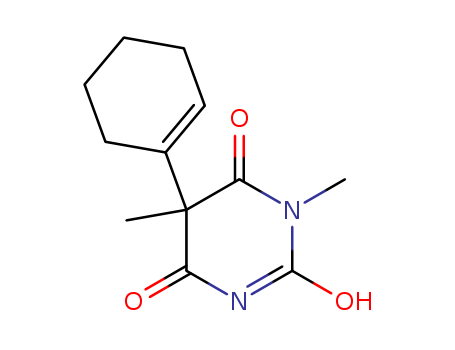
Hexobarbital

Base Information
  • Chemical Name:Hexobarbital
  • CAS No.:56-29-1
  • Deprecated CAS:7200-11-5,630-97-7
  • Molecular Formula:C12H16 N2 O3
  • Molecular Weight:236.271
  • Hs Code.:
  • European Community (EC) Number:200-264-9
  • NSC Number:71929
  • UNII:AL8Z8K3P6S
  • DSSTox Substance ID:DTXSID9023122
  • Nikkaji Number:J1.915A
  • Wikipedia:Hexobarbital
  • Wikidata:Q421183
  • NCI Thesaurus Code:C77630
  • Metabolomics Workbench ID:43516
  • ChEMBL ID:CHEMBL7728
  • Mol file:56-29-1.mol
Hexobarbital

Synonyms:Evipan;Hexenal;Hexobarbital;Hexobarbital, Sodium;Hexobarbitone;Sodium Hexobarbital

Suppliers and Price of Hexobarbital
Supply Marketing:
Business phase:
The product has achieved commercial mass production*data from LookChem market partment
Manufacturers and distributors:
  • Manufacture/Brand
  • Chemicals and raw materials
  • Packaging
  • price
  • Sigma-Aldrich
  • Hexobarbital solution 1.0?mg/mL in methanol, ampule of 1?mL, certified reference material, Cerilliant?
  • 1 mL
  • $ 20.90
  • Sigma-Aldrich
  • Hexobarbital solution 1.0mg/mL in methanol, ampule of 1mL, certified reference material
  • 013-1ml
  • $ 20.30
  • American Custom Chemicals Corporation
  • HEXOBARBITAL 95.00%
  • 250G
  • $ 4717.60
  • AHH
  • Evipal 98%
  • 250g
  • $ 428.00
Total 39 raw suppliers
Chemical Property of Hexobarbital
Chemical Property:
  • Melting Point:145-147° 
  • Refractive Index:1.5460 (estimate) 
  • Boiling Point:368.8 °C at 760 mmHg 
  • PKA:7.99±0.10(Predicted) 
  • Flash Point:176.8 °C 
  • PSA:66.48000 
  • Density:1.225 g/cm3 
  • LogP:1.46800 
  • Storage Temp.:2-8°C 
  • Water Solubility.:434.7mg/L(25 oC) 
  • XLogP3:1.5
  • Hydrogen Bond Donor Count:1
  • Hydrogen Bond Acceptor Count:3
  • Rotatable Bond Count:1
  • Exact Mass:236.11609238
  • Heavy Atom Count:17
  • Complexity:428
Purity/Quality:

97% *data from raw suppliers

Hexobarbital solution 1.0?mg/mL in methanol, ampule of 1?mL, certified reference material, Cerilliant? *data from reagent suppliers

Safty Information:
  • Pictogram(s): HarmfulXn 
  • Hazard Codes:Xn,T,F 
  • Statements: 22-39/23/24/25-23/24/25-11 
  • Safety Statements: 36/37/39-45-36/37-16-7 
MSDS Files:

SDS file from LookChem

Total 1 MSDS from other Authors

Useful:
  • Canonical SMILES:CC1(C(=O)NC(=O)N(C1=O)C)C2=CCCCC2
  • Recent EU Clinical Trials:Androgen metabolism and doping tests
  • Uses Medicine (sedative).
Technology Process of Hexobarbital

There total 8 articles about Hexobarbital which guide to synthetic route it. The literature collected by LookChem mainly comes from the sharing of users and the free literature resources found by Internet computing technology. We keep the original model of the professional version of literature to make it easier and faster for users to retrieve and use. At the same time, we analyze and calculate the most feasible synthesis route with the highest yield for your reference as below:

synthetic route:
Guidance literature:
Methylcyclohexenylcyanoacetic acid ethyl ester; N-Methylurea; With potassium tert-butylate; In tert-butyl alcohol; at 20 - 50 ℃; Inert atmosphere;
With hydrogenchloride; In ethanol; water; for 3h; Reflux;
Guidance literature:
With hydrogenchloride; water; In ethanol; for 3h; Reflux;
DOI:10.1021/jacs.1c06335
Guidance literature:
Multi-step reaction with 3 steps
1.1: rac-Pro-OH / ethanol / 7 h / 75 °C
2.1: potassium tert-butylate / tetrahydrofuran; N,N-dimethyl-formamide / 0.02 h / Inert atmosphere
2.2: 3 h / 20 °C / Inert atmosphere
3.1: potassium tert-butylate / tert-butyl alcohol / 20 - 50 °C / Inert atmosphere
3.2: 3 h / Reflux
With potassium tert-butylate; rac-Pro-OH; In tetrahydrofuran; ethanol; N,N-dimethyl-formamide; tert-butyl alcohol;
Refernces

Synthesis of cannabidiols via alkenylation of cyclohexenyl monoacetate

10.1021/ol060692h

The research focuses on developing a method to synthesize cannabidiol (CBD) and its analogues. The study highlights the potential of CBD as a nonpsychotropic drug due to its lack of binding to receptors responsible for psychoactivity, unlike ?9-tetrahydrocannabinol (?9-THC). The key reaction involves nickel-catalyzed allylation of 2-cyclohexene-1,4-diol monoacetate using a new reagent system, (alkenyl)ZnCl/TMEDA, achieving 94% regioselectivity and good yield. This method allows for the synthesis of CBD and its analogues, including those with longer alkenyl side chains. The research also explores the synthesis of metabolites like 7-hydroxy-CBD and demonstrates the transformation of synthesized compounds into CBD and ?9-THC. Chemicals such as lithium isopropenyl borate, alkenyl Grignard reagents, and various metal catalysts (e.g., NiCl2(tpp)2) play crucial roles in achieving the desired products with high regioselectivity and yield.

Post a RFQ

Enter 15 to 2000 letters.Word count: 0 letters

Attach files(File Format: Jpeg, Jpg, Gif, Png, PDF, PPT, Zip, Rar,Word or Excel Maximum File Size: 3MB)

1 Customer Service

What can I do for you?
Get Best Price

Get Best Price for 56-29-1