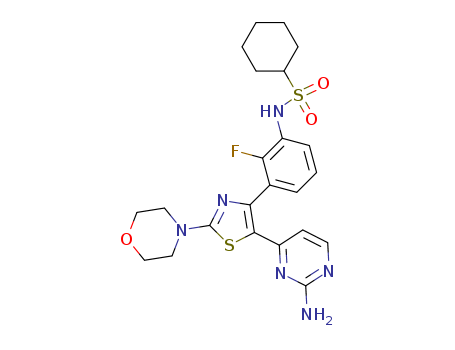
Technology Process of N-{3-[5-(2-Amino-4-pyrimidinyl)-2-(4-morpholinyl)-1,3-thiazol-4-yl]-2-fluorophenyl}cyclohexanesulfonamide
There total 13 articles about N-{3-[5-(2-Amino-4-pyrimidinyl)-2-(4-morpholinyl)-1,3-thiazol-4-yl]-2-fluorophenyl}cyclohexanesulfonamide which
guide to synthetic route it.
The literature collected by LookChem mainly comes from the sharing of users and the free literature resources found by Internet computing technology. We keep the original model of the professional version of literature to make it easier and faster for users to retrieve and use. At the same time, we analyze and calculate the most feasible synthesis route with the highest yield for your reference as below:
synthetic route:
- Guidance literature:
-
With
ammonium hydroxide;
In
water;
at 120 ℃;
for 48h;
microwave irradiation;
- Guidance literature:
-
Multi-step reaction with 8 steps
1.1: caesium carbonate / tris(dibenzylideneacetone)dipalladium(0) chloroform complex; 4,5-bis(diphenylphosphino)-9,9-dimethylxanthene / toluene / 90 °C / Inert atmosphere
2.1: trifluoroacetic acid / dichloromethane / 1 h / 20 °C
3.1: sodium hydrogencarbonate / tetrahydrofuran / 0 - 20 °C
4.1: lithium hexamethyldisilazane / tetrahydrofuran / -10 - 0 °C
4.2: 1.33 h / 0 - 20 °C
5.1: N-Bromosuccinimide / N,N-dimethyl acetamide / 1 h / 20 °C
5.2: 0 - 20 °C
6.1: tri-n-butyl-tin hydride; acetic acid / bis-triphenylphosphine-palladium(II) chloride / dichloromethane / 0 - 20 °C
7.1: pyridine
8.1: ammonium hydroxide / water / 48 h / 120 °C / microwave irradiation
With
pyridine; ammonium hydroxide; N-Bromosuccinimide; tri-n-butyl-tin hydride; sodium hydrogencarbonate; caesium carbonate; acetic acid; trifluoroacetic acid; lithium hexamethyldisilazane;
bis-triphenylphosphine-palladium(II) chloride; tris(dibenzylideneacetone)dipalladium(0) chloroform complex; 4,5-bis(diphenylphosphino)-9,9-dimethylxanthene;
In
tetrahydrofuran; dichloromethane; N,N-dimethyl acetamide; water; toluene;
- Guidance literature:
-
Multi-step reaction with 7 steps
1.1: hydrazine hydrate / nickel / tetrahydrofuran; methanol; water / 70 °C
2.1: sodium hydrogencarbonate / tetrahydrofuran / 0 - 20 °C
3.1: lithium hexamethyldisilazane / tetrahydrofuran / -10 - 0 °C
3.2: 1.33 h / 0 - 20 °C
4.1: N-Bromosuccinimide / N,N-dimethyl acetamide / 1 h / 20 °C
4.2: 0 - 20 °C
5.1: tri-n-butyl-tin hydride; acetic acid / bis-triphenylphosphine-palladium(II) chloride / dichloromethane / 0 - 20 °C
6.1: pyridine
7.1: ammonium hydroxide / water / 48 h / 120 °C / microwave irradiation
With
pyridine; ammonium hydroxide; N-Bromosuccinimide; tri-n-butyl-tin hydride; sodium hydrogencarbonate; hydrazine hydrate; acetic acid; lithium hexamethyldisilazane;
bis-triphenylphosphine-palladium(II) chloride; nickel;
In
tetrahydrofuran; methanol; dichloromethane; N,N-dimethyl acetamide; water;

![N-{3-[5-(2-Chloro-4-pyrimidinyl)-2-(4-morpholinyl)-1,3-thiazol-4-yl]-2-fluorophenyl}cyclohexanesulfonamide](/Databaselist/images/loading.webp)


