Welcome to LookChem.com Sign In|Join Free
  • or

Encyclopedia

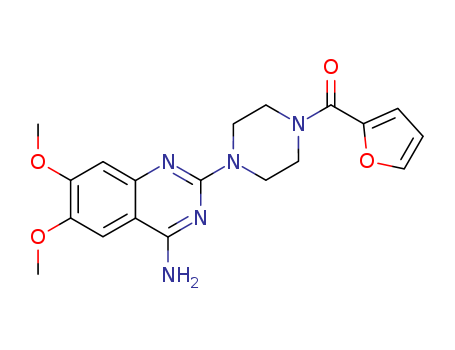
Prazosin

Base Information
  • Chemical Name:Prazosin
  • CAS No.:19216-56-9
  • Molecular Formula:C19H21N5O4
  • Molecular Weight:383.407
  • Hs Code.:2934999090
  • European Community (EC) Number:242-885-8
  • UNII:XM03YJ541D
  • DSSTox Substance ID:DTXSID4049082
  • Nikkaji Number:J10.000E
  • Wikipedia:Prazosin
  • Wikidata:Q425296
  • NCI Thesaurus Code:C767
  • RXCUI:8629
  • Pharos Ligand ID:BD967KAHXVAM,BDCXZQTBSBYV
  • Metabolomics Workbench ID:42807
  • ChEMBL ID:CHEMBL2
  • Mol file:19216-56-9.mol
Prazosin

Synonyms:Furazosin;HCL, Prazosin;Hydrochloride, Prazosin;Minipress;Pratsiol;Prazosin;Prazosin HCL;Prazosin Hydrochloride

Suppliers and Price of Prazosin
Supply Marketing:
Business phase:
The product has achieved commercial mass production*data from LookChem market partment
Manufacturers and distributors:
  • Manufacture/Brand
  • Chemicals and raw materials
  • Packaging
  • price
  • Usbiological
  • Prazosin
  • 1mg
  • $ 368.00
  • TRC
  • Prazosin
  • 25mg
  • $ 45.00
  • Matrix Scientific
  • (4-(4-Amino-6,7-dimethoxyquinazolin-2-yl)-piperazin-1-yl)(furan-2-yl)methanone 95+%
  • 500mg
  • $ 750.00
  • Crysdot
  • Prazosin 98+%
  • 10mg
  • $ 171.00
  • Biosynth Carbosynth
  • [4-(4-Amino-6,7-dimethoxy-2-quinazolinyl)-1-piperazinyl]-2-furanyl-methanone
  • 500 mg
  • $ 500.00
  • Biosynth Carbosynth
  • [4-(4-Amino-6,7-dimethoxy-2-quinazolinyl)-1-piperazinyl]-2-furanyl-methanone
  • 100 mg
  • $ 150.00
  • Biosynth Carbosynth
  • [4-(4-Amino-6,7-dimethoxy-2-quinazolinyl)-1-piperazinyl]-2-furanyl-methanone
  • 50 mg
  • $ 100.00
  • Biosynth Carbosynth
  • [4-(4-Amino-6,7-dimethoxy-2-quinazolinyl)-1-piperazinyl]-2-furanyl-methanone
  • 25 mg
  • $ 65.00
  • Biosynth Carbosynth
  • [4-(4-Amino-6,7-dimethoxy-2-quinazolinyl)-1-piperazinyl]-2-furanyl-methanone
  • 250 mg
  • $ 300.00
  • ApexBio Technology
  • Prazosin
  • 10mg
  • $ 384.00
Total 46 raw suppliers
Chemical Property of Prazosin
Chemical Property:
  • Vapor Pressure:3.4E-16mmHg at 25°C 
  • Melting Point:278-280°C 
  • Refractive Index:1.651 
  • Boiling Point:638.366 °C at 760 mmHg 
  • PKA:pKa 6.54(50% EtOH) (Uncertain) 
  • Flash Point:339.871 °C 
  • PSA:106.95000 
  • Density:1.353 g/cm3 
  • LogP:3.17070 
  • Storage Temp.:2-8°C 
  • Solubility.:DMSO (Slightly), Methanol (Slightly, Heated) 
  • Water Solubility.:3.2mg/L(22.5 oC) 
  • XLogP3:2
  • Hydrogen Bond Donor Count:1
  • Hydrogen Bond Acceptor Count:8
  • Rotatable Bond Count:4
  • Exact Mass:383.15935417
  • Heavy Atom Count:28
  • Complexity:544
Purity/Quality:

99%, *data from raw suppliers

Prazosin *data from reagent suppliers

Safty Information:
  • Pictogram(s):  
  • Hazard Codes: 
MSDS Files:

SDS file from LookChem

Useful:
  • Drug Classes:Antihypertensive Agents
  • Canonical SMILES:COC1=C(C=C2C(=C1)C(=NC(=N2)N3CCN(CC3)C(=O)C4=CC=CO4)N)OC
  • Recent ClinicalTrials:Predicting Responses to PTSD Treatment With Iris and Cardiovascular Tests
  • Recent EU Clinical Trials:Etude préliminaire de l’efficacité d’un α1 bloquant (la prazosine) en prévention de la survenue d’un état de stress post-traumatique chez des patients présentant un état de stress aigu.
  • Uses Antihypertensive. Prazosin is used for treating mid-to-moderate hypertension. When using this drug, blood pressure is reduced without any significant change in indicators of cardiac function such as frequency, coronary flow, or cardiac output. Prazosin is used to treat average or moderate hypertension. Upon taking this drug, blood pressure drops without substantial changes in indicators of heart work, such as rate, coronary flow, and cardiac output. Prazosin is used for weak to moderate hypertension.
  • Therapeutic Function Antihypertensive
  • Clinical Use Prazosin is effective in reducing all grades of hypertension. The drug can be administered alone in mild and (in some instances) moderate hypertension.When the hypertension is moderate or severe, prazosin generally is given in combination with a thiazide diuretic and a -blocker. The antihypertensive actions of prazosin are considerably potentiated by coadministration of thiazides or other types of antihypertensive drugs. Prazosin may be particularly useful when patients cannot tolerate other classes of antihypertensive drugs or when blood pressure is not well controlled by other drugs. Since prazosin does not significantly influence blood uric acid or glucose levels, it can be used in hypertensive patients whose condition is complicated by diabetes mellitus or gout. Prazosin and other -antagonists find use in the management of benign prostatic obstruction, especially in patients who are not candidates for surgery. Blockade of -adrenoceptors in the base of the bladder and in the prostate apparently reduces the symptoms of obstruction and the urinary urgency that occurs at night.
  • Drug interactions Potentially hazardous interactions with other drugs Anaesthetics: enhanced hypotensive effect. Antidepressants: enhanced hypotensive effect with MAOIs. Avanafil, vardenafil, sildenafil and tadalafil: enhanced hypotensive effect - avoid. Beta-blockers: enhanced hypotensive effect, increased risk of first dose hypotensive effect. Calcium-channel blockers: enhanced hypotensive effect, increased risk of first dose hypotensive effect. Diuretics: enhanced hypotensive effect, increased risk of first dose hypotensive effect. Moxisylyte: possibly severe postural hypotension when used in combination.
Technology Process of Prazosin

There total 13 articles about Prazosin which guide to synthetic route it. The literature collected by LookChem mainly comes from the sharing of users and the free literature resources found by Internet computing technology. We keep the original model of the professional version of literature to make it easier and faster for users to retrieve and use. At the same time, we analyze and calculate the most feasible synthesis route with the highest yield for your reference as below:

synthetic route:

Reference yield: 66.0%

Guidance literature:
With potassium carbonate; In N,N-dimethyl-formamide;
Guidance literature:
With N-ethyl-N,N-diisopropylamine; ethyl cyanoglyoxylate-2-oxime; In N,N-dimethyl-formamide; at 20 ℃;
DOI:10.1111/cbdd.12534
Guidance literature:
2-furancarbonyl chloride; 4-amino-6,7-dimethoxy-2-piperazin-1-ylquinazoline; With macroporous polymer-supported carbonate; In dichloromethane; at 20 ℃;
With PS-Trisamine; In dichloromethane;
DOI:10.1016/j.tetlet.2006.02.047
Refernces

Some new prazosin analogues

10.1002/ardp.19893220607

Prazosin, a selective a1-adrenergic antagonist used in antihypertensive therapy, has limitations due to its short half-life and side effects. To address these issues, the researchers synthesized new analogues by modifying the C-2 side-chain of prazosin, incorporating fragments from tienilic acid, guanethidine, and lidoflazine. The compounds were synthesized using various chemical procedures and their structures were confirmed through analytical data. The pharmacological properties were evaluated in terms of acute toxicity and hypotensive effects in mice and genetically hypertensive rats, respectively. The results showed that compound 5, featuring a tienilic residue in place of the furan ring, exhibited the highest hypotensive effect and a more long-lasting activity compared to prazosin. The study concludes that the new compounds, particularly compound 5, have potential for improved pharmacokinetic properties and hypotensive activity, warranting further investigation for their therapeutic applications.

Post a RFQ

Enter 15 to 2000 letters.Word count: 0 letters

Attach files(File Format: Jpeg, Jpg, Gif, Png, PDF, PPT, Zip, Rar,Word or Excel Maximum File Size: 3MB)

1 Customer Service

What can I do for you?
Get Best Price

Get Best Price for 19216-56-9