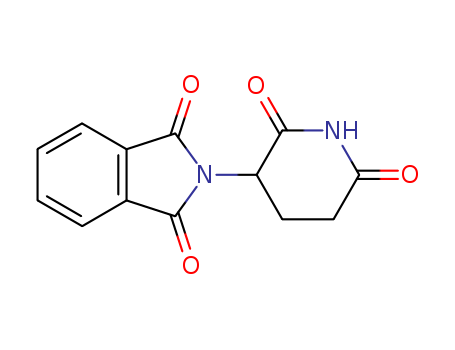
Chemical Property of Thalidomide
Chemical Property:
- Appearance/Colour:white solid
- Vapor Pressure:1.65E-10mmHg at 25°C
- Melting Point:269-271 °C
- Refractive Index:1.646
- Boiling Point:509.7 °C at 760 mmHg
- PKA:10.70±0.40(Predicted)
- Flash Point:262.1 °C
- PSA:83.55000
- Density:1.503 g/cm3
- LogP:0.35450
- Storage Temp.:Store at RT
- Solubility.:45% (w/v) aq 2-hydroxypropyl-β-cyclodextrin: 0.6 mg/mL
- Water Solubility.:<0.1 g/100 mL at 22℃
- XLogP3:0.3
- Hydrogen Bond Donor Count:1
- Hydrogen Bond Acceptor Count:4
- Rotatable Bond Count:1
- Exact Mass:258.06405680
- Heavy Atom Count:19
- Complexity:449
- Transport DOT Label:Poison
- Purity/Quality:
-
99% *data from raw suppliers
Thalidomide *data from reagent suppliers
Safty Information:
- Pictogram(s):
 T
T
- Hazard Codes:T
- Statements:
46-61-21-25-62-22
- Safety Statements:
53-22-26-36/37/39-45
- MSDS Files:
-
SDS file from LookChem
Useful:
- Drug Classes:Antineoplastic Agents
- Canonical SMILES:C1CC(=O)NC(=O)C1N2C(=O)C3=CC=CC=C3C2=O
- Recent ClinicalTrials:UARK 2006-66, Total Therapy 3B: An Extension of UARK 2003-33 Total Therapy
- Recent EU Clinical Trials:A MULTICENTER, OPEN LABEL, RANDOMIZED PHASE II STUDY COMPARING DARATUMUMAB
- Recent NIPH Clinical Trials:None
-
Uses
It is used as sedative and has certain efficacy in treating various types of leprosy reactions such as fever, erythema nodosum, neuralgia, joint pain, and swollen lymph nodes but has no treatment effect on leprosy. Inhibits FGF-induced angiogenesis. Inhibits replication of human immunodeficiency virus type 1. Teratogenic sedative. There is now a growing clinical interest in Thalidomide, and it is introduced as
an immunomodulatory agent used primarily in combination with dexamethasone to treat multiple myeloma. Thalidomide was prescribed as an anti-nausea agent to help pregnant women with morning sickness in the late 1950s. It was found to be a potent teratogen, causing many different forms of birth defects and was withdrawn from the market. Thalidomide and synthetic analogs have recently been proven effective in treating inflammation associated with diseases such as leprosy, arthritis and Crohn’s disease, and in cancers such as multiple myeloma. The direct target for the teratogenicity of thalidomide was not discovered until 2010, when it was found that it interacts directly with the protein cereblon (CRBN; IC50 = 8.5 nM), a ubiquitously-expressed E3 ligase. Binding of thalidomide analogs to CRBN-DNA damage binding protein-1 complexes account for the immunomodulatory and antiproliferative effects of these compounds.[Cayman Chemical] Thalidomide was formerly used as a sedative-hypnotic drug. It is used in the treatmentof leprosy. Recent studies indicate that thecompound may be effective against cancer.
-
Description
Thalidomide is a glutamic acid derivative first synthesized in
1953 by Swiss Pharmaceuticals; however, due to lack of pharmacological
effects, the development was discontinued. In
1954, Chemie Grünenthal, a German company, undertook the
development of thalidomide and, in 1957, thalidomide was
marketed as an anticonvulsant for the treatment of epilepsy.
Since the drug caused drowsiness, it was also marketed as
a sedative. Thalidomide was considered a safe and effective
drug that caused deep sleep with no hangover, and by the end
of the 1950s, 14 pharmaceutical firms were marketing the drug
in countries of Europe, Asia, Australia, the Americas, and Africa.
However, the drug was never approved for use in the United
States due to concerns about the safety of the drug raised by
Frances Kelsey, MD, a drug reviewer at Food and Drug
Administration (FDA). The approval process was delayed due
to her repeated requests for additional safety information from
William S. Merrell Company, the licensee of Chemie Grünenthal
that applied to market thalidomide in the United States.
Dr Kelsey’s concerns were mostly related to thalidomideinduced
neuropathy. Previous research had shown that drugs
that irritated nerves in adult rabbits could have adverse effects
on growth and cause deformities in fetal rabbits. During this
time, the use of the drug became widespread and, because it
was effective in alleviating morning sickness, it became popular
among pregnant women. In 1961, two physicians, William G.
McBride, MD of Australia and Widulind Lenz, MD of Germany,
associated the increase in malformation of the limbs (phocomelia)
and other congenital abnormalities with the use of
thalidomide by pregnant women. By late 1961, birth defects in
more than 12 000 children were associated with thalidomide
use, which forced companies to withdraw the drug worldwide.
The birth defects were due to thalidomide teratogenecity:
mainly phocomelia and malformation of ears, often accompanied
by malformation of the internal organ. In 1965, an
experimental use of thalidomide in patients with lepromatous
leprosy proved to be effective in treating painful skin lesions
that resulted from the inflammatory complications of leprosy.
In fact, experimental use of thalidomide had been extended to
a variety of diseases with various degrees of success, including
refractory rheumatoid arthritis, Crohn’s disease, human
immunodeficiency virus (HIV)-1 associated Kaposi’s sarcoma,
cutaneous lupus, prostate cancer, and colorectal cancer. In
1998, the FDA approved Thalomid as a therapy for erythema
nodosum leprosum (ENL), or leprosy. Subsequently in 2006,
Thalomid in combination with dexamethasone was approved
for treatment of multiple myeloma. (±)-Thalidomide is an immunomodulatory compound with diverse biological activities, including anticancer, anti-inflammatory, and teratogenic properties. It prevents polymorphonuclear leukocyte (PMN) chemotaxis when used at concentrations of 1, 10, and 100 μg/ml. (±)-Thalidomide increases IL-2-induced proliferation and IFN-γ production in primary human T cells in vitro. It enhances natural killer (NK) cell-mediated cytotoxicity in MM.1S multiple myeloma cells. Thalidomide (4 mg/animal) reduces lung IL-6, TGF-β, VEGF, angiopoietin-1, angiopoietin-2, and collagen type Iα1 expression, inhibits pulmonary angiogenesis, and attenuates fibrosis in a mouse model of bleomycin-induced pulmonary fibrosis. It induces apoptosis in primary human embryonic fibroblasts (EC50 = 8.9 μM) and induces limb and eye defects in chicken embryos (EC50 = 50 μg/kg egg weight). Formulations containing thalidomide have been used in the treatment of multiple myeloma and erythema nodosum leprosum (ENL) in non-pregnant individuals.
-
Indications
Thalidomide (Thalomid) is a derivative of glutamic acid
that is chemically related to glutethimide. It exerts a
number of biological effects as an immunosuppressive,
antiinflammatory, and antiangiogenic agent, yet its
mechanisms of action have not been fully elucidated.
Thalidomide potently inhibits production of tumor
necrosis factor (TNF) and interleukin (IL) 12, and its
effect on these and other cytokines may account for
some of its clinical effects.
-
Therapeutic Function
Sedative, Hypnotic, Antiarthritic
-
Clinical Use
Thalidomide is approved for use in the United
States for the treatment of cutaneous manifestations
of erythema nodosum leprosum, a potentially lifethreatening
systemic vasculitis that occurs in some patients
with leprosy.Although not approved for other indications,
thalidomide has also been shown to be very
effective in the management of Beh?et’s disease, HIVrelated
mucosal ulceration (aphthosis), and select cases
of lupus erythematosus.
-
Drug interactions
Potentially hazardous interactions with other drugs
Thalidomide enhances the effects of barbiturates,
alcohol, chlorpromazine and reserpine.
Use with caution with other drugs that can cause
peripheral neuropathy.