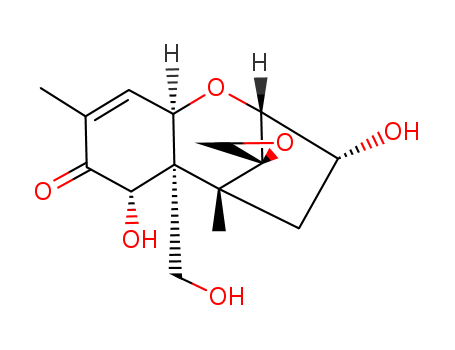
Chemical Property of Deoxynivalenol
Chemical Property:
- Vapor Pressure:4.26E-14mmHg at 25°C
- Melting Point:151-153 C
- Refractive Index:1.4359 (estimate)
- Boiling Point:543.9°Cat760mmHg
- PKA:11.91±0.70(Predicted)
- Flash Point:206.9°C
- PSA:99.52000
- Density:1.48g/cm3
- LogP:-0.83770
- Storage Temp.:2-8°C
- XLogP3:-0.7
- Hydrogen Bond Donor Count:3
- Hydrogen Bond Acceptor Count:6
- Rotatable Bond Count:1
- Exact Mass:296.12598835
- Heavy Atom Count:21
- Complexity:558
- Purity/Quality:
-
99%, *data from raw suppliers
Deoxynivalenol *data from reagent suppliers
Safty Information:
- Pictogram(s):
 T,
T, Xn,
Xn, F,
F, Xi
Xi
- Hazard Codes:T,Xn,F,Xi
- Statements:
25-68/20/21/22-67-66-36-20/21/22-11-36/37/38
- Safety Statements:
36/37/39-45-36-26-16-36/37-37/39
- MSDS Files:
-
SDS file from LookChem
Useful:
- Chemical Classes:Biological Agents -> Mycotoxins
- Canonical SMILES:CC1=CC2C(C(C1=O)O)(C3(CC(C(C34CO4)O2)O)C)CO
- Isomeric SMILES:CC1=C[C@@H]2[C@]([C@@H](C1=O)O)([C@]3(C[C@H]([C@H]([C@@]34CO4)O2)O)C)CO
-
Description
Vomitoxin or deoxynivalenol (DON) is one of the
trichothecenes (mycotoxins) which comprise a large
group (148 or more have been identified) of protein
synthesis inhibitors. These mycotoxins are also powerful
immunosuppressants which may predispose animals to
other diseases.
Vomitoxin is the most commonly found
trichothecene in moldy corn (maize), but a number of
other biologically active trichothecenes are produced by
species of the fungus Fusarium. These include nivalenol,
T-2 toxin, HT-2 toxin, diacetoxyscirpenol (DAS), and
monoacetoxyscipenol (MAS). These mycotoxins are most
toxic when fed to swine and other monogastric animals
including humans. Poultry are generally more resistant
to trichothecenes than hogs, whereas T-2 toxin and DAS
appear to be more toxic to chickens than vomitoxin. Toxins
already present in corn at harvest may increase in stored
ear corn. Extended periods of warm, rainy, or damp
weather from flowering time onward promote infection
of corn by Fusarium species (1–7). 4-deoxy Nivalenol is a trichothecene mycotoxin that has been found in Fusarium. It binds to eukaryotic ribosomes and inhibits protein synthesis in mice when administered at doses ranging from 5 to 25 mg/kg. 4-deoxy Nivalenol (0.1 and 0.2 mg/kg) induces emesis in pigs and decreases feed consumption in pigs when administered at a dose of 40 ppb in the diet. It induces lethality in mice (LD50 = 46-78 mg/kg). 4-deoxy Nivalenol has been found in F. graminearum-infected cereal grains such as wheat, barley, and corn.
-
Uses
Deoxynivalenol is a natural type B trichothecene produced by certain species of the fungus Fusarium, particularly those found on cereal crops, including wheat, barley, oats, maize, and rye. This mycotoxin can induce vomiting, diarrhea, and weight loss as well as other physiological and toxicological effects. It inhibits protein biosynthesis, binds to peptidyl transferase, and inhibits the synthesis of RNA and DNA, contributing to immunotoxicity. It passes the blood-brain barrier at different rates in different animals and this may be related to anorexia. Deoxynivalenol solution has been used as an analytical reference standard for the quantification of the analyte in cornmeal and wheat meal matrices using high-performance liquid chromatography with UV detection (HPLC-UV). It is used as an analytical standard in investigating its toxicity mechanism on human chondrocytes by microarray and bioinformatics analysis. Deoxynivalenol is a tricothecene mycotoxin and potent protein synthesis inhibitor. Deoxynivalenol exhibits cytotoxic activity in vivo via the ribotoxic stress response. Deoxynivalenol induces p38-mediated gene expression and apoptosis in leukocytes; activity results in systemic expression of interleukin-6 (IL-6) and other proinflammatory cytokines. Also induces migration of NF-κB into the nucleus.