Welcome to LookChem.com Sign In|Join Free
  • or

Encyclopedia

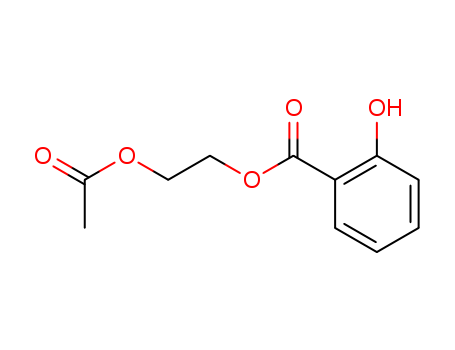
2-(acetoxy)ethyl salicylate

Base Information
  • Chemical Name:2-(acetoxy)ethyl salicylate
  • CAS No.:87-23-0
  • Molecular Formula:C11H12 O5
  • Molecular Weight:224.213
  • Hs Code.:2918230000
  • Mol file:87-23-0.mol
2-(acetoxy)ethyl salicylate

Synonyms:Salicylicacid, 2-hydroxyethyl ester, 1-acetate (8CI);1-Acetoxy-2-(2-hydroxybenzoxy)ethane; Acetyl Glycol Salicylate; Ethylene glycolacetate, salicylate

Suppliers and Price of 2-(acetoxy)ethyl salicylate
Supply Marketing:
Business phase:
The product has achieved commercial mass production*data from LookChem market partment
Manufacturers and distributors:
  • Manufacture/Brand
  • Chemicals and raw materials
  • Packaging
  • price
Total 7 raw suppliers
Chemical Property of 2-(acetoxy)ethyl salicylate
Chemical Property:
  • PSA:72.83000 
  • LogP:1.11210 
Purity/Quality:

99% *data from raw suppliers

Safty Information:
  • Pictogram(s):  
  • Hazard Codes: 
MSDS Files:

SDS file from LookChem

Useful:
Technology Process of 2-(acetoxy)ethyl salicylate

There total 2 articles about 2-(acetoxy)ethyl salicylate which guide to synthetic route it. The literature collected by LookChem mainly comes from the sharing of users and the free literature resources found by Internet computing technology. We keep the original model of the professional version of literature to make it easier and faster for users to retrieve and use. At the same time, we analyze and calculate the most feasible synthesis route with the highest yield for your reference as below:

synthetic route:
Guidance literature:
β-Oxyaethyl-acetylsalicylat, HCl, trock.Bzl.;
Refernces

PERICYCLIC TRANSFORMATIONS OF TETRACYCLO<8,2,1,02,903,8>TRIDECA-4,6,11-TRIENES, AND FORMATION OF DIHYDROSEMIBULLVALENES BY THERMAL INTRAMOLECULAR<?4a+?2a>CYCLOADDITION IN SUBSTITUTED CYCLOOCTATRIENES

10.1016/0040-4020(80)88028-8

The research focuses on the pericyclic transformations of tetracyclo[8,2,1,02'9]trideca-4,6,11-trienes, exploring the synthesis and properties of homologous and related polycyclic systems with unsaturated rings fused syn and anti to the cyclobutane moiety. The study aims to understand the thermal intramolecular [4+2] cycloaddition in substituted cyclooctatrienes, leading to the formation of dihydrosemibullvalene derivatives through a novel sequence involving cheletropic loss of carbon monoxide and electrocyclic ring opening. The conclusions drawn from the research highlight the potential for these compounds to undergo various pericyclic transformations, such as electrocyclic ring-opening and closure, and sigmatropic group transfer, which are competitive processes when steric inhibition is not severe.

Synthesis of cyclobutane lignans via an organic single electron oxidant-electron relay system

10.1039/c3sc50643f

The study presents a method for synthesizing cyclobutane lignans and their analogs using photoinduced electron transfer. Key chemicals include oxygenated alkenes, which are used to form terminal or substituted cyclobutane adducts with complete regiocontrol and trans stereochemistry. The aromatic electron relay (ER), such as anthracene or naphthalene, is crucial for minimizing competing cycloreversion. The photooxidant 2,4,6-tris(4-methoxyphenyl)pyrylium tetrafluoroborate (p-OMeTPT) is used to excite the system and facilitate the oxidation of the alkene substrate by the ER, which then forms a cation radical capable of oxidizing the alkene. This method has been successfully applied to synthesize natural products like magnosalin and pellucidin A. The study also explores the role of the ER in preventing cycloreversion and polymerization, highlighting its importance in achieving higher yields and selectivity in the cyclobutane synthesis.


Post a RFQ

Enter 15 to 2000 letters.Word count: 0 letters

Attach files(File Format: Jpeg, Jpg, Gif, Png, PDF, PPT, Zip, Rar,Word or Excel Maximum File Size: 3MB)

1 Customer Service

What can I do for you?
Get Best Price

Get Best Price for 87-23-0