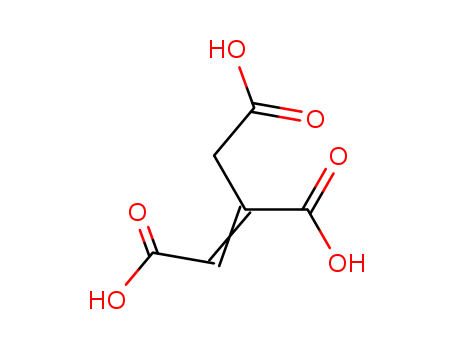
Chemical Property of Aconitic acid
Chemical Property:
- Vapor Pressure:3.29E-13mmHg at 25°C
- Melting Point:192°C (rough estimate)
- Refractive Index:1.57
- Boiling Point:542.6°C at 760 mmHg
- PKA:2.39±0.36(Predicted)
- Flash Point:296°C
- PSA:111.90000
- Density:1.66g/cm3
- LogP:-0.44330
- XLogP3:-1
- Hydrogen Bond Donor Count:3
- Hydrogen Bond Acceptor Count:6
- Rotatable Bond Count:4
- Exact Mass:174.01643791
- Heavy Atom Count:12
- Complexity:251
- Purity/Quality:
-
99% *data from raw suppliers
ACONITIC ACID 95.00% *data from reagent suppliers
Safty Information:
- Pictogram(s):
- Hazard Codes:
- MSDS Files:
-
SDS file from LookChem
Useful:
- Chemical Classes:Other Classes -> Organic Acids
- Canonical SMILES:C(C(=CC(=O)O)C(=O)O)C(=O)O
-
Description
Aconitic acid has pleasant, winey, acid taste; almost odorless. Aconitic acid of the trans-configuration can be isolated during the processing of sugarcane by precipitating it as the calcium salt from cane syrup or molasses. The concentration in molasses ranges from 1.8 to 2.5%. Aconitic acid may be synthesized from citric acid by dehydration with sulfuric acid or by catalytic dehydration. The cis-configuration is somewhat unstable and is readily rearranged to the trans form by heating. Trans-aconitic acid is decarboxylated to itaconic acid by heating to 180°F. The cis form occurs in plant and animal tissues as a metabolic intermediate in the Krebs cycle during the isomerization of citric acid to isocitric acid by the action of enzyme aconitase.
-
Uses
Aconitic Acid is a flavoring substance which occurs in the leaves and tubers of aconitum napellus l. And other ranunculaceae. Transaconitic acid can be isolated during sugar cane processing, by precipitation as the calcium salt from cane sugar or molasses. It may be synthesized by sulfuric acid dehydration of citric acid but not by the methanesulfonic acid method. It is used in a maximum level, as served, of 0.003% for baked goods, 0.002% for alcoholic beverages, 0.0015% for frozen dairy products, 0.0035% for soft candy, and 0.0005% or less for all other food categories.