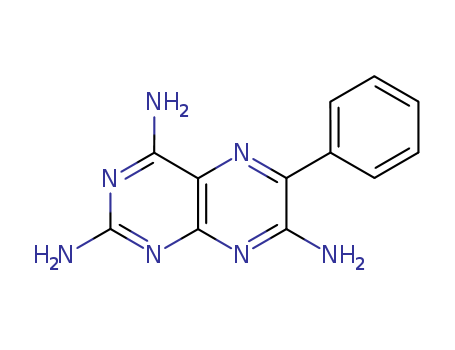
Chemical Property of Triamterene
Chemical Property:
- Appearance/Colour:Yellow solid
- Melting Point:316 °C
- Refractive Index:1.8260 (estimate)
- Boiling Point:573.4 °C at 760 mmHg
- PKA:6.2(at 25℃)
- Flash Point:335.5 °C
- PSA:129.62000
- Density:1.502 g/cm3
- LogP:2.57700
- Storage Temp.:2-8°C
- Solubility.:formic acid: soluble200 mg + 4 mL warm Formic Acid, clear, yello
- Water Solubility.:<0.1 g/100 mL at 20℃
- XLogP3:1
- Hydrogen Bond Donor Count:3
- Hydrogen Bond Acceptor Count:7
- Rotatable Bond Count:1
- Exact Mass:253.10759338
- Heavy Atom Count:19
- Complexity:307
- Purity/Quality:
-
99%, *data from raw suppliers
Triamterene *data from reagent suppliers
Safty Information:
- Pictogram(s):
 Xn,
Xn,  T,
T,  F
F
- Hazard Codes:Xn,T,F
- Statements:
22-36/37/38-36/38-23/25-39/23/24/25-23/24/25-11
- Safety Statements:
26-36/37/39-45-33-24-16-7-36/37
- MSDS Files:
-
SDS file from LookChem
Useful:
- Drug Classes:Diuretics
- Canonical SMILES:C1=CC=C(C=C1)C2=NC3=C(N=C(N=C3N=C2N)N)N
- Recent ClinicalTrials:Data Analysis for Drug Repurposing for Effective Alzheimer's Medicines (DREAM)- Amiloride vs Triamterene
-
Description
Triamterene is an inhibitor of the epithelial sodium channel (ENaC; IC50 = 4.5 μM for the rat channel). In vivo, triamterene (0.5-32 mg/animal) enhances sodium secretion and decreases potassium secretion in adrenalectomized rats. Formulations containing triamterene have been used in the treatment of edema. This product is also available as an analytical reference standard .
-
Uses
Triamterene is a potassium-sparing diuretic ie, it inhibits the urinary excretion of potassium Triamterene is a weak diuretic with potassium sparing properties; blocks Na+ reuptake in the kidneys. This drug is recommended in combination with other diuretics for treating edema
caused by usual reasons such as circulatory insufficiency, cirrhosis of the liver, and
nephrotic syndrome.
-
Therapeutic Function
Diuretic
-
Biological Functions
Triamterene (Dyrenium)
results in changes in urinary electrolyte
patterns that are qualitatively similar to those produced
by spironolactone. The mechanism by which this
agents bring about the alterations in electrolyte loss,
however, is quite different. Triamterene
produces this effects whether or not aldosterone or any
other mineralocorticoid is present. The action of this
drug is clearly unrelated to endogenous mineralocorticoid
activity, and this drug is effective in adrenalectomized
patients.
-
Clinical Use
Triamterene can be used in the treatment of congestive
heart failure, cirrhosis, and the edema caused by
secondary hyperaldosteronism. It is frequently used in
combination with other diuretics except spironolactone.
Amiloride, but not triamterene, possesses antihypertensive
effects that can add to those of the thiazides.
These K+-sparing diuretics have low efficacy when
used alone, since only a small amount of total Na reabsorption
occurs at more distal sites of the nephron.
These compounds are used primarily in combination
with other diuretics, such as the thiazides and loop diuretics,
to prevent or correct hypokalemia. The availability
of fixed-dose mixtures of thiazides with nonsteroidal
K+-sparing compounds has proved a rational
form of drug therapy. Both triamterene and amiloride
are available alone or in combination with hydrochlorothiazide.
-
Drug interactions
Potentially hazardous interactions with other drugs
ACE inhibitors and angiotensin-II antagonists:
enhanced hypotensive effect (risk of severe
hyperkalaemia).
Analgesics: increased risk of nephrotoxicity with
NSAIDs; increased risk of hyperkalaemia, especially
with indometacin; antagonism of hypotensive effect.
Antibacterials: avoid concomitant use with
lymecycline.
Antidepressants: enhanced hypotensive effect with
MAOIs; increased risk of postural hypotension with
tricyclics.
Antipsychotics: enhanced hypotensive effect with
phenothiazines.
Antihypertensives: enhanced hypotensive effect;
increased risk of first dose hypotensive effect of postsynaptic alpha-blockers, e.g. prazosin.
Ciclosporin: increased risk of hyperkalaemia.
Cytotoxics: increased risk of nephrotoxicity and
ototoxicity with platinum compounds.
Lithium: reduced excretion of lithium (risk of
lithium toxicity).
Potassium salts: increased risk of hyperkalaemia.
Tacrolimus: increased risk of hyperkalaemia.