Welcome to LookChem.com Sign In|Join Free
  • or

Encyclopedia

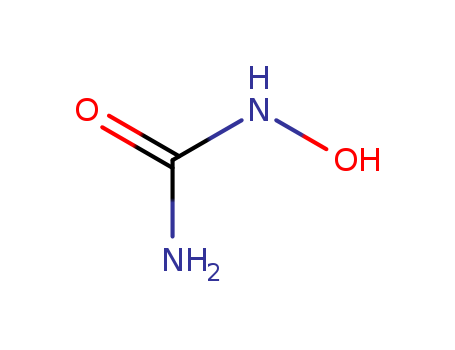
Hydroxyurea

Base Information
  • Chemical Name:Hydroxyurea
  • CAS No.:127-07-1
  • Molecular Formula:CH4N2O2
  • Molecular Weight:76.055
  • Hs Code.:29242100
  • European Community (EC) Number:204-821-7,232-439-0
  • NSC Number:757072,32065
  • UN Number:2811
  • UNII:X6Q56QN5QC
  • DSSTox Substance ID:DTXSID6025438
  • Nikkaji Number:J2.937H
  • Wikipedia:Hydroxycarbamide
  • Wikidata:Q212272
  • NCI Thesaurus Code:C560
  • RXCUI:5552
  • Pharos Ligand ID:YS9WPYDSAP5A
  • Metabolomics Workbench ID:43251
  • ChEMBL ID:CHEMBL467
  • Mol file:127-07-1.mol
Hydroxyurea

Synonyms:Urea,hydroxy- (6CI,8CI,9CI);Biosupressin;Carbamohydroxamic acid;Carbamohydroximicacid;Carbamoyl oxime;Droxia;Hydrea;Hydreia;Hydroxycarbamide;Hydroxylamine, N-(aminocarbonyl)-;Hydura;Hydurea;Onco-Carbide;Oxyrea;Oxyurea;

Suppliers and Price of Hydroxyurea
Supply Marketing:
Business phase:
The product has achieved commercial mass production*data from LookChem market partment
Manufacturers and distributors:
  • Manufacture/Brand
  • Chemicals and raw materials
  • Packaging
  • price
  • Usbiological
  • Hydroxyurea
  • 10g
  • $ 64.00
  • TRC
  • Hydroxyurea
  • 50mg
  • $ 65.00
  • TCI Chemical
  • Hydroxyurea >97.0%(N)
  • 25g
  • $ 260.00
  • TCI Chemical
  • Hydroxyurea >97.0%(N)
  • 5g
  • $ 91.00
  • Sigma-Aldrich
  • Hydroxyurea 98%, powder
  • 1g
  • $ 36.60
  • Sigma-Aldrich
  • Hydroxycarbamide European Pharmacopoeia (EP) Reference Standard
  • $ 190.00
  • Sigma-Aldrich
  • Hydroxycarbamide European Pharmacopoeia (EP) Reference Standard
  • y0000119
  • $ 190.00
  • Sigma-Aldrich
  • Hydroxyurea
  • 5gm
  • $ 101.00
  • Sigma-Aldrich
  • Hydroxyurea Pharmaceutical Secondary Standard; Certified Reference Material
  • 300MG
  • $ 129.00
  • Sigma-Aldrich
  • Hydroxyurea 98%, powder
  • 5g
  • $ 123.00
Total 199 raw suppliers
Chemical Property of Hydroxyurea
Chemical Property:
  • Appearance/Colour:off-white crystalline solid 
  • Melting Point:135-140 °C 
  • Refractive Index:1.543 
  • Boiling Point:136.04°C (rough estimate) 
  • PKA:10.56±0.23(Predicted) 
  • PSA:75.35000 
  • Density:1.457 g/cm3 
  • LogP:0.13510 
  • Storage Temp.:2-8°C 
  • Solubility.:H2O: 50 mg/mL 
  • Water Solubility.:soluble 
  • XLogP3:-1.8
  • Hydrogen Bond Donor Count:3
  • Hydrogen Bond Acceptor Count:2
  • Rotatable Bond Count:0
  • Exact Mass:76.027277375
  • Heavy Atom Count:5
  • Complexity:42.9
  • Transport DOT Label:Poison
Purity/Quality:

99% *data from raw suppliers

Hydroxyurea *data from reagent suppliers

Safty Information:
  • Pictogram(s): ToxicT,HarmfulXn 
  • Hazard Codes:T,Xn 
  • Statements: 46-63-61-40 
  • Safety Statements: 53-36/37-45-36-22 
MSDS Files:

SDS file from LookChem

Useful:
  • Drug Classes:Antineoplastic Agents; Sickle Cell Disease Agents
  • Canonical SMILES:C(=O)(N)NO
  • Recent ClinicalTrials:Promoting Utilization and Safety of Hydroxyurea Using Precision in Africa
  • Recent EU Clinical Trials:A multicentre trial evaluating the efficacy and safety of oral decitabine-tetrahydrouridine (NDec) in patients with sickle cell disease
  • Recent NIPH Clinical Trials:Phase 2 study of pretreatment with hydroxyurea prior to induction therapy for patients with newly diagnosed acute myeloid leukemia (PREFACE study)
  • Uses It belongs to anti-metabolic anti-cancer drugs with its major role in the proliferation of cells in G1 and S phase. It also had delayed effect on G1/S interface. It is a cell-specific drug. It can be applied to biochemical studies. Through the formation of free nitric oxide, it binds to the tyrosine of the enzyme active site, leaving the nucleoside reductase inactivated. This hampers the synthesis of deoxynucleotide. It is clinically used for the treatment of chronic myelogenous leukemia as well as being used to treat metastatic ovarian cancer, head and neck primary squamous cell carcinoma and intractable psoriasis. The good belongs to anticancer drugs. Hydroxyurea USP is used to treat Chronic granulocytic leukemia; melanoma; cancer of ovary, head, neck. An anti-neoplastic - inhibits ribonucleoside reductase and DNA replication. A potential therapy for sickle cell anemia which involves the nitrosylation of sickle cell hemoglobin. Horseradish peroxidase catalyzes nitric oxide formation from hydroxyurea in the presence of hydrogen peroxide. antineoplastic, inhibits ribonucleoside diphosphate reductase
  • Production method It is produced through the reaction between ethyl carbamate and hydroxylamine hydrochloride. The sodium hydroxide solution was cooled to 20-25 ℃. Add alternately under stirring of urethane and hydroxylamine hydrochloride and react at 25-28 ℃ for 16h. Use hydrochloric acid to neutralize to a pH of 6.5-7, control the temperature be not exceeding 25 ℃. Then apply concentration under reduced pressure, filtered hot and the filtrate was cooled to below 0 ℃ to precipitate our the crystal, filter, wash crystal with ice water, and dry to give crude hydroxyurea with the yield of about 65%. After refining, we can obtain pharmaceutical grade hydroxyurea.
  • Description Readily oxidized in vivo to free radical forms, which destroy the stable tyrosyl free radical of the metalloenzyme ribonucleotide reductase, suppressing deoxyribonucleotide production and blocking DNA synthesis and repair.1,2 Reduces cell proliferation, and causes S-phase arrest and death.3 Induces p53-dependent NF-κB target gene expression in U2OS cells expressing HA-RelA.4 Stimulates fetal hemoglobin production in vitro and in vivo.5 Allows for S phase enrichment of CHO cells with maintenance of viability for enhanced site-specific genome engineering.6 Anticancer and antiviral agent.
  • Indications Hydroxyurea (Hydrea) inhibits the enzyme ribonucleotide reductase and thus depletes intracellular pools of deoxyribonucleotides, resulting in a specific impairment of DNA synthesis. The drug therefore is an Sphase specific agent whose action results in an accumulation of cells in the late G1- and early S-phases of the cell cycle.
  • Therapeutic Function Cancer chemotherapy
  • Clinical Use Hydroxyurea is used for the rapid lowering of blood granulocyte counts in patients with chronic granulocytic leukemia. The drug also can be used as maintenance therapy for patients with the disease who have become resistant to busulfan. Only a small percentage of patients with other malignancies have had even brief remissions induced by hydroxyurea administration.
  • Drug interactions Potentially hazardous interactions with other drugs Antipsychotics: avoid with clozapine, increased risk of agranulocytosis. Antivirals: increased toxicity with didanosine and stavudine - avoid. Vaccines: risk of generalised infections - avoid.
Technology Process of Hydroxyurea

There total 34 articles about Hydroxyurea which guide to synthetic route it. The literature collected by LookChem mainly comes from the sharing of users and the free literature resources found by Internet computing technology. We keep the original model of the professional version of literature to make it easier and faster for users to retrieve and use. At the same time, we analyze and calculate the most feasible synthesis route with the highest yield for your reference as below:

synthetic route:
Guidance literature:
With ethanol;
Guidance literature:
With ethanol; at 20 ℃; for 15h;
Guidance literature:
With pyridine; hydrogenchloride; hydroxylamine hydrochloride; hydroxylamine; In tetrahydrofuran; ethanol; dichloromethane; water; toluene;
Refernces

Discovery of potential anti-inflammatory drugs: Diaryl-1,2,4-triazoles bearing N-hydroxyurea moiety as dual inhibitors of cyclooxygenase-2 and 5-lipoxygenase

10.1039/c3ob41936c

The research presented in the "Organic & Biomolecular Chemistry" paper focuses on the discovery of potential anti-inflammatory drugs, specifically diaryl-1,2,4-triazoles bearing an N-hydroxyurea moiety, which serve as dual inhibitors of cyclooxygenase-2 (COX-2) and 5-lipoxygenase (5-LOX). The study involves the synthesis and evaluation of a series of hybrid compounds derived from diaryl-1,2,4-triazole and hydroxamic acid or N-hydroxyurea, designed to act as novel anti-inflammatory agents. The synthesized compounds were biologically tested for their inhibitory activities against COX-2 and 5-LOX in vitro, with compound 15e showing optimal inhibitory activities. The selectivity of these compounds for COX-2 over COX-1 was also evaluated, with 15e demonstrating a selectivity index comparable to celecoxib. Additionally, the anti-inflammatory activity of selected compounds was assessed using xylene-induced ear edema in mice, albumen-induced paw edema in rats, and acetic acid-induced vascular permeability in mice models. The analgesic activity was evaluated using acetic acid-induced writhing response and hot-plate assays. Molecular modeling studies were conducted to understand the binding interactions of compound 15e with COX-2 and 5-LOX. The research suggests that compound 15e may be a promising anti-inflammatory agent for further evaluation. The reactants used in the synthesis include para-position substituted phenylhydrazine hydrochloride, ethyl 3-bromopropionate, hydroxylamine methanol solution, KOH, and various substituted phenyl rings, among others. The analyses involved high-performance liquid chromatography (HPLC), electrospray ionisation (ESI) mass spectrometry, infrared (IR) spectroscopy, and nuclear magnetic resonance (NMR) spectroscopy to determine the structures and purities of the synthesized compounds.

Synthetic methodology for the preparation of N-hydroxysulfamides

10.1016/j.tetlet.2007.09.037

The research presents a convenient synthetic methodology for preparing a variety of substituted N-hydroxysulfamides, which are structurally similar to N-hydroxyureas, N-hydroxysulfonamides, and sulfamides and exhibit a wide range of biological activity. The key starting material, N-Boc-sulfamoyl chloride, was prepared by reacting t-butanol with chlorosulfonylisocyanate (CSI). This intermediate was then reacted with several O-TBDMS protected hydroxylamines in the presence of triethylamine to form protected N-hydroxysulfamides. These protected sulfamides were further alkylated using Mitsunobu conditions or standard alkylation conditions with alkyl halides to introduce different alkyl groups on the nitrogen atoms. The final deprotection to the desired N-hydroxysulfamides was achieved using trifluoroacetic acid (TFA) and hydrochloric acid (HCl) in methanol. The methodology was extended to synthesize more complex targets such as bis-N-hydroxysulfamides and cyclic N-hydroxysulfamides. Chemicals such as t-butanol, chlorosulfonylisocyanate, O-TBDMS protected hydroxylamines, triethylamine, PPh3, DEAD, alkyl alcohols, alkyl halides, and TFA played crucial roles in the synthesis process.


Post a RFQ

Enter 15 to 2000 letters.Word count: 0 letters

Attach files(File Format: Jpeg, Jpg, Gif, Png, PDF, PPT, Zip, Rar,Word or Excel Maximum File Size: 3MB)

1 Customer Service

What can I do for you?
Get Best Price

Get Best Price for 127-07-1