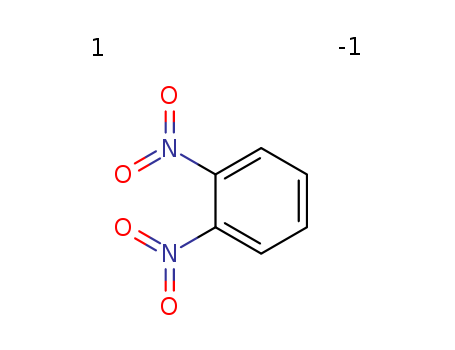
Chemical Property of 1,2-Dinitrobenzene
Chemical Property:
- Appearance/Colour:light yellow-brown powder
- Melting Point:116 °C
- Refractive Index:1.5650
- Boiling Point:319.9 °C at 760 mmHg
- Flash Point:169.2 °C
- PSA:91.64000
- Density:1.486 g/cm3
- LogP:2.54940
- Solubility.:chloroform: soluble5%, clear, yellow-green
- Water Solubility.:150 mg/L (20 ºC)
- XLogP3:1.7
- Hydrogen Bond Donor Count:0
- Hydrogen Bond Acceptor Count:4
- Rotatable Bond Count:0
- Exact Mass:168.01710661
- Heavy Atom Count:12
- Complexity:173
- Purity/Quality:
-
99% *data from raw suppliers
1,2-Dinitrobenzene *data from reagent suppliers
Safty Information:
- Pictogram(s):
 T+,
T+, N
N
- Hazard Codes:T+,N
- Statements:
26/27/28-33-50/53
- Safety Statements:
28-36/37-45-60-61-28A
- MSDS Files:
-
SDS file from LookChem
Useful:
- Chemical Classes:Nitrogen Compounds -> Nitros, Aromatic
- Canonical SMILES:C1=CC=C(C(=C1)[N+](=O)[O-])[N+](=O)[O-]
- Inhalation Risk:No indication can be given about the rate at which a harmful concentration of this substance in the air is reached on evaporation at 20 °C.
- Effects of Short Term Exposure:The substance is irritating to the eyes and respiratory tract. The substance may cause effects on the blood. This may result in the formation of methaemoglobin. The effects may be delayed. Medical observation is indicated.
- Effects of Long Term Exposure:The substance may have effects on the liver. This may result in liver impairment. The substance may have effects on the blood. This may result in anaemia.
-
Uses
1,2-Dinitrobenzene was used as internal standard for analysis of the explosives, TNT, RDX, and tetryl in sea water by vapor phase chromatography with the nickel-63 electron capture detector.