Welcome to LookChem.com Sign In|Join Free
  • or

Encyclopedia

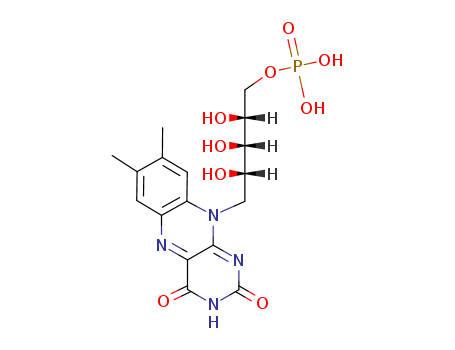
Flavin mononucleotide

Base Information
  • Chemical Name:Flavin mononucleotide
  • CAS No.:146-17-8
  • Molecular Formula:C17H21 N4 O9 P
  • Molecular Weight:456.349
  • Hs Code.:HOSPHATE SODIUM PRODUCT IDENTIFICATION
  • European Community (EC) Number:205-664-7
  • UNII:7N464URE7E
  • DSSTox Substance ID:DTXSID8023559
  • Nikkaji Number:J30.175B
  • Wikipedia:Flavin_mononucleotide
  • Wikidata:Q376061
  • NCI Thesaurus Code:C61925
  • RXCUI:1925821
  • Metabolomics Workbench ID:37845
  • ChEMBL ID:CHEMBL1201794
  • Mol file:146-17-8.mol
Flavin mononucleotide

Synonyms:5'-Monophosphate, Riboflavin;5'-Phosphate, Riboflavin;Flavin Mononucleotide;Flavin Mononucleotide Disodium Salt;Flavin Mononucleotide Monosodium Salt;Flavin Mononucleotide Monosodium Salt, Dihydrate;Flavin Mononucleotide Sodium Salt;FMN;Mononucleotide, Flavin;Mononucleotide, Riboflavin;Phosphate, Sodium Riboflavin;Riboflavin 5' Monophosphate;Riboflavin 5' Phosphate;Riboflavin 5'-Monophosphate;Riboflavin 5'-Phosphate;Riboflavin Mononucleotide;Riboflavin Phosphate, Sodium;Sodium Riboflavin Phosphate

Suppliers and Price of Flavin mononucleotide
Supply Marketing:
Business phase:
The product has achieved commercial mass production*data from LookChem market partment
Manufacturers and distributors:
  • Manufacture/Brand
  • Chemicals and raw materials
  • Packaging
  • price
Total 76 raw suppliers
Chemical Property of Flavin mononucleotide
Chemical Property:
  • Appearance/Colour:yellow to orange crystalline powder 
  • Melting Point:195 °C 
  • Boiling Point:°Cat760mmHg 
  • PKA:1.84±0.10(Predicted) 
  • Flash Point:°C 
  • PSA:217.90000 
  • Density:1.83g/cm3 
  • LogP:-1.55820 
  • XLogP3:-2.6
  • Hydrogen Bond Donor Count:6
  • Hydrogen Bond Acceptor Count:10
  • Rotatable Bond Count:7
  • Exact Mass:456.10461526
  • Heavy Atom Count:31
  • Complexity:844
Purity/Quality:

99%, *data from raw suppliers

Safty Information:
  • Pictogram(s): Not regulated UN NO. 
  • Hazard Codes:Not regulated UN NO. 
MSDS Files:

SDS file from LookChem

Useful:
  • Chemical Classes:Biological Agents -> Vitamins and Derivatives
  • Canonical SMILES:CC1=CC2=C(C=C1C)N(C3=NC(=O)NC(=O)C3=N2)CC(C(C(COP(=O)(O)O)O)O)O
  • Isomeric SMILES:CC1=CC2=C(C=C1C)N(C3=NC(=O)NC(=O)C3=N2)C[C@@H]([C@@H]([C@@H](COP(=O)(O)O)O)O)O
  • Recent ClinicalTrials:Epi-On Corneal Crosslinking for Keratoconus
  • Recent EU Clinical Trials:'Randomized clinical trial with two parallel groups, double-blind, placebo-controlled trial to investigate whether administration of CBG000592 (riboflavin/vitamin B2) in patients with acute ischemic stroke causes a reduction of glutamate-mediated excitotoxicity'
  • Uses One of the bioactive forms of Riboflavin. Nutritional factor found in milk, eggs, malted barley, liver, kidney, heart, leafy vegetables. Richest natural source is yeast. Minute amounts present in all plant and animal cells. Vitamin (enzyme cofactor) Riboflavine 5’-Phosphate is an intermediate in the synthesis of Riboflavin-4''-phosphate (R415010), a phosphate ester of Riboflavin (R414995) which is a nutritional factor found in milk, eggs, malted barley, liver, kidney, heart, leafy vegetables. Richest natural source is yeast. Minute amounts present in all plant and animal cells. Vitamin (enzyme cofactor).
Technology Process of Flavin mononucleotide

There total 24 articles about Flavin mononucleotide which guide to synthetic route it. The literature collected by LookChem mainly comes from the sharing of users and the free literature resources found by Internet computing technology. We keep the original model of the professional version of literature to make it easier and faster for users to retrieve and use. At the same time, we analyze and calculate the most feasible synthesis route with the highest yield for your reference as below:

synthetic route:
Refernces

Facile oxidation of leucomethylene blue and dihydroflavins by artemisinins: Relationship with flavoenzyme function and antimalarial mechanism of action

10.1002/cmdc.201000225

The research investigates the interaction between artemisinins, a class of compounds derived from the plant Artemisia annua and used in the treatment of malaria, and redox-active substrates such as leucomethylene blue and dihydroflavins. The study aims to understand the molecular mechanism by which artemisinins exert their antimalarial effects, particularly their ability to generate reactive oxygen species (ROS) and interfere with the redox balance within the malaria parasite. The researchers found that artemisinins can act as both one-electron transfer agents and two-electron acceptors, potentially disrupting the function of flavin cofactors in redox-active enzymes within the parasite. The chemicals used in the study include artemisinins, methylene blue, ascorbic acid, N-benzyldihydronicotinamide (BNAH), riboflavin, flavin mononucleotide (FMN), and flavin adenine dinucleotide (FAD), among others. The conclusions suggest that artemisinins may act as antimalarial drugs by perturbing the redox balance within the malaria parasite, and their selective potency may be due to differences in sensitivity between parasite and human glutathione reductase. This research provides insights into the potential mechanisms of artemisinin resistance in malaria parasites and could inform the development of new antimalarial drugs.

Post a RFQ

Enter 15 to 2000 letters.Word count: 0 letters

Attach files(File Format: Jpeg, Jpg, Gif, Png, PDF, PPT, Zip, Rar,Word or Excel Maximum File Size: 3MB)

1 Customer Service

What can I do for you?
Get Best Price

Get Best Price for 146-17-8