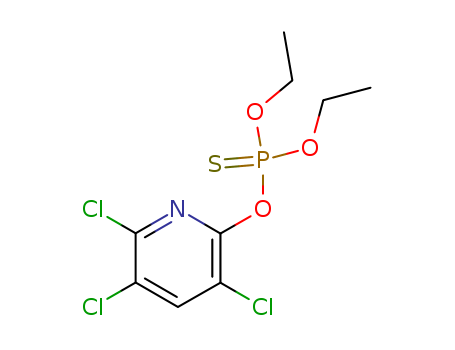
Chemical Property of Chlorpyrifos
Chemical Property:
- Appearance/Colour:White granular crystals
- Vapor Pressure:4.09E-06mmHg at 25°C
- Melting Point:42-44 °C
- Refractive Index:1.56
- Boiling Point:375.9 °C at 760 mmHg
- PKA:-5.28±0.10(Predicted)
- Flash Point:181.1 °C
- PSA:82.48000
- Density:1.48 g/cm3
- LogP:5.36870
- Storage Temp.:APPROX 4°C
- Solubility.:(At 25 °): 6.5, 7.9, 6.3, and 0.45 kg/kg in acetone, benzene, chloroform, and methanol, respectively
(Worthing and Hance, 1991)
- Water Solubility.:Insoluble. 0.00013 g/100 mL
- XLogP3:5.3
- Hydrogen Bond Donor Count:0
- Hydrogen Bond Acceptor Count:5
- Rotatable Bond Count:6
- Exact Mass:348.926284
- Heavy Atom Count:18
- Complexity:303
- Transport DOT Label:Poison
- Purity/Quality:
-
97% *data from raw suppliers
Chlorpyrifos *data from reagent suppliers
Safty Information:
- Pictogram(s):
 T,
T, N
N
- Hazard Codes:T;N,N,T,Xn,F,Xi
- Statements:
25-50/53-36-20/21/22-11-38
- Safety Statements:
1/2-45-60-61-36/37-26-16
- MSDS Files:
-
SDS file from LookChem
Total 1 MSDS from other Authors
Useful:
- Chemical Classes:Pesticides -> Organophosphate Insecticides
- Canonical SMILES:CCOP(=S)(OCC)OC1=NC(=C(C=C1Cl)Cl)Cl
- Inhalation Risk:A harmful concentration of airborne particles can be reached quickly on spraying or when dispersed, especially if powdered.
- Effects of Short Term Exposure:The substance may cause effects on the nervous system by a cholinesterase inhibiting effect. Exposure far above the OEL could cause death. The effects may be delayed. Medical observation is indicated.
- Effects of Long Term Exposure:Cholinesterase inhibition. Cumulative effects are possible. See Acute Hazards/Symptoms.
-
Description
Chlorpyrifos is a kind of crystalline organophosphate insecticide, acaricide and miticide used primarily for the control of foliage and soil-borne insect pests in many kinds of food and feed crops. Chlorpyrifos is widely used around the world to control pest insects in agricultural, residential and commercial settings. Its largest usage amount is consumed in corn. It can also be used on other crops or vegetables including soybeans, fruit and nut trees, cranberries, broccoli, and cauliflower. The non-agricultural applications include golf courses, turf, green houses, and no-structural wood treatment. It can also be used as a mosquito adulticide, and used in roach and anti bait stations in child resistant packaging. Its mechanism of action is through suppressing the nervous system of insects via inhibiting acetylcholinesterase. Chlorpyrifos is a chlorinated organophosphorus (OP) ester
manufactured as an insecticide, acaricide, and miticide. Like the
other OP insecticides, the most prominent toxicity of chlorpyrifos
is associated with binding and inhibition of the enzyme
acetylcholinesterase (AChE) in insects and mammals. Chlorpyrifos
requires metabolic activation to chlorpyrifos oxon to
yield anticholinesterase activity.First sold in 1965, chlorpyrifos is used globally to control
agricultural and structural pests and mosquitos. In the 1990s,
chlorpyrifos ranked as one of the top selling pesticides in the
world, for the most part, replacing the persistent organochlorine
insecticides. Over the last decade, concerns regarding
toxicity to the developing nervous system have limited its use.
By 2001, residential uses and uses in schools and parks were
prohibited, and many agricultural uses were restricted and the
US Residential use limitations were also imposed in Canada,
Australia, and the European Union (EU). It continues to be
used in large quantities to control crop damage worldwide. In the developing countries, excessive agricultural application
and lack of protective devices result in hundreds of thousands
of deaths yearly. Chlorpyrifos is an organophosphate insecticide. It is lethal to A. melinus, G. ashmeadi, E. eremicus, and E. formosa adults (LC50s = 0.8, 6, 12, and 17 ng/ml, respectively). Chlorpyrifos induces mortality in O. insidiosus adults when applied to corn, sorghum, and alfalfa plants. It is toxic to mice (LD50 = 155 mg/kg). Postnatal day 11 to 14 exposure to chlorpyrifos (3 mg/kg) decreases nest building and defense behaviors in adult female mice. Formulations containing chlorpyrifos have been used in the control of insects in agriculture.
-
Uses
Chlorpyrifos is a broad-spectrum organophosphate insecticide sold under the trade names of Dursban, Empire 20, Equity, and Whitmire PT 270. First registered in 1965 to control foliage- and soil-borne insect pests on a variety of food and feed crops, it is one of the most widely used and one of the major insecticides used residentially (U.S. EPA, 2000). Chlorpyrifos belongs to a class of insecticides known as organophosphates. Technical chlorpyrifos is amber to white crystalline solid with a mild sulphur odour. Formulations of chlorpyrifos include emulsifiable concentrate, dust, granular wettable powder, microcapsule, pellet, and sprays. Chlorpyrifos is widely used as an active ingredient in many commercial insecticides such as Dursban and Lorsban to control household pests, mosquitoes, and pests in animal houses. The U.S. EPA classified chlorpyrifos as GUP. Chlorpyrifos is an organophosphorus insecticide used to control insects on a wide
variety of crops including fruits, vegetables, ornamentals and forestry Chlorpyrifos is used to control many types of insect pests in a wide
range of crops and ornamentals. It is also used to control household pests,
including termites.
-
Physical properties
Chlorpyrifos is a white crystalline or irregularly flaked solid. Chlorpyrifos has a very faint mercaptan-type odor. Chlorpyrifos is not soluble in water. Chlorpyrifos can cause slight irritation to the eye and skin.