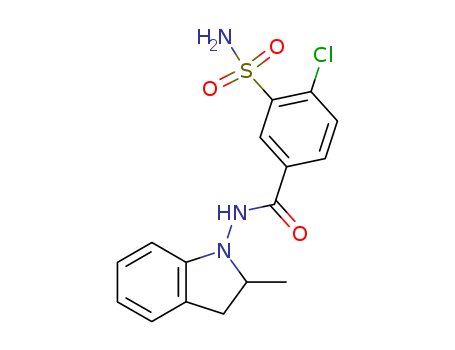
Chemical Property of Indapamide
Chemical Property:
- Appearance/Colour:Crystalline solid
- Melting Point:160-162 °C
- Refractive Index:1.693
- Boiling Point:110.4°C (rough estimate)
- PKA:pKa (25°) 8.8 ± 0.2
- PSA:100.88000
- Density:1.51 g/cm3
- LogP:4.32040
- Storage Temp.:-20°C Freezer
- Solubility.:Practically insoluble in water, soluble in ethanol (96 per cent).
- Water Solubility.:Soluble in ethanol. Insoluble in water
- XLogP3:2.9
- Hydrogen Bond Donor Count:2
- Hydrogen Bond Acceptor Count:5
- Rotatable Bond Count:3
- Exact Mass:365.0600902
- Heavy Atom Count:24
- Complexity:580
- Purity/Quality:
-
99%, *data from raw suppliers
racIndapamide *data from reagent suppliers
Safty Information:
- Pictogram(s):
- Hazard Codes:
- MSDS Files:
-
SDS file from LookChem
Useful:
- Canonical SMILES:CC1CC2=CC=CC=C2N1NC(=O)C3=CC(=C(C=C3)Cl)S(=O)(=O)N
- Recent ClinicalTrials:Zilebesiran as Add-on Therapy in Patients With Hypertension Not Adequately Controlled by a Standard of Care Antihypertensive Medication (KARDIA-2)
- Recent EU Clinical Trials:Evaluation of the clinical efficacy and safety of perindopril 10 mg/indapamide 2.5 mg/amlodipine 5 or 10 mg/bisoprolol 5 mg in single-pill combination after 8 weeks of treatment versus the free combination of perindopril 10 mg, indapamide 2.5 mg and amlodipine 5 or 10 mg in patients with uncontrolled essential hypertension. An international, multicentre, randomised, double-blind, 16-week study.
- Recent NIPH Clinical Trials:Effects of the combination therapy of irbesartan and indapamide in chronik kidney disease with hypertension
-
Uses
For the treatment of mild to moderate essential hypertension. Used as an antihypertensive. Diuretic diuretic, antihypertensive Used as an antihypertensive. Diuretic.
-
Description
Indapamide is a derivative of benzolsulfonamide and its mechanism of action is analogous to
that of thiazides. It is intended for lowering arterial blood pressure and as an adjuvant drug for
treating edema caused by cardiac insufficiency. Indapamide (Item No. 21308) is an analytical reference standard that is categorized as a sulfonamide diuretic that blocks delayed-rectifier potassium currents. Formulations containing indapamide are used to treat hypertension, but it is abused by athletes to reduce body weight rapidly or mask the presence of other athletic-enhancing substances. Indapamide can be detected in urine. This product is intended for research and forensic applications.
-
Therapeutic Function
Diuretic Indapamide
-
Clinical Use
Indapamide is an effective
diuretic drug when GFR falls below 40 mL/min. The duration of action is approximately 24 hours, with the normal oral adult dosage starting at 2.5 mg given each morning.
The dose may be increased to 5.0 mg/day, but doses beyond this level do not appear to provide additional results.
-
Drug interactions
Potentially hazardous interactions with other drugs
Analgesics: increased risk of nephrotoxicity with
NSAIDs; antagonism of diuretic effect.
Anti-arrhythmics: hypokalaemia leads to increased
cardiac toxicity; effects of lidocaine and mexiletine
antagonised.
Antibacterials: avoid administration with
lymecycline.
Antidepressants: increased risk of hypokalaemia
with reboxetine; enhanced hypotensive effect with
MAOIs; increased risk of postural hypotension with
tricyclics.
Antiepileptics: increased risk of hyponatraemia with
carbamazepine.
Antifungals: increased risk of hypokalaemia with
amphotericin.
Antihypertensives: enhanced hypotensive effect;
increased risk of first dose hypotension with postsynaptic
alpha-blockers like prazosin; hypokalaemia
increases risk of ventricular arrhythmias with sotalol.
Antipsychotics: hypokalaemia increases risk
of ventricular arrhythmias with amisulpride;
enhanced hypotensive effect with phenothiazines;
hypokalaemia increases risk of ventricular
arrhythmias with pimozide - avoid.
Atomoxetine: hypokalaemia increases risk of
ventricular arrhythmias.
Cardiac glycosides: increased toxicity if hypokalaemia
occurs.
Ciclosporin: increased risk of nephrotoxicity and
possibly hypomagnesaemia.
Cytotoxics: increased risk of ventricular arrhythmias
due to hypokalaemia with arsenic trioxide; increased
risk of nephrotoxicity and ototoxicity with platinum
compounds.
Lithium excretion reduced (increased toxicity).