Welcome to LookChem.com Sign In|Join Free
  • or

Encyclopedia

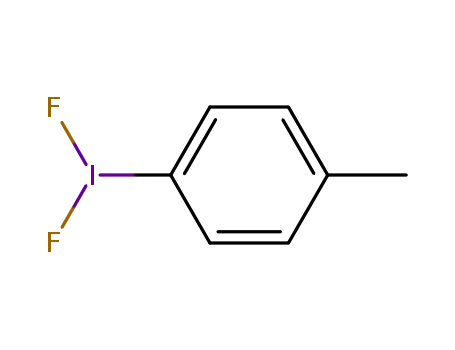
Difluoroiodotoluene

Base Information
  • Chemical Name:Difluoroiodotoluene
  • CAS No.:371-11-9
  • Molecular Formula:C7H7 F2 I
  • Molecular Weight:256.034
  • Hs Code.:
  • European Community (EC) Number:689-018-3
  • UNII:3R9W1C8C84
  • Nikkaji Number:J1.189.573E
  • Wikidata:Q27257935
  • Mol file:371-11-9.mol
Difluoroiodotoluene

Synonyms:371-11-9;p-(Difluoroiodo)toluene;Difluoroiodotoluene;4-IODOTOLUENE DIFLUORIDE;Difluoroiodotoluene [MI];Difluoro(4-methylphenyl)iodine;4-Methyl-1-(difluoroiodo)benzene;Benzene, 1-(difluoriodo)-4-methyl-;difluoro-(4-methylphenyl)-lambda3-iodane;3R9W1C8C84;p-iodotoluene difluoride;UNII-3R9W1C8C84;1-(Difluoriodo)-4-methylbenzene;Iodine, difluoro(4-methylphenyl)-;SCHEMBL582973;AKOS007929934;difluoro(4-methylphenyl)-lambda3-iodane;CS-0179659;EN300-299836;Q27257935

Suppliers and Price of Difluoroiodotoluene
Supply Marketing:
Business phase:
The product has achieved commercial mass production*data from LookChem market partment
Manufacturers and distributors:
  • Manufacture/Brand
  • Chemicals and raw materials
  • Packaging
  • price
  • American Custom Chemicals Corporation
  • 4-IODOTOLUENE DIFLUORIDE 95.00%
  • 100G
  • $ 5214.83
  • American Custom Chemicals Corporation
  • 4-IODOTOLUENE DIFLUORIDE 95.00%
  • 1G
  • $ 1514.83
Total 53 raw suppliers
Chemical Property of Difluoroiodotoluene
Chemical Property:
  • Melting Point:102-106 °C 
  • PSA:0.00000 
  • LogP:3.44000 
  • XLogP3:4
  • Hydrogen Bond Donor Count:0
  • Hydrogen Bond Acceptor Count:2
  • Rotatable Bond Count:0
  • Exact Mass:255.95605
  • Heavy Atom Count:10
  • Complexity:97.8
Purity/Quality:

97% *data from raw suppliers

4-IODOTOLUENE DIFLUORIDE 95.00% *data from reagent suppliers

Safty Information:
  • Pictogram(s):  
  • Hazard Codes:
  • Statements: 34 
  • Safety Statements: 26-36/37/39-45 
MSDS Files:

SDS file from LookChem

Useful:
  • Canonical SMILES:CC1=CC=C(C=C1)I(F)F
  • General Description 4-Iodotoluene difluoride (DFIT) is a hypervalent iodine reagent that serves as an efficient fluorinating agent and oxidant in organic synthesis. It facilitates the generation of electrophilic phenylselenium species when combined with diphenyldiselenide, enabling the phenylselenofluorination of alkenes and internal alkynes with high stereo- and regioselectivity. DFIT is particularly useful for mild and selective fluorination reactions, though its effectiveness varies with substrate type, as terminal alkynes only undergo selenation rather than fluoroselenation. This reagent expands synthetic strategies for incorporating fluorine into organic frameworks, making it valuable for constructing bioactive molecules and complex natural products.
Technology Process of Difluoroiodotoluene

There total 8 articles about Difluoroiodotoluene which guide to synthetic route it. The literature collected by LookChem mainly comes from the sharing of users and the free literature resources found by Internet computing technology. We keep the original model of the professional version of literature to make it easier and faster for users to retrieve and use. At the same time, we analyze and calculate the most feasible synthesis route with the highest yield for your reference as below:

synthetic route:
Guidance literature:
With hydrogen fluoride; In dichloromethane; at 20 ℃; for 0.5h;
DOI:10.1002/ejoc.200400659
Guidance literature:
With Selectfluor; triethylamine tris(hydrogen fluoride); In [D3]acetonitrile; at 20 ℃; for 22h; Reagent/catalyst; Concentration; Schlenk technique; Inert atmosphere; Darkness;
DOI:10.1021/acs.joc.7b01671
Guidance literature:
With hydrogen fluoride; mercury(II) oxide; In dichloromethane; for 2h;
DOI:10.1039/b209079a
Refernces

Phenylselenofluorination of alkenes and alkynes promoted by difluoroiodotoluene and diphenyldiselenide

10.1055/s-2004-832827

The study explores a phenylselenofluorination method for alkenes and alkynes using difluoroiodotoluene (DFIT) and diphenyldiselenide (PhSeSePh). DFIT, acting as a fluorinating agent, oxidizes PhSeSePh to generate an electrophilic phenylselenium species in situ. This species then reacts with alkenes and internal alkynes to form phenylselenofluorinated products. The method is efficient and mild, achieving high stereo- and regioselectivity. Various alkenes and internal alkynes were successfully transformed into the desired products, with yields ranging from 58% to 92%. Terminal alkynes, however, only underwent hydrogen substitution by the PhSe group, indicating that their reactivity is independent of the hypervalent iodine structure used. The study demonstrates a promising approach for introducing fluorine atoms into organic molecules, with potential applications in the synthesis of complex natural products and bioactive compounds.

Post a RFQ

Enter 15 to 2000 letters.Word count: 0 letters

Attach files(File Format: Jpeg, Jpg, Gif, Png, PDF, PPT, Zip, Rar,Word or Excel Maximum File Size: 3MB)

1 Customer Service

What can I do for you?
Get Best Price

Get Best Price for 371-11-9