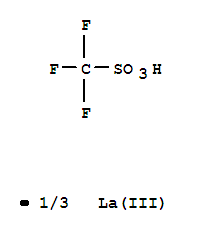
Base Information
- Chemical Name:CID 16212794
- CAS No.:52093-26-2
- Molecular Formula:C3F9LaO9S3
- Molecular Weight:586.11
- Hs Code.:28469099
- Mol file:52093-26-2.mol
Synonyms:SCHEMBL160029
Synonyms:SCHEMBL160029
99%, *data from raw suppliers
Lanthanum(III) Trifluoromethanesulfonate *data from reagent suppliers
 Xi
Xi
The study presents an efficient method for the formation of para-methoxybenzyl (PMB) ethers using trichloroacetimidate of PMB alcohol and lanthanum triflate. The PMB group is widely used as a protecting group for alcohols due to its robustness under various chemical conditions. The authors explored different catalysts and solvents to find milder conditions for the protection of alcohols, especially those sensitive to basic conditions. They discovered that lanthanum triflate, among other metal triflates, is highly effective in catalyzing the formation of PMB ethers, allowing for high yields and short reaction times. The study tested various alcohols, including α-hydroxy ketones, glucose derivatives, and acid-sensitive epoxy alcohols, demonstrating the versatility and mildness of the method. The use of lanthanum triflate enabled the protection of even sensitive substrates under low-temperature conditions, highlighting its potential for practical applications in organic synthesis.
The research focuses on the synthesis and cytotoxic potency of novel tris(1-alkylindol-3-yl)methylium salts. The study demonstrates an easy substitution of indole rings in trisindolylmethanes for other indoles under the action of acids and discusses the mechanism of substitution. An environmentally safe method of oxidation of trisindolylmethanes with air oxygen in acidic conditions was developed to obtain trisindolylmethylium salts. The cytotoxicity of the novel compounds increased with the number of carbon atoms in the alkyl chains, with optimal potency observed for compounds with 3–5 carbon atoms. The most potent compounds killed human tumor cells at nanomolar-to-submicromolar concentrations, being significantly more potent than the prototype antibiotic turbomycin A. Key chemicals involved in the research include tris(indol-3-yl)methanes, tris(indol-3-yl)methylium salts, N-alkylindol-3-carboxaldehydes, N-substituted indoles, acetic acid, La(OTf)3, Dy(OTf)3, methanesulfonic acid, and various other reagents used for synthesis and biological testing. The study concludes that N-alkyl substituted tris(1-alkylindol-3-yl)methylium salts are promising candidates for further development as anticancer drugs.

What can I do for you?
Get Best Price

Total 8 Pictures about this product