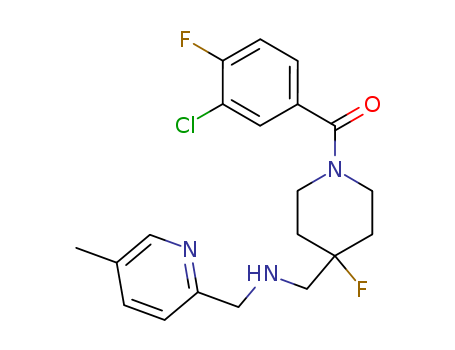
Chemical Property of Befiradol
Chemical Property:
- Boiling Point:536.9±50.0 °C(Predicted)
- PKA:8.01±0.20(Predicted)
- PSA:45.23000
- Density:1.30
- LogP:4.24540
- XLogP3:3.2
- Hydrogen Bond Donor Count:1
- Hydrogen Bond Acceptor Count:5
- Rotatable Bond Count:5
- Exact Mass:393.1419464
- Heavy Atom Count:27
- Complexity:502
- Purity/Quality:
-
99%, *data from raw suppliers
NLX-112hydrochloride ≥98%(HPLC) *data from reagent suppliers
Safty Information:
- Pictogram(s):
- Hazard Codes:
- MSDS Files:
-
SDS file from LookChem
Useful:
- Canonical SMILES:CC1=CN=C(C=C1)CNCC2(CCN(CC2)C(=O)C3=CC(=C(C=C3)F)Cl)F
- Recent ClinicalTrials:Study to Assess the Safety, Tolerability and Preliminary Efficacy of NLX-112 Versus Placebo in L-dopa-induced Dyskinesia
- Recent EU Clinical Trials:A Randomized, Double-blind, Placebo-controlled Study to Assess the Safety, Tolerability and Preliminary Efficacy of NLX-112 versus Placebo in Levodopa-induced Dyskinesia in Parkinson’s Disease
-
Use Description
Befiradol, a selective serotonin 5-HT1A receptor agonist, has specific applications primarily in the field of pharmaceuticals and neuroscience. In the realm of pharmacology and neurology, befiradol is of interest for its potential as a medication in the treatment of various psychiatric and neurological disorders. Its role is pivotal in targeting the serotonin system in the brain, which plays a crucial role in mood regulation and anxiety management. Research on befiradol explores its potential as an antidepressant and anxiolytic, offering a novel approach to addressing conditions like major depressive disorder and generalized anxiety disorder. While its primary applications are centered around mental health, its utility underscores its significance in advancing our understanding of the brain's serotonin receptors and their role in psychiatric illnesses, where it plays a vital role in potential therapeutic interventions and neuroscientific research.