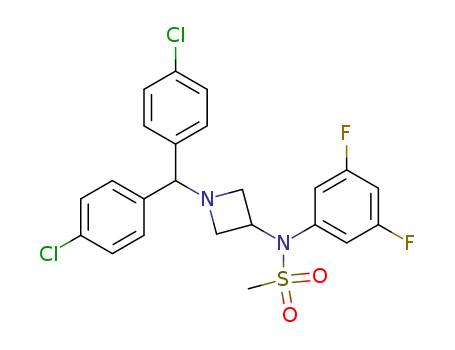
Chemical Property of Drinabant
Chemical Property:
- Boiling Point:581.7±60.0 °C(Predicted)
- PKA:5.44±0.10(Predicted)
- PSA:49.00000
- Density:1.458
- LogP:6.53010
- Solubility.:≤0.15mg/ml in ethanol;15mg/ml in DMSO;15mg/ml in dimethyl formamide
- XLogP3:5.6
- Hydrogen Bond Donor Count:0
- Hydrogen Bond Acceptor Count:6
- Rotatable Bond Count:6
- Exact Mass:496.0590608
- Heavy Atom Count:32
- Complexity:686
- Purity/Quality:
-
98%Min *data from raw suppliers
AVE-1625 *data from reagent suppliers
Safty Information:
- Pictogram(s):
- Hazard Codes:
- MSDS Files:
-
SDS file from LookChem
Useful:
- Canonical SMILES:CS(=O)(=O)N(C1CN(C1)C(C2=CC=C(C=C2)Cl)C3=CC=C(C=C3)Cl)C4=CC(=CC(=C4)F)F
- Recent ClinicalTrials:Efficacy and Safety of AVE1625 as a Co-treatment With Antipsychotic Therapy in Schizophrenia
- Recent EU Clinical Trials:A double-blind placebo-controlled study of the activity of AVE1625 at doses of 10 mg and 40mg for 12 weeks in patients with mild to moderate Alzheimer's Disease
-
Description
The central cannabinoid (CB1) receptor is a G protein-coupled receptor that is widely distributed in the central nervous system and several peripheral tissues and binds the active component of cannabis, Δ9-tetrahydrocannabinol. Signaling through the CB1 receptor is implicated in attentional and working memory deficits as well as obesity. AVE-1625 is a highly potent, selective antagonist for the CB1 receptor with Ki values of 0.16-0.44 nM. At 1-3 mg/kg, AVE-1625 significantly improves the performance of rodents in working memory tasks. At 30 mg/kg, AVE-1625 reduces caloric intake by more than 50% of controls and significantly increases lipolysis from fat tissues and reduces hepatic glycogen levels in rodents.
-
Uses
AVE-1625 is a selective antagonist for the CB1 receptor.